
Introduction
Without leaps of imagination, or dreaming, we lose the excitement of what is possible. Dreaming is, after all, a form of planning.
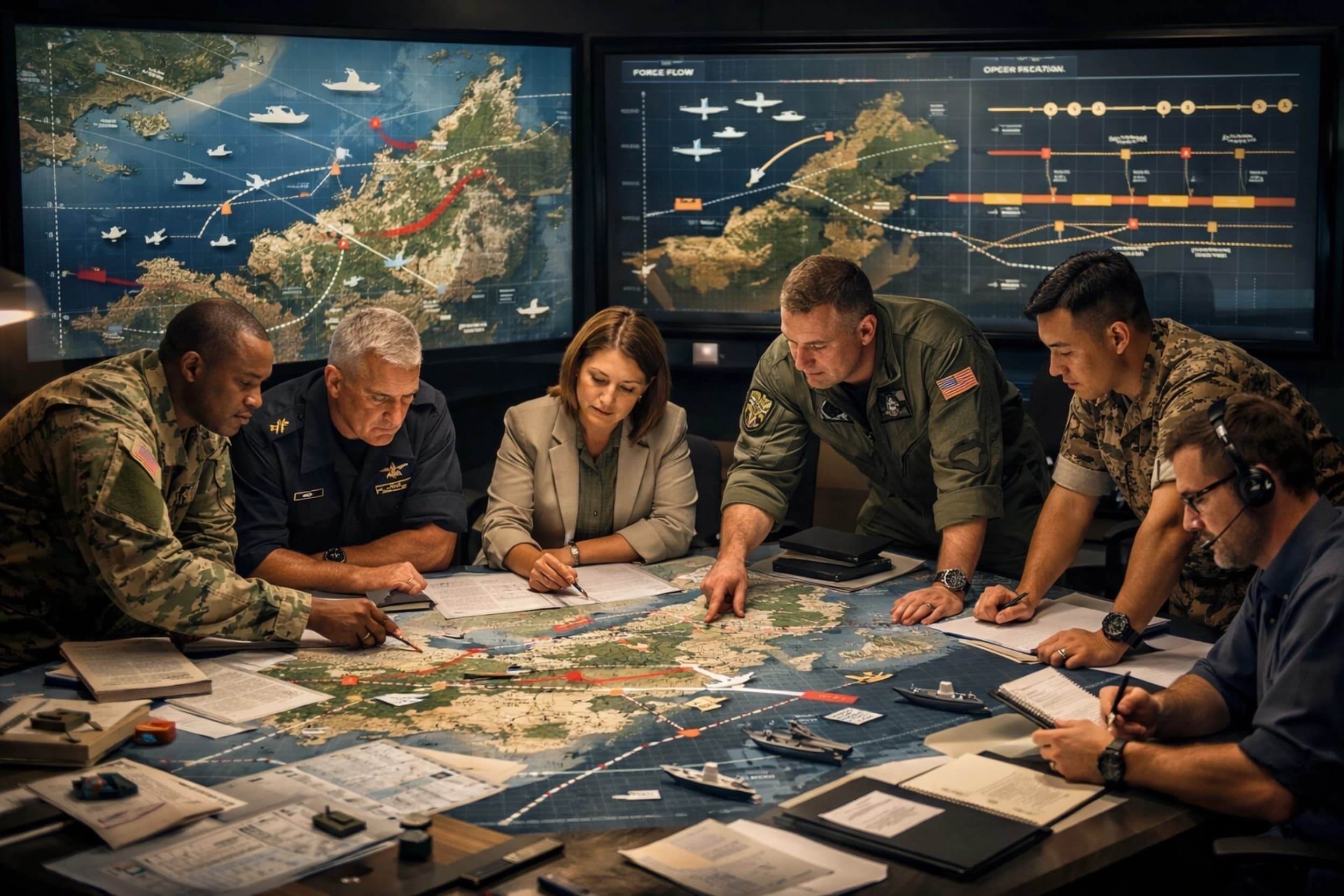
Module 5 felt less like another class and more like stepping into the map room. Up to this point in JPME Phase I, the journey had been largely individual: reading, analyzing, writing, and wrestling with strategy as a student. This final module changed the tempo entirely. It was the capstone, the point where the theory stopped sitting neatly on the page and had to be put to work through a team, a planning process, and a realistic operational problem. Instead of writing alone, I found myself as part of Blue Team alongside a Surface Warfare Officer, a legal officer, a medical officer, and me, a civilian, all working together to turn guidance, assumptions, and competing priorities into something much more concrete: a war plan. Over the course of the module, we built a Joint Planning Process product that stretched almost 200 pages and then translated that work into an OPORD, forcing us to move from ideas and analysis into decisions, sequencing, risk, and execution. In many ways, Module 5 was where everything from the earlier parts of the course finally came alive.
This post continues my JPME Phase I series:
- Foundational Knowledge Course (FKC)
- Module 1 - Fundamentals of Strategy
- Module 2 - The Security Environment
- Module 3 - Operational Art
- Module 4 - Joint Capabilities
Joint Planning Process (JPP)
I tell this story to illustrate the truth of the statement I heard long ago in the Army: Plans are worthless, but planning is everything.
If strategy is the art of deciding where you want to go, the Joint Planning Process is the machinery that helps you figure out how to get there without driving off a cliff. It is the formal planning framework joint staffs use to turn guidance from higher headquarters into an executable operation. In plain English, the JPP takes a problem that looks overwhelming at first glance and breaks it down into a sequence of disciplined steps: understand the environment, analyze the mission, identify assumptions and constraints, develop and compare courses of action, test them through wargaming, and then turn the chosen concept into a plan or order. In our case, that meant moving from a warning order and a complicated crisis in East Malaysia and Brunei to a full campaign concept and, ultimately, an OPORD our fictional joint force could execute.
What struck me most about the JPP was that it did not let us skip the hard parts. It forced us to slow down and define the operational environment before racing toward solutions. Our Blue Team had to account for jungle terrain, limited roads, vulnerable sea lines of communication, coalition politics, Indonesian neutrality, escalation risk, and the simple fact that time was not on our side. This was not a planning exercise where you could wave your hands and say, "we will just move forces where we need them." Every assumption had consequences, and every geographic or political constraint narrowed the range of realistic options.
From there, the process pushed us into mission analysis, which is where a broad problem starts becoming a real military problem. We had to identify the higher commander's mission and intent, separate specified tasks from implied and essential tasks, examine available forces, assess risk, and draft a mission statement precise enough to guide later planning. For CJTF PACTEAK, that meant more than simply "defeat the enemy." The mission had to account for establishing air superiority and sea control, forcibly inserting land forces, protecting key ports, airfields, and energy infrastructure, limiting civilian harm, and setting conditions for a Malaysian-led transition afterward. In other words, the mission was never just about winning a fight. It was about winning the right fight, in the right way, for the right political end state.
That is where the JPP starts to feel less like paperwork and more like architecture. You are not just writing sentences. You are building the frame of a campaign. Our team developed multiple courses of action, weighed different main efforts, and examined questions of tempo, force flow, operational reach, and risk. We compared options that emphasized Sarawak, Sabah, or simultaneous offensives, then tested those concepts against enemy actions and operational friction. By the time we selected our preferred approach, a south-weighted concept with Sarawak as the decisive effort and Sabah as an economy-of-force fight, the choice had been earned through analysis rather than intuition.
What made this especially valuable was that the JPP demanded constant translation between abstraction and execution. It was one thing to say a course of action was "acceptable" or "feasible." It was another thing entirely to define the decision points, reserve criteria, transition conditions, and operational phases that would actually make it work. In our final concept, those ideas became concrete: a four-phase operation moving from deterrence and deployment, to shaping and defense, to decisive operations, and finally transition and stabilization. The process forced us to think not only about how to begin a campaign, but how to sustain it, adapt it, and eventually hand it off.
That, to me, was the real lesson of the JPP. It is easy to admire war plans in hindsight, when they look clean on a map or tidy in a briefing. Living through the planning process, even in an academic setting, showed how much thought sits beneath every line on that map. The JPP was not glamorous. It was iterative, detailed, and often messy. But that is exactly the point. It gave our Blue Team a way to turn complexity into a shared understanding, and then turn that shared understanding into a plan that could be briefed, debated, wargamed, and eventually written as an order.
The next part of the module made that even more real: wargaming. That was where the plan met resistance, and where ideas on paper had to survive contact with an enemy that would not cooperate.
Wargaming
It does not do to leave a live dragon out of your calculations, if you live near him.
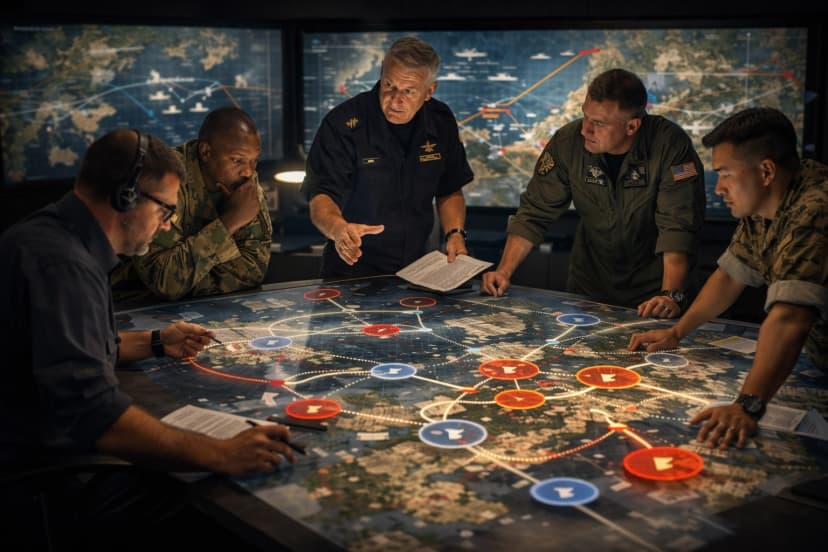
If the JPP gave us the blueprint, wargaming was the moment we started shaking the structure to see what cracked. On paper, a course of action can look clean, balanced, and even elegant. In discussion, it can sound persuasive. Wargaming is where that confidence gets tested. It is the step in the Joint Planning Process where planners take a proposed course of action and walk it through likely enemy reactions, friendly responses, decision points, and friction across time and space. In other words, it is where a plan stops being a theory and starts entering the realm of consequences. Our Blue Team had already developed multiple COAs, assessed governing factors such as mass, risk to mission, security, flexibility, tempo, sustainment, and legitimacy, and selected a preferred concept. Wargaming was how we pressure-tested whether that concept could actually hold together under stress.
For our team, that process became especially real during a two-hour session with Professor Wegge. That meeting felt less like a classroom event and more like a planning huddle inside a headquarters, where every assumption could be challenged and every weak point exposed. We walked through how our operation would unfold, phase by phase, and had to think through not only what we wanted friendly forces to do, but what the enemy would likely do in response. A plan is easy to admire when only one side gets a vote. Wargaming reminds you that the adversary votes too.
That is what made the exercise so valuable. Our team had to think in terms of action, reaction, and counteraction. If coalition forces moved to secure the initiative, how might Kalimantan respond? If the enemy withdrew, reinforced, mined key approaches, used sabotage, or tried to exploit seams in Sabah, what would we do next? If our main effort in Sarawak succeeded, what risks might emerge elsewhere? Those questions forced us to think beyond the first move and into branches, sequels, reserve criteria, and transition conditions. The worksheet captured that logic in a structured way, including decision points tied to force closure, reserve commitment, limited-objective actions, and eventual handoff to Malaysian and Bruneian forces.
Wargaming also revealed something that is easy to miss when reading doctrine: good planning is not about finding a perfect answer. It is about identifying where the plan is fragile and then building in ways to adapt. Our preferred course of action, a south-weighted concept centered on Sarawak as the decisive effort, looked strong in comparison against the other COAs, but the wargame helped show why it worked and under what conditions it might fail. It sharpened our understanding of when to accelerate force closure, when to hold back, when to commit the operational reserve, and how to avoid letting success in one area create vulnerability in another. It also reinforced the importance of phasing, because operational tempo, sustainment, and political legitimacy all had to be managed together rather than treated as separate problems.
What I appreciated most was how collaborative the session became. Blue Team brought different lenses to the table, and that mattered. A wargame is not just about maneuver arrows on a map. It is also about medical support, legal authorities, coalition coordination, sustainment, force protection, and the conditions needed for transition after combat operations. In that sense, the two-hour session with Professor Wegge did exactly what the best wargaming should do: it forced us to confront the gaps between an attractive concept and an executable one. By the end, the plan was stronger not because it had become simpler, but because we understood it better.
That same discipline carried directly into the next major task. Once the team had wargamed the concept and refined the logic behind it, the next challenge was turning all of that analysis into something even more demanding: a clear, coherent OPORD.
OPORD Development
If language is not correct, then what is said is not what is meant; if what is said is not what is meant, then what must be done remains undone.
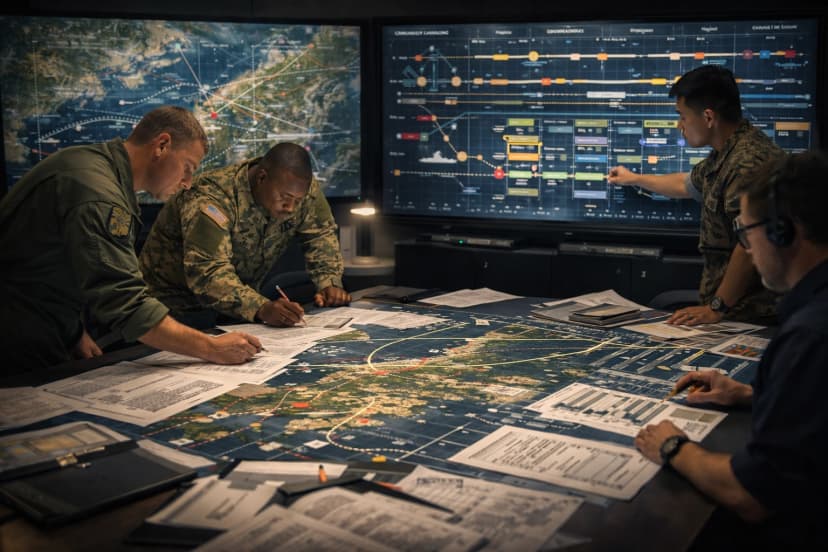
If the JPP was the long campaign of thought, the OPORD was the moment all of that thought had to become unmistakably clear. A planning worksheet can afford to explore, compare, and debate. An operations order cannot. The OPORD is the formal document that tells a joint force what mission it will execute, why it is doing it, how the commander intends to accomplish it, and what each component must do to make the plan real. In that sense, writing the OPORD felt like moving from the architect's table to the construction site. The sketches were over. Now the measurements had to be exact. Our Blue Team had to take everything developed through mission analysis, COA comparison, risk assessment, and wargaming and translate it into a coherent order for CJTF PACTEAK.
What made that difficult, and valuable, was that the OPORD demanded precision without losing the larger logic of the campaign. The mission statement could no longer be a loose summary of intent. It had to be concise, operationally sound, and tied directly to the desired end state. In our final order, the mission centered on conducting joint and combined operations in East Malaysia and the surrounding maritime approaches to defeat Kalimantan's forward forces, restore Malaysian territorial integrity, protect Brunei's sovereignty, and compel withdrawal to pre-conflict boundaries so that security responsibilities could transition back to Malaysian and Bruneian forces. That sentence carried the weight of the entire planning effort behind it.
The commander's intent then gave the order its spine. It clarified the purpose, the method, and the end state, which is what keeps an operation from becoming a collection of disconnected tasks. In our case, the purpose was not merely to defeat an enemy formation. It was to reverse aggression while preserving regional stability and setting conditions for follow-on control by partners. The method emphasized rapid establishment of air superiority and sea control, protection of key ports, airfields, and energy infrastructure, integration of coalition partners, and careful management of escalation and political constraints. The end state described not just battlefield success, but secured territory, protected infrastructure, preserved maritime access, minimal civilian harm, and a credible transition to Malaysian control. That is one of the biggest lessons of OPORD development: the order is not only about combat power. It is about connecting military action to political purpose.
The concept of operations section was where the order truly came alive. Our OPORD organized the campaign into four overlapping, condition-based phases: deterrence and deployment, shaping and defense, decisive operations, and transition/stabilization. That phasing mattered because it turned a broad concept into a sequence of executable actions tied to changing conditions on the ground, at sea, and in the air. The order spelled out when the force would posture into theater, when it would defend and shape, when it would shift to the decisive Sarawak counteroffensive, and when it would begin handing security responsibilities back to Malaysian and Bruneian forces. It was no longer enough to say we had a plan. The OPORD had to show how the campaign would unfold over time and under what conditions it would transition from one phase to the next.
That same discipline carried into tasking. One of the hardest parts of OPORD development was ensuring that each component had clear, purposeful tasks nested within the commander's concept. In the final order, JFMCC protected sea lines of communication, established sea control, and prevented maritime interdiction. JFACC surged ISR, established defensive counterair, executed strike missions, and later shifted to overwatch and deterrent presence. JFLCC carried the main effort ashore, first in forward defense and then in the decisive Sarawak counteroffensive, while maintaining economy-of-force positions in Sabah. JFSOCC supported reconnaissance, targeting, and direct action against key seams in the enemy system, while MARFOR remained afloat as an operational reserve prepared to reinforce, raid, or exploit opportunity on order. Those tasks were not random lines under a heading. They were the operational translation of the choices we had made earlier in the JPP and refined through wargaming.
The OPORD also forced us to think seriously about control. Planning products can sometimes hide uncertainty behind broad language, but an order has to account for decision points, coordinating instructions, and employment conditions. Our order identified phase transition criteria, initial CCIRs, reserve commit triggers, and decision points tied to force closure, operational reserve employment, limited-objective raids, and redeployment. In other words, the OPORD did not simply describe what we hoped would happen. It established the conditions under which commanders would make choices as the situation evolved. That is where the OPORD became more than a summary of the plan. It became a tool for command and control.
What stood out to me most was how writing the OPORD revealed the difference between understanding a plan and communicating one. In the JPP, our team could talk through assumptions, alternatives, and unresolved tension. In the OPORD, ambiguity had to be squeezed out. The final order had to be readable, traceable to the planning logic, and usable by components who would need to act on it. That was the real shift. The OPORD was not just the last assignment in the module. It was the final proof that the team had moved from analysis to action, from discussion to direction, and from academic study to something that resembled the real craft of joint war planning.
Key Concepts
Every module in JPME has its own vocabulary, but Module 5 felt different because the terms were no longer just things to memorize for a discussion board or paper. They became tools. Some helped us frame the problem. Others helped us compare competing ideas. A few only really made sense once we had to turn a concept into a working plan and then into an order. That is what made this module stick. The language of joint planning stopped sounding like staff jargon and started feeling like the grammar of action.
At the center of it all was the Joint Planning Process itself. The JPP is the structured method a joint staff uses to translate higher headquarters guidance into an executable plan or order. It gives planners a disciplined way to move from a complicated operational problem to something a commander can approve and components can execute. In our case, that meant starting with guidance from the higher headquarters WARNORD, analyzing the mission, identifying assumptions and limitations, examining available forces, developing and comparing COAs, pressure-testing them through wargaming, and then converting the selected concept into an OPORD. Our worksheet reflected that flow directly, beginning with mission analysis items like the AO/JOA, enemy situation, assumptions, limitations, tasks, risk, end state, mission statement, and initial CCIRs.
It also reminded me that planning is never done in a vacuum. Our work began from the higher commander's mission and intent in the WARNORD, which framed Pacific Teak as a secondary theater, emphasized economy of force, coalition integration, and enabling Malaysian and Bruneian follow-on operations rather than building a large, enduring U.S. footprint. The WARNORD also shaped our assumptions, including coalition access, timing, weather, and escalation limits. In that sense, the WARNORD was not just background paperwork. It was the opening chord of the entire module, setting the rhythm for everything that followed.
Just as important, Module 5 made logistics feel real. Maps and maneuver graphics can create the illusion that forces simply appear where planners want them. The actual planning products reminded us that combat power has to move by ship and plane, arrive in sequence, pass through ports and airfields, and then be sustained once ashore. Our OPORD emphasized strategic sealift for heavy tonnage, strategic airlift for personnel and critical enablers, trans-loading because of limited port space, Bintulu as the primary SPOD, and Brunei International plus secured Malaysian airports as the primary APODs. Even the phase transitions depended on practical factors like APOD/SPOD defense, force closure, throughput, and fuel or Class V burn rates. In other words, logistics was not a supporting detail off to the side. It was one of the quiet engines of feasibility.
Authorities mattered in much the same way. They do not usually show up in the most dramatic part of a briefing, but they shape what is legally, politically, and operationally possible. Our planning had to account for ROE and restraint guidance, operations alongside coalition partners under national command authorities, Indonesia neutrality restrictions, SOFA-related context, and other limits imposed from above. It was a reminder that joint planning is not just about fire and movement. It is also about legitimacy, access, and operating inside a framework of law, policy, and coalition politics.
Here is the study-guide version of the concepts that mattered most in Module 5:
| Concept | What it means | Why it mattered in Module 5 |
|---|---|---|
| Joint Planning Process (JPP) | The structured method joint staffs use to turn guidance into a plan or order. | This was the backbone of the entire module. It gave Blue Team a disciplined way to move from an operational problem to a coherent campaign concept and final OPORD. |
| WARNORD | A warning order from higher headquarters that initiates planning and provides initial guidance. | Our planning started here. The WARNORD framed the mission, assumptions, priorities, and limits that shaped everything downstream. |
| Mission Analysis | The step where planners examine the mission, higher intent, assumptions, constraints, available forces, and required tasks. | This was where the problem became clearer and where a broad crisis started becoming a real military planning problem. |
| Assumptions | Conditions accepted as true for planning purposes when facts are not yet confirmed. | Assumptions about coalition access, available lift, weather, enemy A2/AD, and timing shaped the feasibility of every COA. |
| Constraints and Restraints | Things the force must do and things it must not do. | These mattered because planning was bounded by neutrality restrictions, coalition legitimacy concerns, and political guidance from above. |
| Authorities | The legal and command permissions governing what forces may do and under what framework. | Authorities influenced ROE, coalition coordination, national command relationships, and what actions were politically and legally acceptable. |
| Enemy Courses of Action (ECOAs) | Likely or dangerous ways the enemy may act. | We could not build a friendly plan in isolation. We had to think about how Kalimantan might react, reinforce, mine approaches, or exploit seams. |
| Course of Action (COA) | A distinct friendly option for accomplishing the mission. | Blue Team developed and compared multiple COAs before selecting the one that best balanced mission accomplishment, risk, and tempo. |
| COA Evaluation Criteria | Standards such as suitability, feasibility, acceptability, distinguishability, and completeness used to judge COAs. | These criteria helped us compare options rigorously instead of just choosing the plan that sounded best in discussion. |
| Operational Approach | The broad logic describing how the force will achieve objectives and reach the desired end state. | This was the bridge between analysis and execution, connecting strategy to campaign design. |
| Center of Gravity (COG) | The source of strength, freedom of action, or will that gives a force power. | Even when not front and center in every paragraph, COG thinking shaped how we thought about what had to be protected, isolated, or defeated. |
| Decisive Point | A place, event, capability, or function that gives a marked advantage. | This helped explain why ports, airfields, sea control, and certain land actions mattered more than others. |
| Commander's Intent | A statement of purpose, method, and end state that guides execution. | This became the spine of the OPORD and kept the plan tied to the larger political and operational objective. |
| End State | The set of desired conditions that should exist when the operation is complete. | This kept the campaign focused on restoring territorial integrity and enabling transition, not merely defeating enemy forces tactically. |
| Risk | The probability and consequence of harm to mission success or the force. | Risk ran through every part of the module, from escalation and force flow to sustainment, legitimacy, and overextension. |
| Operational Reach | The distance and duration over which a force can effectively employ capabilities. | This was crucial in a scenario shaped by sea lines of communication, limited ports and airfields, and the challenge of sustaining combat power over distance. |
| Main Effort / Supporting Effort | The primary action that drives success and the supporting actions that enable it. | Blue Team's south-weighted concept depended on keeping Sarawak as the main effort while holding Sabah as an economy-of-force fight. |
| Wargaming | The testing of a COA against likely enemy reactions and friendly counteractions. | This was where the plan met friction. The two-hour session with Professor Wegge forced us to expose weak points and refine decision points. |
| Branches and Sequels | Contingency options and follow-on operations that may be required as events unfold. | These mattered because good plans do not stop at the first move; they anticipate adaptation and what comes next. |
| Phasing | Organizing the operation into stages tied to purpose or conditions. | Phasing helped us think through how the campaign would unfold from deterrence and deployment to decisive operations and transition. |
| Decision Points | Key moments when the commander must choose among options based on conditions. | These made the plan more realistic by tying choices to things like reserve commitment, force closure, and redeployment. |
| CCIRs | Commander's Critical Information Requirements needed for timely decision-making. | These linked planning to command and control by identifying what the commander needed to know to act. |
| APOD / SPOD | Aerial Ports of Debarkation and Sea Ports of Debarkation. | These were central to feasibility because moving and sustaining the force depended on defended, functioning entry points into theater. |
| Force Flow / Force Closure | The sequencing and arrival of forces into theater until enough combat power is available. | Our planning repeatedly returned to the reality that tempo and success depended on when the right forces actually arrived. |
| Pre-staging | Positioning personnel, equipment, or supplies in advance to support operations. | Pre-staging made the difference between a concept that looked fast on paper and one that could actually generate tempo early in the campaign. |
| Strategic Airlift and Sealift | Long-range transportation of personnel, equipment, and sustainment by aircraft and ship. | Heavy tonnage moved primarily by sealift, while airlift prioritized personnel and critical enablers, making transportation a core planning concern. |
| Sustainment | The provision of logistics and services necessary to maintain operations. | Sustainment was a constant planning factor, from fuel and ammunition to medical support, trans-loading, and inland distribution. |
| OPORD | The formal order that communicates the mission, intent, concept of operations, and tasks to the force. | This was the final product of the module, where all of the analysis had to become clear, executable direction. |
What made these concepts memorable was not the definitions by themselves. It was the way they nested together. The WARNORD established the mission and planning frame. Mission analysis clarified the problem. Assumptions, constraints, and authorities narrowed what was possible. Logistics determined what was feasible. COAs and ECOAs created competing visions of action and reaction. Wargaming exposed friction. The OPORD then forced all of that hard thinking into a form precise enough for a joint force to execute. By the end of Module 5, these were no longer just terms from a workbook. They were the scaffolding behind a real planning effort.
Assignments
Module 5 was less about a stack of separate assessments and more about building toward a pair of major planning products. Instead of writing in isolation, the work centered on collaborative war planning with Blue Team. The result was two substantial deliverables: a full Joint Planning Process worksheet and the final OPORD that translated that planning into an executable order.
| Assignment | Description | Download |
|---|---|---|
| SA-7 Part I (JPP Worksheet) | Blue Team's Joint Planning Process product covering mission analysis, assumptions, ECOAs, COAs, wargaming, risk, and decision support logic. | Download |
| SA-7 Part II (OPORD) | Final operations order derived from the team's planning, including mission, commander's intent, concept of operations, phasing, and component tasks. | Download |
| DBF 5.1 | Discussion participation tied to the opening phase of the module and initial engagement with the planning problem. | Download |
Conclusion
Have a bias toward action - let's see something happen.
Module 5 felt like the point where the classroom map finally turned into terrain. The earlier parts of JPME Phase I built the intellectual foundation: strategy, the security environment, operational art, and joint capabilities. This final module asked us to put those pieces together and actually use them. Through the JPP, wargaming, and OPORD development, Blue Team moved from theory to application, from individual understanding to collective planning. It was demanding work, but it also made the course feel complete. For me, that was the real value of the capstone. It showed that joint planning is not just about mastering doctrine or memorizing process. It is about learning how to think through complexity with others, make disciplined choices under uncertainty, and turn a shared understanding into a plan that can be executed.
It also reminded me how much better serious planning becomes when it is done as a team. One of the most rewarding parts of the module was being part of a great Blue Team that worked hard, collaborated well, and met almost daily to move the planning effort forward. That kind of rhythm made a difference. Everyone brought a different background and perspective to the table, and the final products were stronger because of it. I am grateful to the team for an outstanding experience and for making an intense module both productive and genuinely enjoyable. Looking back across the full journey, Module 5 was where the earlier modules stopped standing apart and started locking together. Now the next milestone is the virtual graduation and, with it, receiving the JPME Phase I diploma. After all the reading, writing, planning, and teamwork, that feels like a fitting way to close this chapter.
See the associated LinkedIn post.
Comments
To leave feedback or questions, simply login using your preferred social network. I will read and answer your comments promptly, but please keep in mind that they will be public.