

Introduction
Twelve years ago I joined federal service because the mission mattered.
It still does. That's why I'm leaving.
After twelve years at NIWC PAC, I'm leaving federal service and joining Rise8. This post is my honest account of both sides of that decision — the pride, the grief, and the reasons I'm choosing a different path toward the same destination.
The people who made it matter
The first thing I want to say, before anything else, is that the people I worked alongside were extraordinary.
Mission-focused, hungry to help, selfless in ways that don't show up on any org chart. Many worked long hours for modest pay and limited benefits not because they had to, but because they genuinely believed in what they were building. There was no financial windfall waiting for them. The reward was the work itself, and the knowledge that it mattered.
That kind of culture is rare. I've thought a lot about what created it. Part of it was the nature of the mission — when the stakes are national security and the customers are warfighters, it's hard not to care. Part of it was the people themselves, who chose public service for the right reasons and kept choosing it every day even when the conditions made it hard.
I carry those people with me. They shaped how I think about teams, about leadership, and about what it means to show up for something bigger than yourself.
What we built together
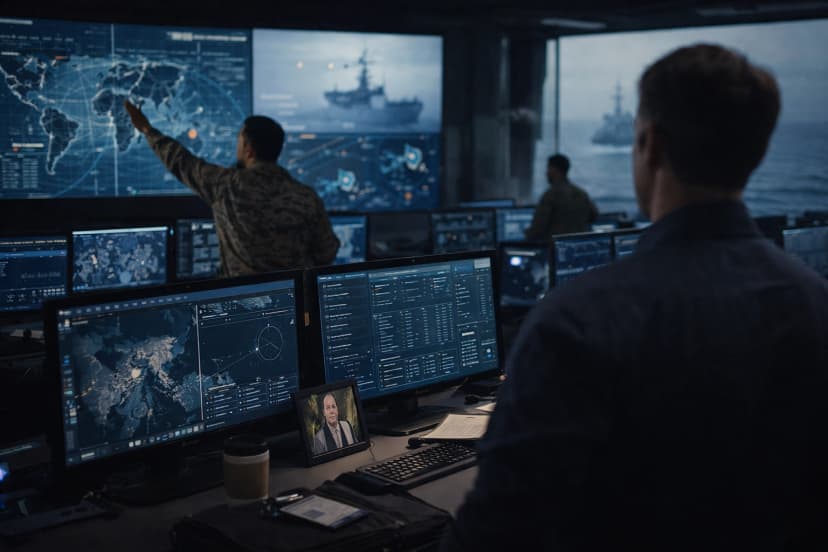
Twelve years is a long time. Long enough to see ideas become programs, programs become institutions, and institutions change how entire organizations operate.
A few things stand out.
Intelligence, C2, targeting, and beyond. Over the years I led products and portfolios spanning intelligence analysis tools, command and control systems, targeting capabilities, and enterprise business systems, not just for the Navy but across the joint community. That perspective was built over more than twenty years, including both my federal service and my earlier decade at Northrop Grumman, much of it tied to GCCS-J, I3, and the broader intelligence and C2 mission space. I worked with organizations across the intelligence community and DoD, from DISA, ONI, DIA, NSA, NGA, and NRO to Joint Staff J2 and J3, the military services, and Combatant Commands and component commands in the United States and abroad. That continuity gave me a rare view into how the mission actually gets executed across institutions, echelons, and environments. Each domain had its own complexity, its own stakeholders, and its own version of "the mission." What unified them was the question I always came back to: does this get better, faster, more accurate information in front of the people making the hardest decisions in the worst possible conditions?
Kessel Run. I had the opportunity to support Kessel Run in its early days — before it became the widely cited model for modern software delivery in the DoD. But the thread starts earlier than that. While working on Integrated Imagery & Intelligence (I3) program, I was pushing ideas about how software could be built and delivered differently: Agile and Lean methods instead of bloated waterfall programs, user-centered design that started with operators rather than requirements documents, DevOps practices that collapsed the gap between build and deployment. And architectures that matched the reality of how organizations actually worked — microservices and domain-driven design structured around Conway's Law, where the software reflected the team boundaries and communication patterns of the humans using it rather than fighting them. The I3 program office didn't see the value. Those ideas didn't die there, though. I brought them to the USAF T&G SPO, where the people I worked with had both the appetite and the authority to actually execute. They did. The work found traction, found support, and eventually formed part of the intellectual and operational foundation for what Kessel Run became. Watching that effort grow from a scrappy, unconventional experiment into something that reshaped how the Department thinks about delivering software was genuinely thrilling — partly because I'd been carrying some of those ideas since before anyone was ready to hear them.
Scientists to Sea. This one changed me personally. I spent a week aboard a Navy warship as part of the Scientists to Sea program - an effort designed to bridge the gap between the civilians building technology and the sailors living with it. You can read requirements documents and user stories all day long. None of it prepares you for standing on the deck of a warship, talking to a sailor who depends on the system you helped build, watching them navigate real constraints in a real operational environment. I came back a different technology leader. More grounded. More honest about the difference between what we think users need and what they actually need.
Real environments, real consequences. I traveled extensively in support of our warfighters - working on complex, hard problems in the field, in partner nations, in environments that reminded me why the work is urgent. There's a difference between solving a problem in a conference room and solving one alongside the people who live with the consequences. I'm grateful I got to do both.
That continuity across contractor and civilian service gave me a front-row seat to what endures, what breaks, and what actually helps the joint force operate better. Through all of it, I was trusted to lead critical initiatives with real autonomy. That kind of empowerment isn't universal in large organizations. I didn't take it for granted.
The human cost of staying

I'm a single dad.
For a stretch of years, this career gave me what I needed most: stability, flexibility, and the ability to be present for my daughter while doing work I believed in. That combination made the modest salary and the long hours feel like fair trade.
Then the return-to-office mandate arrived.
Every day, I sat in four hours of traffic — two hours each way — while my 16-year-old got herself ready for school without me. That's not a minor inconvenience to navigate or a policy to debate abstractly. That's the fabric of a kid's life, and the hours in it that don't come back.
The mandate wasn't the only pressure. Salaries that hadn't kept pace with years of inflation or industry. Increasing workload and uncertainty. An environment where the ground was constantly shifting beneath programs that required patience, continuity, and trust to function properly.
Still, I was determined to finish one final commitment before making any decision. In March 2026, I completed U.S. Naval War College JPME Phase I. I wanted to finish that first. It mattered to me because it reflected what the work was really about, and I was not willing to walk away from it mid-stride.
But I'd been watching the conditions around me change for a while. And the four-hour commute was the clearest signal I got that the calculus had shifted.
What broke and what it means

We want the bureaucrats to be traumatically affected. When they wake up in the morning, we want them to not want to go to work, because they are increasingly viewed as the villains. We want their funding to be shut down … We want to put them in trauma.
That's not a leak. Not a misquote taken out of context. That was the stated strategy, on the record, from inside the administration.
What followed was consistent with it.
What I witnessed beneath that strategy was a broader lack of leadership at nearly every level. Some leaders were constrained by forces above them. Others were absent when their people needed them most. Too few were willing or able to provide clarity, absorb pressure, and protect the mission and the workforce at the same time. That vacuum made an already damaging environment even harder to navigate.
I want to be honest here, because I think honesty is more useful than either bitterness or sanitized professionalism.
What happened to the federal civilian workforce over the past year wasn't reform. According to the Office of Personnel Management, 322,049 employees left the federal government between the start of the Trump administration and the end of 2025 — a net loss of roughly 220,000 people. The largest reduction in the federal workforce in modern history. DOGE made no meaningful effort to distinguish between high performers and poor ones, between essential institutional knowledge and genuine inefficiency. Researcher Don Moynihan, writing a year-out assessment in January 2026, called it what it was: "a rapid unscheduled disassembly of your government."
Musk had promised to slash the federal deficit by $1 trillion. He failed. DOGE made no meaningful impact on federal spending — because federal employee salaries represent only about 5-6% of total government outlays. You can fire hundreds of thousands of people and barely dent the budget. The "wall of receipts" DOGE published to document its savings was, per a definitive New York Times analysis, largely a wall of lies: double-counting, claiming Biden-era cuts, claiming programs still in operation had been eliminated, vastly exaggerating scale.
The cuts that did happen followed a pattern with nothing to do with efficiency. Stanford political scientist Adam Bonica found that agencies viewed as serving more progressive causes were disproportionately targeted while conservative-aligned agencies were protected or grew. Contract cuts fell harder on firms that donated to Democrats. Defense and national security workers — the people carrying the weight of this country's most critical programs — were not protected. Experienced technologists were pushed out of government even as DOGE claimed to be modernizing it. By March 2026, CNN was reporting how the cuts were hampering U.S. government readiness during the Iran conflict, quoting officials describing the national security apparatus as "a shell of our former self."
Broad, blunt cuts that didn't distinguish between inefficiency and institutional knowledge. Chaos layered on chaos. People on edge. Programs quietly shutting down. A daily experience of uncertainty that made it impossible to plan, build, or lead effectively.
I've thought about how to characterize this, and the best I can do is this: government civilians are the continuity. They're the institutional memory. They're the ones who know where the bodies are buried, how to navigate the acquisition process, which contractors can be trusted, and how to keep critical programs running when political leadership changes every four years and military personnel cycle out every three — often just as they're finally getting fully up to speed.
You cannot replace that with a contractor surge, a mandate, or a reorganization. It accumulates over years and decades. When it walks out the door — and it has been walking out the door — it doesn't come back quickly.
We didn't need a blunt instrument. We certainly didn't need a chainsaw. We needed a scalpel.
I want to be clear that this isn't a partisan statement. It's an operational one. The national security enterprise runs on the backs of civilian professionals who chose stability and mission over higher private sector salaries. Treating them as a problem to be solved rather than an asset to be invested in has costs that will compound for years.
I hit a ceiling within that environment, and I recognized that the path I was on no longer aligned with how I could best serve the mission.
Why Rise8

Fall seven times, rise eight.
I'm not leaving government as a rejection of the mission. I'm leaving a particular path toward it.
Rise8's origin story isn't incidental to why I chose them. The company was founded by Bryon Kroger — a former Air Force targeteer who saw the cost of bad software firsthand, co-founded Kessel Run, and pioneered the original continuous ATO. I had the chance to support Kessel Run in its early days, before it became the widely cited model for modern software delivery in the DoD. When institutional change stalled, Bryon left active duty to launch Rise8 and do what the system wouldn't let him do from the inside: deliver better software, faster, for critical missions. That's not a company founded to extract value from government contracts. That's a company founded in frustration with the same gap I spent twelve years trying to close.
Their stated purpose is direct: to create a future where fewer bad things happen because of bad software. Their core belief is that digital transformation starts with people — specifically the ones organizations already have — and that most institutions don't need more talent, they just need help getting out of their own way.
Those aren't marketing lines. They're the operational argument I've been making internally for years.
Their core values put it plainly.
- Keep it Real: be authentic, transparent, practice radical candor, back your words with undeniable proof. If you can't prove it, don't say it.
- Outcomes in Production: output is meaningless without impact. That's not a culture that tolerates theater. It's a place where the work either ships and matters, or it doesn't count.
Continuous delivery (real, rapid, reliable) of valuable software (outcomes in production = mission impact) that users love (great user experience (UX)).
There's something clarifying about choosing an organization whose entire reason for existing is to make government work better. Not to perpetuate complexity. Not to win the next contract by promising the moon. To actually improve the system from a position that has both the incentives and the tools to do it.
Rise8 gives me the chance to do what I care most about — improving how capability gets delivered to the people who need it — from a position where I can move faster, think longer-term, and work with a team that's deeply aligned on the values I've carried through my career: mission impact, honest feedback, accountability, and genuine curiosity about hard problems.
I'll bring everything I learned at NIWC PAC — the product leadership, the operational understanding, the empathy from that week aboard a warship, the institutional knowledge from a dozen different programs — to this next chapter. None of that disappears. It compounds.
The mission doesn't change. The path does.
A closing note to the people who served alongside me
If you worked with me at NIWC PAC — on any of the programs, in any of the roles, in any of the years — I want you to know something.
What you do matters. The chaos of the current moment doesn't change that. The blunt instruments don't change that. The uncertainty and the noise and the headlines don't change that.
You are the continuity. You are the institutional memory. You are the reason these systems work, the reason the warfighters trust them, and the reason the mission gets accomplished despite everything.
Thank you for the privilege of serving alongside you.
The mission doesn't change. The path does.
All ahead flank.
I'm now at Rise8, focused on modernizing government software delivery and getting better capability into the hands of the people who need it most. If you're working on similar problems — in government, in the contractor community, or in the defense tech space — I'd genuinely love to connect.
See the associated LinkedIn post.
Comments
To leave feedback or questions, simply login using your preferred social network. I will read and answer your comments promptly, but please keep in mind that they will be public.