
Introduction
Module 4 of JPME Phase I was supposed to be a clean, predictable run: start on September 26, 2025, keep a steady cadence, and wrap on December 4. A tidy arc. Enough time to build momentum, internalize the logic of joint capabilities, and roll directly into Module 5 without losing the thread.
That is not how it went.
About a month into the course, the government shutdown hit and the class went dark for roughly a month. When we finally came back up for air, we ran straight into the holiday break, adding another two-week pause. The net effect was exactly what you would expect in any complex effort that depends on continuity: the schedule slipped, the finish line moved, and Module 4 ultimately closed out on January 15, 2026. That extension did not just change dates on a calendar. It pushed the follow-on start for Module 5, and it introduced the uniquely frustrating kind of friction where the hardest part is not the material itself, but rebuilding context every time the train starts moving again.
There is a certain irony in that, because Module 4 is, in many ways, about managing friction. Joint capabilities are not a catalog you browse when you need something. They are an interdependent capability set: authorities and command relationships, timelines and lift, sustainment and access, intelligence and information, cyber realities, and the integration burden that shows up the moment you try to assemble a coherent force. Interrupt that learning for weeks at a time and you do not just forget definitions. You lose the connective tissue, the relationships that make the subject operationally useful.
What made the stop-and-start sequence workable was the professor's consistency. Communication stayed clear, expectations stayed grounded, and when we resumed it felt less like restarting an abandoned project and more like stepping back into a guided plan. That mattered because the point of Module 4 is not memorizing what each Service can do in isolation. It is learning how the joint force actually comes together across the competition continuum—how you build options that are feasible, sustainable, and credible under real constraints.
That is the frame for this post. This is not a session-by-session recap. It is the story of what Module 4 was really teaching beneath the surface: how capabilities fit together, where the seams show, and how operational leaders translate "options on paper" into something that can deploy, command, sustain, and, just as importantly, disengage on purpose.
This post continues my JPME Phase I series:
- Foundational Knowledge Course (FKC)
- Module 1 - Fundamentals of Strategy
- Module 2 - The Security Environment
- Module 3 - Operational Art
Executive Summary
- Joint capabilities are a system, not a menu. The operational problem is assembling a coherent capability set with real dependencies, not listing what each Service can do in isolation.
- The competition continuum is the default environment. Planning has to work across cooperation, competition, and conflict, with credible options that can scale and transition without a restart.
- C2 and authorities determine what is feasible. Command relationships, delegated authorities, and multinational arrangements shape tasking, tempo, risk acceptance, and unity of effort.
- Logistics is a pacing function, not "support." Strategic mobility, sustainment capacity, and distribution realities constrain operational reach, tempo, and endurance—and can culminate a plan if ignored.
- Intelligence is decision advantage only if integrated. ISR collection, analysis, dissemination, and coalition-sharing constraints must be designed into the operation, not bolted on after the fact.
- Information and cyber are operational—not decorative. Narrative coherence, influence, and cyber defense/offense shape freedom of action, legitimacy, and resilience across the continuum.
- Each Service contributes unique strengths with specific limits. The joint force works when planners understand what each Service brings, what it needs, and where it is vulnerable in contested environments.
- Naval warfare is central because it underwrites access and options. Sea control/denial, maritime maneuver, and presence/coercion effects shape joint freedom of action and strategic flexibility.
- Multinational operations trade simplicity for legitimacy and capacity. Coalitions add access and credibility, but increase friction in interoperability, ROE alignment, and information sharing.
- The real skill is integration under constraint. Sequence forces, align authorities, validate sustainment and lift, integrate enabling functions, and preserve disengagement/redeployment options from the start.
Module 3 trained me to start with operational art: define a clear operational objective, identify the conditions required to achieve it, and then design lines of effort that are feasible under real constraints. Module 4 builds directly on that foundation. Instead of treating capabilities as inputs, it forces you to treat them as ways—tools you assemble, sequence, and sustain to achieve the objective, manage risk, and preserve options as the situation evolves.
The Operating Context
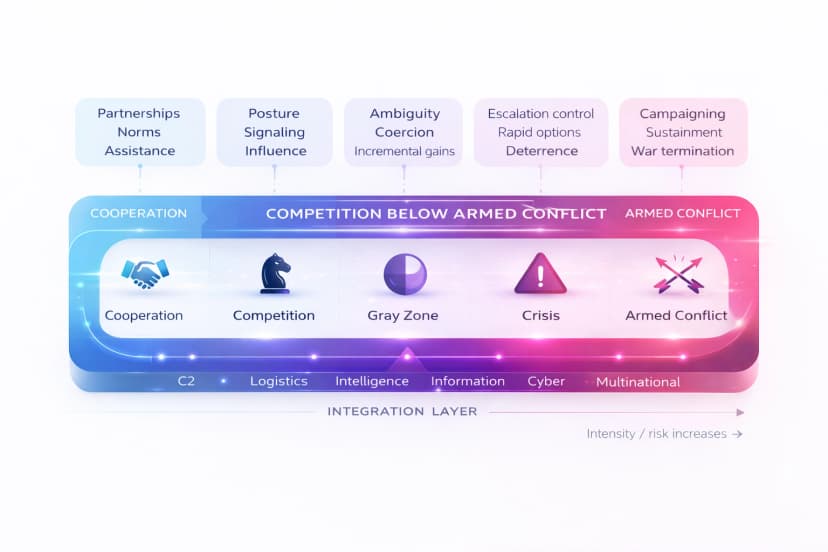
If Module 4 had a "baseline assumption," it was this: the United States does not get to choose between peace and war like flipping a switch. The joint force operates in a world where competition is persistent, escalation is managed, and conflict is always a possibility—not a calendar event. As one of the course materials put it bluntly, "War and warfare will always be with us: war is a permanent feature of the human condition."
That framing matters because it changes how you evaluate everything that follows. Joint capabilities are not only about what wins battles. They are about what creates leverage before battle, what prevents conflict from becoming inevitable, and what allows the nation to shift rapidly when deterrence fails.
The competition continuum forces planners to think in terms of simultaneity and transitions. Cooperation, competition below armed conflict, and armed conflict are not separate lanes with clean handoffs. They overlap. Actions meant to deter can also provoke. Activities designed to reassure partners can also signal intent to an adversary. The operational art problem becomes designing campaigns and capability packages that remain coherent as conditions shift—without requiring a full organizational reset every time the situation moves left or right on the continuum.
In practical terms, this is why Module 4 treats "joint" as the default condition. You do not "go joint" only when shots are fired. You posture joint capabilities in competition so they can scale in crisis, and you structure them in conflict so they can transition back into a stable competitive posture afterward.
A second idea sits underneath the continuum: coercion. Not in the simplistic sense of "threaten and comply," but as the operational logic that links presence, posture, signaling, and selective force to political aims. Coercion is where the military instrument is often most politically relevant—because it is the space where states try to influence behavior without triggering uncontrolled escalation.
That is also where the credibility gap shows up fast. Presence alone is not strategy. A ship on station, an air patrol, a deployed formation, or a cyber posture can signal intent—but only if it is tied to believable capability, clear authorities, and an adversary-facing understanding of what you can actually do next. The course repeatedly returned to this point in different domains: the value is not the platform or the unit by itself, but the option set it enables.
Once you accept the continuum and coercion as the operating context, the remainder of Module 4 snaps into focus:
- Capability selection becomes about credibility. What you deploy must be capable of producing effects, not just being seen.
- Integration becomes the decisive variable. Coercion and deterrence fail when seams show—when C2 is unclear, sustainment is thin, ISR is disconnected, or coalition interoperability is assumed instead of built.
- Tempo and endurance become strategic messaging. A force that cannot sustain presence, rotate, or rapidly reinforce signals limitation as clearly as any communiqué.
- Transitions must be designed, not improvised. The joint force has to be assembled with "next steps" in mind—both escalation pathways and disengagement/redeployment pathways.
This is why the post that follows stays concept-driven rather than session-driven. Module 4 is best understood as a single argument: the joint force exists to create and execute credible options across the competition continuum, and those options are only real when authorities, C2, logistics, intelligence, information, cyber, and multinational integration are treated as first-class operational problems—not afterthoughts.
Command and Control, Authorities, and Task Organization
The most useful lesson of Module 4 was not a list of capabilities; it was an integration discipline. Assembly is not an administrative step that happens before real operations. It is the operation—because command and control (C2) determines what the force can actually do, how quickly it can do it, and how much friction it will carry into execution. The course treats C2 as central and ties it directly to the Joint Force Commander's authorities, command relationships, organizational options, and staff processes, then extends that logic into multinational realities like intelligence sharing, rules of engagement (ROE), capability gaps, and logistics.
At the most basic level, C2 is the exercise of authority and direction by a properly designated commander over assigned forces to accomplish the mission. That sounds obvious until you start assembling a joint force and realize the system is only as effective as the authority boundaries and clarity you establish up front.
A practical way to think about the Joint Force Commander's design problem is as a set of linked decisions:
| C2 design problem | What the commander/staff must decide | Why it matters |
|---|---|---|
| Organize the force | Service components vs functional components (or hybrid), subordinate command relationships, staff structure | Determines unity of effort, speed of decisions, and the seams that require active management |
| Build decision advantage | Battle rhythm, information flow, CCIRs (commander's critical information requirements), staff processes | The force that decides faster can act faster, adapt faster, and carry less friction into execution |
| Engineer adaptability | Structures and processes that still work when the environment shifts | The plan will change; C2 must hold while the force transitions |
A theme that kept surfacing is that misunderstanding authority is a primary source of friction and failure—especially when the force is stitched together from multiple components and partners. The issue is not memorizing labels. The issue is understanding the scope of each relationship and what it allows the commander to do.
| Command relationship | Plain-language scope | Typical planning implication |
|---|---|---|
| COCOM (combatant command, command authority) | Highest level command authority over assigned forces; nontransferable | Establishes the ceiling of what can be delegated and how forces are assigned and employed |
| OPCON (operational control) | Authority to organize and employ forces to accomplish assigned missions; commonly delegated | Usually determines whether your scheme of maneuver and cross-component tasking is executable |
| TACON (tactical control) | Limited authority to direct movements/maneuvers for a specific task and time | Useful for discrete missions, but insufficient for broader operational integration |
| Support | One force aids, protects, complements, or sustains another | Clarifies who is supported vs supporting and reduces friction at the seams |
Operational takeaway: the authority label is not the point—the scope is. If the staff cannot articulate what the relationship does and does not allow, the force is being assembled on assumptions.
This is also why the Joint Task Force (JTF) construct matters. A JTF is purpose-built: it exists to solve a specific operational problem, not to preserve a permanent organizational chart. Once that is accepted, task organization becomes less about the right template and more about building a structure that fits the mission, the geography, and the coalition reality.
| Task organization objective | What good looks like | What it prevents |
|---|---|---|
| Match the problem and geography | Components and subordinate HQs aligned to the operational problem and battlespace | Misaligned structures that slow tempo and create handoff friction |
| Keep span of control realistic | A commander can actually control, coordinate, and make decisions at speed | Cognitive overload, sluggish decisions, brittle execution |
| Enable decentralized execution | Clear commander's intent and authorities that allow initiative | Paralysis when the plan meets reality |
Two assembly rules stood out. First, commander's intent is not motivational text; it is a control mechanism. The clearer the intent, the more freedom subordinate commanders have to act when conditions change. Second, span of control is a real constraint. Exceed it and you pay for it in slower decisions and fragile execution.
When assembling a joint force—or reassembling it midstream—the staff can force early clarity with a short checklist:
| Assembly checkpoint | The question you must answer |
|---|---|
| Mission and end state | What is the purpose, and what does success look like? |
| Command relationships | Who has COCOM/OPCON/TACON/support over whom, and what does that authorize? |
| Component structure | Are you organizing primarily by Service, function, or a hybrid—and why? |
| Decision architecture | What decisions must be made fast, and what processes support them (CCIRs, battle rhythm, information flow)? |
| Seams and dependencies | Where will integration fail first (intel sharing, comms, sustainment, ROE, partner access)? |
The course is explicit that the U.S. will rarely operate unilaterally, so multinational C2 is treated as a core C2 problem set, not an add-on. An elegant command structure is not enough if trust, interoperability, intelligence sharing, ROE alignment, and logistics coordination are not deliberately built. In combined operations, unity of effort is not automatic; it is engineered.
Finally, modern C2 rides on cyberspace. The joint force's decision advantage depends on communications pathways, networks, and data flows that can be contested. Even a well-designed headquarters becomes fragile if the information infrastructure that supports decisions is disrupted or compromised.
Seen through the Module 3 lens, C2 design is operational art. It is how you translate an operational objective into executable tasks, maintain tempo, manage friction, and preserve unity of effort when the plan meets reality.
Bottom line: Module 4 treats joint force assembly as a disciplined design problem. C2 and authorities define what is possible; task organization determines whether the force can think and act at speed; and multinational realities ensure that unity of effort is something you build on purpose, not something you assume will happen because you drew the org chart.
The Services
One of the easiest ways to misunderstand joint capabilities is to treat the Services like a buffet: pick the entrée you want and assume the rest of the meal will show up automatically. Module 4 pushed the opposite mindset. Each Service brings distinctive strengths, but those strengths are only operationally meaningful when you account for the limits and the dependencies that come with them—C2 arrangements, access and basing, lift and sustainment, ISR and communications, protection, and (in most real-world scenarios) multinational interoperability. This section is written the way a planner thinks: what each Service can contribute, what constrains it, and what it typically needs from the rest of the joint force to be effective.
| Service | What it brings (core contributions) | Typical limits / constraints | Common dependencies (what it needs to be effective) |
|---|---|---|---|
| Army | Land power, scale, endurance, theater sustainment, air/missile defense, fires | Strategic mobility burden; time to build mass; exposure to long-range threats | Lift + reception/staging; protection; joint fires/ISR; logistics distribution network; assured comms |
| Navy | Sea control/denial, maritime maneuver, strike, sea-based presence and access, SLOC protection | Magazine depth; maintenance cycles; contested seas/air; chokepoint vulnerability | Space/cyber-enabled comms; ISR/targeting; logistics (fuel, parts, munitions); air cover/IAMD integration; coalition maritime interoperability |
| Marine Corps | Naval expeditionary force, littoral ops, crisis response, amphibious integration, forward posture | Limited mass/endurance; sustainment burden when ashore; access dependence | Navy lift/sea base; joint fires/ISR; logistics and medical; air/space comms; partner access/permissions |
| Air Force | Speed, reach, air superiority, global mobility, ISR, precision strike, theater/global C2 nodes | Basing/access; high demand/low density assets; contested airfields; fuel/munitions throughput | Basing rights + protection; logistics throughput; space for PNT/SATCOM; cyber defense; joint targeting/intel |
| Space Force | PNT, SATCOM, missile warning, space domain awareness, space effects enabling joint force | Vulnerable space architectures; contested spectrum; limited redundancy in some mission sets | Resilient architectures; cyber/spectrum protection; joint planning integration; ground stations/terminals |
| SOF | Discreet options, irregular warfare, partner enablement, special reconnaissance, precision effects | Not designed for mass; finite capacity; sustainment and access constraints | High-quality intel; comms; air mobility; diplomatic/partner access; conventional support for scale/protection |
| Coast Guard | Maritime security, law enforcement authorities, partner capacity, gray-zone utility | Not a high-end naval combat force; capacity constraints | Interagency alignment; maritime C2; partner legal frameworks; ISR; logistics support when deployed |
The first table answers the baseline question: "What does each Service contribute, and what does it generally depend on?" The next step is more operational: when plans fail, they rarely fail because a Service "lacked capability" in the abstract. They fail at the seams—because a dependency was assumed, a constraint was ignored, or a common failure mode was not covered by design.
| Service | Typical operational roles in a joint design | Common force constructs / echelons (examples) | Common failure modes (what breaks first) |
|---|---|---|---|
| Army | Land control, endurance, theater posture, protection of critical nodes | Division/Corps, Air Defense units, Theater sustainment formations | Lift/JRSOI throughput insufficient; sustainment distribution strain; exposure to long-range fires |
| Navy | Sea control/denial, maritime maneuver, sea-based presence, strike | Carrier/Surface action groupings, Amphibious ready group/expeditionary group constructs | Magazine depth + maintenance cycles; ISR/targeting gaps; contested comms and air/missile threat saturation |
| Marine Corps | Expeditionary/littoral operations, crisis response, early entry | MEU-like expeditionary constructs, littoral task organizations | Sustainment ashore becomes pacing constraint; access/permissions; overextension beyond naval support |
| Air Force | Counterair, strike, ISR, global/theater mobility, operational C2 nodes | Expeditionary wings/squadrons, AOC-enabled C2 | Basing access + protection; fuel/munitions throughput; mission system cyber/spectrum disruption |
| Space Force | PNT, SATCOM, missile warning, enabling joint C2 and targeting | Mission-focused deltas/constellations and ground segment | Jamming/spectrum contestation; cyber intrusion; loss of redundancy/ground nodes |
| SOF | Special reconnaissance, partner enablement, precision effects, irregular approaches | SOTF-like task force constructs | Access denied; intel shortfalls; comms gaps; limited sustainment/protection without conventional support |
| Coast Guard | Maritime security, law enforcement, partner engagement in competition/gray zone | Cutter and deployable specialized forces constructs | Legal/authority friction; limited capacity; interagency misalignment; sustainment when forward deployed |
This table is deliberately blunt. It forces the planning habit Module 4 keeps reinforcing: identify the likely "break points" early and cover them with design choices—sequencing, protection, redundancy, coalition mechanisms, or alternative basing and sustainment concepts. It also highlights where you should be cautious about assumptions, especially around basing, information sharing, comms resilience, and sustainment throughput.
The final table shifts from components to composition. It captures common joint capability packages that show up across the competition continuum and makes explicit what planners are actually doing when they "go joint": building coherent option sets with known fragilities and mitigation plans.
| Package (common pattern) | Primary purpose | What it often includes (functions/Services) | Common fragility to mitigate |
|---|---|---|---|
| Forward competition / signaling | Visible presence + credible response options below armed conflict | Navy/Coast Guard presence, Air Force ISR and patrol, SOF partner engagement, information effects | "Presence without teeth," unclear authorities, say-do gap, thin sustainment |
| Crisis response / early entry | Buy time, seize initiative, enable follow-on forces | Air mobility + C2, maritime sea base, Marines, ISR integration, cyber defense | Access/basing risk, JRSOI bottlenecks, contested comms, limited endurance |
| Maritime access / sea control | Create freedom of maneuver and protect sea lines of communication | Navy strike/ASW, integrated air and missile defense, ISR/targeting, cyber/spectrum protection | Targeting gaps, magazine depth, maintenance cycles, undersea/mines threat |
| Theater defense / protection | Protect bases, ports, C2 nodes, and key terrain | Army air and missile defense, Air Force counterair, maritime defense, space warning | Interoperability gaps, sustainment throughput, sensor-to-shooter integration |
| Sustained land operations | Endurance and land control over time | Army formations + sustainment, joint fires, air support, ISR | Lift and distribution strain, culmination risk, long-range fires vulnerability |
| Coalition-enabled stabilization | Legitimacy + partner capacity + long-duration control | Lead-nation CJTF, multinational components, interagency coordination, OCS | ROE mismatch, intel releasability, coalition caveats, competing political aims |
Taken together, these tables replace a long narrative with something closer to a course briefing: what the Services contribute, how they tend to be employed, where they break first, and how planners assemble them into coherent capability packages. That framing also sets up the rest of the post, because the next sections are about what actually makes those packages feasible—maritime objectives, enabling functions, and integration under real constraints.
Taken together, the Services are not parts you bolt together after you pick a plan. They are the building blocks that shape what plans are feasible. Module 4's quiet lesson was that operational success starts when you stop asking, "What can each Service do?" and start asking, "What capability set can I assemble—under real authorities and real constraints—that can deploy, command, sustain, and adapt across the competition continuum?"
Maritime Theory and Objectives
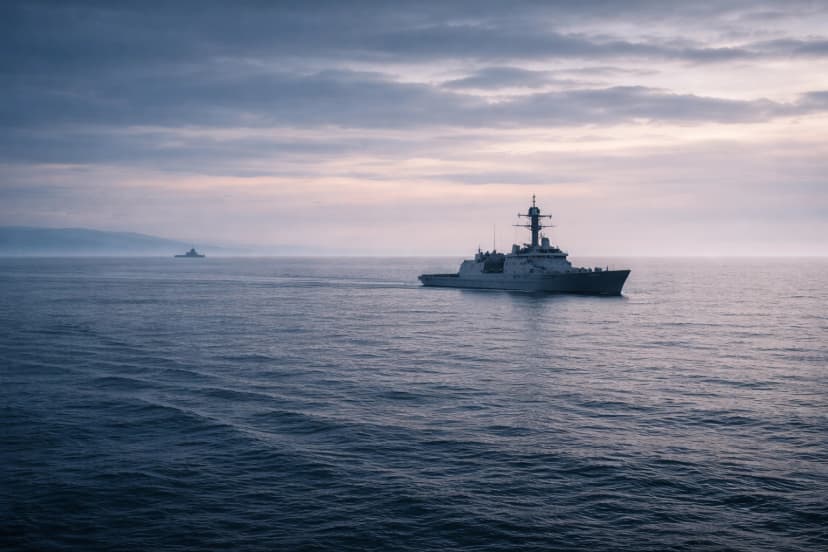
Module 4 treated naval warfare as more than "the Navy's part of the plan." It framed the maritime domain as a logic problem that shapes what the entire joint force can do: where it can go, how long it can stay, what it can sustain, and how much risk it must accept to generate effects across the competition continuum.
At the center of that logic is sea control and sea denial. The course definition is clean and operational: "Sea control is the ability of one's fleet to operate with a high degree of freedom in a sea or ocean area for a limited period of time." (Module 4.3, Objectives of Naval Warfare) The inversion is equally important: sea denial is what a weaker maritime actor uses to raise risk, disrupt access, and challenge a stronger force's freedom to operate. In a fight, that distinction becomes the difference between moving with options and moving with constraints.
The part that stuck with me is that maritime presence is not the same thing as maritime advantage. The materials make the point directly: "A blue-water navy does not obtain sea control through forward presence…" (Module 4.3, Objectives of Naval Warfare) In peacetime, most navies can show up. In crisis and conflict, the problem is whether you can operate—under threat, under friction, under real contestation—and still create conditions that support joint objectives.
That is why the course kept returning to maritime power as an enabling condition for the rest of the force. Sea control is not a naval-centric trophy. It is what makes power projection, amphibious options, and sustainment feasible at the operational level. It is also what underwrites sea lines of communication (SLOCs), which become a joint vulnerability the moment an adversary can credibly contest the maritime domain.
The maritime logic also connects directly to coercion. Naval forces are uniquely useful for signaling and pressure because they can appear, posture, and maneuver without necessarily committing to a large footprint ashore—and they can often withdraw as easily as they arrived. That flexibility is a feature and a limitation. The course's coercion framing captured the intent: "The strategy of coercion seeks to erode an opponent's motivation by exploiting the capacity to inflict damage…" (Session 4.1, Naval Support of Foreign Policy) But credibility matters. If the capability behind the signal is thin, or the sustainment behind the posture is brittle, the signal can collapse into theater.
This is where the integrated naval power idea becomes operationally useful. The Navy, Marine Corps, and Coast Guard are not three separate maritime storylines; they are a set of complementary tools that create different options across competition and conflict. The Navy provides blue-water reach, sea control, strike, and survivable deterrence options. The Marine Corps provides expeditionary and littoral options that can complicate an adversary's targeting and create denial effects closer to shore, but with tighter sustainment and mobility constraints. The Coast Guard adds authorities and a posture that can be decisive in competition and gray-zone contexts where legitimacy, law enforcement, and calibrated escalation matter as much as firepower.
The course also made the tactical-to-operational linkage explicit by breaking naval warfare into concrete disciplines and reminding us that the maritime fight is combined arms. Naval aviation extends reach and speed in a maritime environment. Air and missile defense preserves freedom of action by protecting the force so it can do everything else. Amphibious operations are inherently joint and force planners to respect preconditions: establish local sea control and air superiority, select beaches, and design ship-to-shore movement, fires, and afloat sustainment as an integrated system. Subsurface warfare (and the ASW problem) is a persistent operational headache because submarines and mines impose outsized friction on maneuver and timelines, especially in the littorals.
And none of this is "just maritime." Naval warfare is joint by construction because its dependencies run immediately into other domains. Sea control and denial depend on ISR and targeting, resilient communications, cyber defense and spectrum protection, and (often) land-based airpower and integrated air and missile defense. Logistics is inseparable from maritime operations because fuel, parts, and munitions are not abstractions; they are the pacing factors that determine whether presence can become persistence and whether persistence can become leverage.
If there is one takeaway I would carry forward into planning, it is this: maritime power is not primarily about ships doing ship things. It is about using the sea to create—and deny—freedom of action for the entire joint force, across the full continuum, with credibility that holds up when the environment stops being permissive.
Enabling Functions
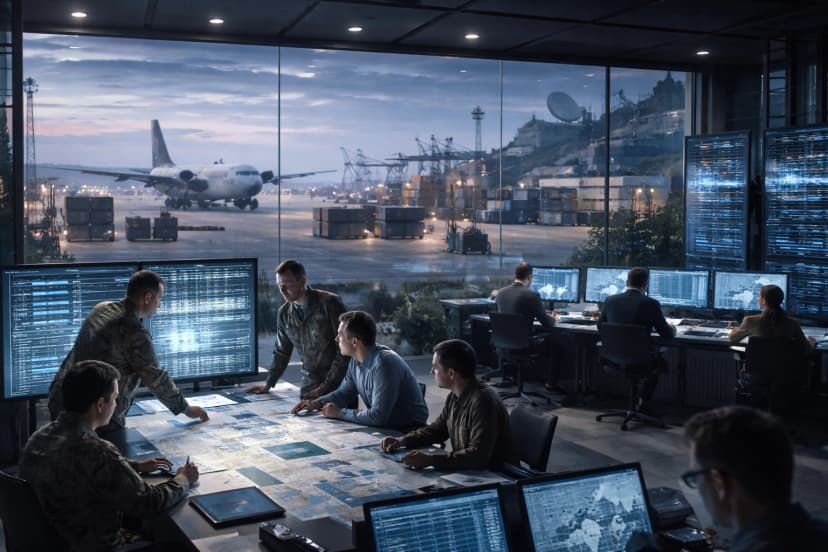
Module 4 quietly makes a planner's point that is easy to miss if you focus on order of battle: the enablers determine feasibility, sequencing, and risk more than the headline combat formations do. A force package can look decisive on paper and still be operationally irrelevant if it cannot deploy on time, integrate on arrival, maintain decision advantage, protect its networks, and stay aligned with a credible narrative.
Start with logistics and sustainment, because it is the constraint that never negotiates. The module frames joint logistics, deployment/redeployment, and operational contract support as core planning problems, not afterthoughts. Joint Reception, Staging, Onward Movement, and Integration (JRSOI) is treated as the critical in-theater process that turns arriving forces into an integrated, combat-capable part of the joint force, and it is often the most complex link between strategic deployment and tactical employment. Strategic mobility itself is presented as a triad—common user airlift, sealift, and prepositioned stocks—because the joint force is constantly trading speed, capacity, and positioning against time and threat. Operational Contract Support (OCS) is similarly double-edged: it can extend reach and responsiveness, but it introduces management, security, legal, and accountability requirements that become friction when planners treat it as "someone else's problem." The key takeaway is stated plainly in your notes: the operational commander's plan is fundamentally constrained by what is logistically feasible, and mobility capacity and speed drive the timeline and scale of force projection. In practice, sustainment is what determines whether the force can keep tempo, endure contact, and still preserve options for redeployment and disengagement when the political end state shifts or the culminating point approaches.
Intelligence is the second "make or break" function because it is how the commander buys time and reduces uncertainty. The course overview emphasizes intelligence as essential in peace and war, describes it as a high-demand/low-density enterprise, and stresses that scarce intelligence resources must be prioritized by commander's intent and guidance. Your notes sharpen that into an operational rule: JIPOE is the foundation for joint planning because adversary COAs developed through JIPOE drive friendly COA development and wargaming; a flawed JIPOE produces a flawed plan. Intelligence also does not exist as a linear pipeline—evaluation and feedback between producers and consumers is part of the process, which is another way of saying the J-2 and the commander have to operate as a system, not as a support queue. In combined operations, intelligence becomes even more constraining because classification, releasability, and partner equities can slow dissemination and fracture a shared picture. The notes emphasize pushing information to the lowest possible classification to maximize access for consumers, including multinational partners.
Information and cyber are where the course forces you to confront credibility and resilience as operational variables. The notes define the information environment as physical, informational, and cognitive dimensions and treat Operations in the Information Environment (OIE) as the integrated use of information-related capabilities to influence behavior and decision-making. That matters because the "say-do gap" is not a communications problem; it is an operational design problem. The doctrine excerpt you captured makes the requirement explicit: "actions are planned and conducted in a way that complements the narrative and avoids a 'say-do gap.'" If actions and narrative diverge, credibility collapses in the cognitive dimension, and tactical success can become strategic loss.
Cyber planning reinforces the same theme: freedom of action is fragile if the networks, data, and access pathways that enable modern C2 and decision-making are not protected and contested deliberately. The notes define cyberspace operations as employing cyberspace capabilities to achieve objectives in or through cyberspace, with Offensive Cyberspace Operations (OCO) projecting power and Defensive Cyberspace Operations (DCO) preserving the ability to use friendly cyberspace capabilities. Your glossary section aligns with that framing and makes DCO's purpose explicit: passive and active operations to preserve friendly cyberspace capability. The planning implication is the point you flagged: cyber cannot be bolted on late. It must be integrated into the scheme of maneuver and protection plan because cyberspace depends on physical infrastructure, and cyber actions can cascade into physical effects and vulnerabilities.
Module 3 language applies here directly: enablers define operational reach and help determine when and where a force will culminate. If lift, sustainment, intelligence flow, and network resilience are not designed early, the plan's ways exceed its means, and risk becomes structural rather than manageable.
The tie-back across all four enablers is what Module 4 keeps insisting on: joint capability is not the sum of Services; it is the ability to integrate functions into a feasible, sequenced plan. Your own course summary captures it cleanly: information is a joint function where narrative alignment matters, and logistics is the pacing function that underpins everything else. That is why planners who obsess over force lists but under-resource JRSOI, treat OCS as an afterthought, assume intelligence will "flow," or ignore the say-do gap are not just taking risk—they are building plans that may never become real.
Operational Integration and Force Design
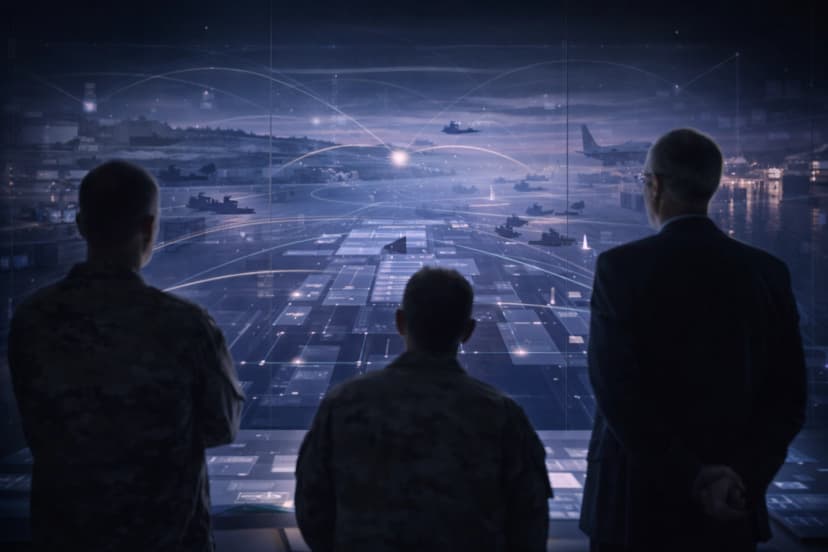
By the end of Module 4, the most useful takeaway was not a better mental catalog of capabilities. It was a repeatable way to assemble a joint and combined capability set without getting seduced by "what we could do" and forgetting "what we can actually sustain, command, and integrate." In other words: a practical integration lens that forces feasibility and risk to the surface early, before a plan hardens around assumptions.
The method is straightforward, but it is unforgiving if you skip steps.
First, define the objective in operational terms and state risk tolerance explicitly. What is the operational problem you must solve, what is the minimum acceptable outcome, and what risks are unacceptable (escalation, chemical use, loss of access, freedom of navigation, partner fracture)? In the North Africa vignette I used for SA-6, the objective was intentionally narrow and decisive: deny an adversary the ability to coerce or seize decisive terrain through a mechanized thrust enabled by submarines, dispersed air forces, and mobile missile coercion. That framing matters because it keeps the force package disciplined: you select capabilities that close specific operational vulnerabilities, not capabilities that look impressive in isolation.
Second, select and sequence forces based on what creates immediate leverage versus what creates endurance later. Sequencing is where planners either preserve options or create a cul-de-sac. Early arrivals should be the high-impact enablers that compress decision timelines, reduce uncertainty, protect critical nodes, and signal credible capability. Follow-on forces should build staying power and the ability to sustain operations if deterrence fails. In SA-6, that logic drove early emphasis on warning and information flow, maritime access and protection of sea movement, rapid air-enabled mobility of key enablers, and only then the heavier land combat power that depends on throughput and mature reception.
Third, confirm authorities and C2 before you commit to a force design that cannot be tasked the way you assume. A force package that requires cross-component synchronization but lacks clear command relationships is a plan built on friction. The practical test is simple: can the commander task the force the way the scheme of maneuver demands, can the staff move information fast enough to support those decisions, and can coalition partners plug in without breaking unity of effort? In SA-6, that drove a lead-nation CJTF construct with functional components (air, maritime, land, SOF) and explicit coalition and host-nation coordination mechanisms to manage intelligence release, ROE alignment, sustainment prioritization, and political constraints.
Fourth, validate lift and sustainment as the reality check on ambition. Strategic mobility is not an implementation detail; it is the governor on tempo, mass, and endurance. If your plan requires heavy formations early but lift and reception capacity cannot support them, the plan is not high risk, it is simply not executable. In the vignette, that meant treating airlift as the fast, capacity-limited way to move high-value enablers and sealift as the slower mechanism that delivers mass once sea lines and ports are sufficiently protected. It also meant designing the early force package to be sea-based and rapidly redeployable where possible, so the joint force preserved disengagement options instead of locking itself into large fixed infrastructure ashore.
Fifth, integrate intelligence, information, and cyber as first-order design requirements. If ISR, dissemination, narrative coherence, and network resilience are supporting, they arrive late and fail early. In SA-6, the operational problem was built around time-sensitive uncertainty: dispersed missile forces, deception, and short warning windows. The solution required an intelligence architecture that could find and track mobile threats, an information posture that stayed aligned with actions (to avoid credibility collapse), and a cyber posture that protected the communications pathways the CJTF depended on for speed of decision.
Sixth, build coalition mechanisms deliberately, not aspirationally. Combined operations magnify both strength and friction. The planner's job is to reduce predictable friction points with structure: liaison networks, coordination centers, intelligence release processes, and logistics prioritization rules that keep partners aligned when stress rises. In SA-6, the CJTF design explicitly included coalition and host-nation coordination elements so the staff could manage the real constraints—information sharing, ROE, sustainment, and political limitations—without slowing operational tempo.
Finally, preserve disengagement and redeployment options from the start. This is not pessimism; it is operational discipline. If national policy shifts, if escalation thresholds change, or if the coalition fractures, the force should be able to reposition and reduce exposure without collapsing the mission. The capstone lesson for me was that disengagement planning is not a final paragraph in the CONOPS. It is a design property of the capability set you choose and the degree of early reliance you accept on large, fixed footprints ashore.
What SA-6 forced me to do—and what Module 4 kept reinforcing—is to treat every capability recommendation as a chain of dependencies with a timeline attached. The joint force does not win by selecting the best capabilities in the abstract. It wins by assembling a capability set that arrives in time, integrates under clear authorities, sustains long enough to matter, and preserves options to escalate, de-escalate, or disengage when policy demands it.
Key Concepts (study guide)

The tables below capture the concepts I kept coming back to throughout Module 4. They are intentionally definition-heavy and written in plain language so they can serve as a quick refresher before assignments or as a reference while drafting plans and recommendations. Where acronyms appear, I spell them out once and keep the acronym for quick recognition.
Strategic context and maritime concepts
| Concept | Definition (plain language) | Why it matters (planner's lens) |
|---|---|---|
| Competition continuum | The operating environment spans cooperation, competition below armed conflict, and armed conflict, often simultaneously rather than in neat phases. | Forces must be postured and designed to transition quickly without organizational resets. |
| Gray zone | Competitive activities below the threshold of armed conflict that exploit ambiguity, coercion, and incremental gains while staying short of clear casus belli. | Many real-world problems live here; credibility, legitimacy, and escalation management drive capability selection. |
| Coercion | Using the credible threat (and limited application) of force to shape an opponent's behavior without uncontrolled escalation. | Presence only matters if it creates believable options and leverage. |
| Deterrence | Preventing action by convincing an adversary the costs outweigh benefits (by denial, punishment, or both). | Determines what capabilities must be visible, survivable, and rapidly employable. |
| Escalation management | Deliberately controlling signals, actions, and thresholds to avoid inadvertent escalation while preserving freedom of action. | Affects force posture, rules of engagement (ROE), information messaging, and sequencing. |
| Sea control | Ability to operate with a high degree of freedom in a maritime area for a limited time. | Enables power projection, sustainment, and maritime maneuver. |
| Sea denial | Preventing an adversary from controlling or freely operating in a maritime area. | Shapes access, increases risk, and constrains timelines for the joint force. |
| Power projection | Applying military power from one domain into another (often sea/air to land) to achieve objectives. | Dependent on access, command and control (C2), intelligence/surveillance/reconnaissance (ISR), sustainment, and protection. |
| Sea lines of communication (SLOCs) | Maritime routes used for military and economic movement. | Vulnerabilities here can determine operational endurance and strategic leverage. |
| Amphibious operations | Operations launched from the sea onto land requiring integrated naval, ground, and air components. | Integration-intensive; demands local sea/air control and robust sustainment design. |
| Littorals | Coastal zones where land, sea, and air effects overlap and friction intensifies. | Often decisive terrain for access, denial, and political signaling. |
Joint force organization and authorities
| Concept | Definition (plain language) | Why it matters (planner's lens) |
|---|---|---|
| Joint Force Commander (JFC) | Commander with authority to employ joint forces to accomplish a mission. | Owns integration, prioritization, and risk decisions across components. |
| Joint Task Force (JTF) | A joint force created for a specific mission, typically temporary and purpose-built. | The normal construct for focused operations; built for the problem, not permanence. |
| Combined Joint Task Force (CJTF) | A JTF that includes multinational partners under a combined headquarters. | Enables unity of effort in coalitions, but increases coordination and interoperability demands. |
| Service component | A component organized by Service (Army, Navy, Air Force, Marine Corps, Space Force). | Useful when Service expertise and sustainment systems are central. |
| Functional component | A component organized by function (Air, Land, Maritime, Special Operations). | Useful when cross-Service integration is needed around a single operational function. |
| Combatant command (command authority) (COCOM) | Nontransferable command authority over assigned forces held by a combatant commander. | Defines top-level authority boundaries and what can be delegated. |
| Operational control (OPCON) | Authority to organize and employ forces for assigned missions and direct tasking. | Often determines whether a scheme of maneuver is executable. |
| Tactical control (TACON) | Limited authority to direct movements or maneuvers for a mission or task. | Enables tactical control without full operational authority. |
| Support | A relationship where one force aids, protects, complements, or sustains another. | Clarifies who is "supported" and who is "supporting," reducing friction. |
| Unity of command | One commander with authority over all forces toward a common objective. | Ideal but often constrained in multinational operations. |
| Unity of effort | Coordinated effort toward a common objective even without unity of command. | The practical goal in most coalitions; requires deliberate coordination mechanisms. |
Enabling functions (logistics, intelligence, information, cyber)
| Concept | Definition (plain language) | Why it matters (planner's lens) |
|---|---|---|
| Strategic mobility triad | Common-user airlift, sealift, and prepositioned stocks used to move and position forces. | Governs speed vs mass and shapes the deployment timeline. |
| Joint reception, staging, onward movement, and integration (JRSOI) | The in-theater process that receives forces, stages them, moves them to employment areas, and integrates them into the joint force. | Turns arrivals into usable combat power; often the hinge between plan and reality. |
| Sustainment | Providing support to maintain operations until mission completion and through redeployment. | Sets operational reach, tempo, and endurance; can culminate operations. |
| Operational contract support (OCS) | Contracted support integrated into operations (supplies, services, construction). | Extends capability but adds legal, security, and management complexity. |
| Joint intelligence preparation of the operational environment (JIPOE) | Joint process to analyze the operational environment and develop adversary capabilities and courses of action (COAs). | Drives friendly COA development and wargaming; errors cascade into flawed plans. |
| Intelligence, surveillance, and reconnaissance (ISR) integration | Aligning collection, processing, exploitation, and dissemination to commander priorities and timelines. | Produces decision advantage only if aligned to intent and time constraints. |
| Information environment | Physical, informational, and cognitive dimensions where perceptions and decisions are shaped. | Misalignment between actions and narrative undermines legitimacy and influence. |
| Operations in the information environment (OIE) | Integrated use of information-related capabilities (IRCs) to influence, disrupt, corrupt, or usurp adversary decision-making while protecting friendly decision-making. | Must be planned with operations to avoid a "say-do gap." |
| Cyberspace operations | Use of cyberspace capabilities to achieve objectives in or through cyberspace. | Protects C2 and decision pathways; enables or denies freedom of action. |
| Defensive cyberspace operations (DCO) | Operations to preserve friendly cyberspace capability (passive and active defense). | Prevents mission degradation and protects tempo and resilience. |
| Offensive cyberspace operations (OCO) | Operations to project power and create effects in/through cyberspace. | Can disrupt adversary systems and shape conditions for other domains. |
Multinational integration (structures and recurring friction points)
| Concept | Definition (plain language) | Why it matters (planner's lens) |
|---|---|---|
| Alliance | Formal, enduring relationship with established commitments and mechanisms. | Often improves interoperability and predictability compared to ad hoc coalitions. |
| Coalition | Temporary arrangement of nations for a specific purpose, often with varied capabilities and constraints. | Adds capacity and legitimacy but increases coordination requirements. |
| Lead nation construct | One nation provides the commander and core headquarters, and partners integrate under that structure. | Simplifies decision-making and tempo, but requires trust and clear national caveats management. |
| Parallel command | Nations fight alongside each other with separate national chains of command, coordinated through liaison and coordination mechanisms. | Preserves sovereignty and caveats, but can slow unity of effort and complicate synchronization. |
| Integrated command | Partners place forces under a combined commander with integrated staff and processes (closest to unity of command). | Improves unity of effort and interoperability, but is politically and legally harder to establish. |
| Interoperability | Ability to operate together effectively (technical, procedural, and human). | Determines whether partners can share information, coordinate fires, and sustain operations. |
| Rules of engagement (ROE) alignment | Reconciling national restrictions and legal authorities into usable ROE across the force. | Misalignment slows tempo and can fracture unity of effort. |
| Information sharing / releasability | What can be shared with which partners at what classification and speed. | Shapes the "shared picture" and can limit integrated targeting and decision-making. |
| Liaison networks | People and processes that connect commands and partners for coordination. | Often the difference between friction and flow in combined operations. |
| Host-nation support (HNS) | Support from the host nation (access, basing, services, permissions). | Can be decisive for sustainment and legitimacy; can also be a critical vulnerability. |
| Burden sharing | Distribution of costs, risks, and responsibilities among partners. | Sustains coalitions over time and reduces strategic overstretch. |
Assignments
Module 4 was assessment-heavy in the best way: each submission forced me to apply the same core ideas from different angles. The formative assessments reinforced the fundamentals (competition framing, maritime theory, and C2 design), while the discussion boards sharpened the "planner's voice" by testing how well I could explain capabilities, constraints, and integration tradeoffs. The capstone (SA-6) pulled everything together into a coherent joint/combined capability recommendation.
| Assignment | Description | Download |
|---|---|---|
| SA #6: North Africa Vignette | Capstone written assessment applying Module 4 joint capabilities: assemble a feasible joint/combined capability set for the North Africa scenario, justify choices, sequencing, risk, and integration across domains and enabling functions. | Download |
| Formative Assessment 13 | Formative write-up reinforcing early Module 4 concepts (competition continuum framing and implications for joint force employment and capability choices). | Download |
| Formative Assessment 14 | Formative write-up focused on naval theory and maritime concepts (how naval power creates leverage, freedom of action, and operational options). | Download |
| Formative Assessment 15 | Formative write-up focused on multinational C2 design and joint task organization (authorities, HQ relationships, integration considerations). | Download |
| DBF 4.1: Military Operations and the Competition Continuum | Discussion post analyzing how operations align across the competition continuum and what that means for joint force posture, signaling, and escalation management. | Download |
| DBF 4.2: Naval Theory | Discussion post applying naval theory to operational problems (sea control/denial, maritime strategy, and coercion). | Download |
| DBF 4.3: U.S. Naval Capabilities | Discussion post surveying U.S. naval capability contributions, constraints, and dependencies in joint operations. | Download |
| DBF 4.4: USCG / USMC Capabilities | Discussion post comparing Coast Guard and Marine Corps roles in competition and conflict, including authorities, access, and expeditionary employment. | Download |
| DBF 4.5: Logistics | Discussion post focused on logistics as an operational constraint (mobility, sustainment, distribution, OCS, and how logistics shapes COA feasibility). | Download |
| DBF 4.6: INTEL, INFO & CYBER | Discussion post integrating intelligence, information, and cyber as enabling functions that shape decision advantage, credibility, and freedom of action. | Download |
Conclusion
Module 4 reinforced a simple but demanding truth: joint capability is not the sum of Service contributions. It is the ability to assemble a force that can deploy, integrate, command, sustain, and adapt across the competition continuum under real constraints. The course material consistently pushed past platform-level thinking and forced a planner's discipline—define the operational objective, design the force and C2 to achieve it, validate lift and sustainment, integrate intelligence and information, and treat cyber resilience as a prerequisite for decision speed rather than a technical detail.
The most lasting shift in my own thinking was how quickly "good ideas" become non-executable when enablers are assumed. Mobility and JRSOI (joint reception, staging, onward movement, and integration) dictate what arrives when. Sustainment dictates how long you can keep tempo. Intelligence dictates whether you can see and anticipate adversary options fast enough to stay inside their decision cycle. Information coherence determines whether your actions strengthen legitimacy or create a damaging say-do gap. Cyber defense determines whether the C2 pathways you depend on remain functional when contested. In combination, these are not supporting functions—they are the feasibility engine of the operation.
Module 4 also sharpened how I think about maritime power in joint terms. Maritime theory and the objectives of naval warfare are not simply "Navy topics." Sea control and sea denial shape access, sustainment, and the ability to create strategic leverage without immediately committing to large footprints ashore. Maritime options remain uniquely valuable across the gray zone and into armed conflict precisely because they can be calibrated, repositioned, and integrated with other joint functions—if the dependencies are addressed deliberately.
Finally, the capstone work (SA-6) made the integration lesson unavoidable. A credible capability recommendation is a chain of dependencies with a timeline attached. If the force design cannot be tasked under the right authorities, cannot be integrated through a workable C2 construct, cannot be moved and sustained at the required pace, or cannot operate inside a coherent intelligence and information architecture, then it is not a plan—it is aspiration.
Key takeaways
- Joint capability is a system-of-systems problem, not a catalog of Service strengths.
- The competition continuum and gray-zone dynamics demand credible options short of war, not just warfighting capacity.
- Command relationships and C2 design shape tempo and feasibility as much as combat power.
- Logistics, mobility, and sustainment are pacing constraints that determine operational reach and endurance.
- Intelligence and ISR integration are decision advantage only when aligned to commander intent and coalition realities.
- Information coherence matters operationally; avoiding a say-do gap is part of credibility and legitimacy.
- Cyber resilience is a prerequisite for modern C2 and must be integrated from the start.
- Maritime theory matters because sea control/denial underwrites access, sustainment, and strategic flexibility.
Module 4 closed later than planned, but the delay did not dilute the lesson. If anything, the stop-and-start cadence underscored the course's point: operations rarely unfold as a clean sequence. The force that succeeds is the one assembled with clarity of purpose, disciplined integration, and options preserved for escalation, de-escalation, and disengagement.
To close out Module 4, it is hard not to look forward to the final block of JPME Phase I: Module 5, Joint Planning Process (JPP). The promise of the module is straightforward: take everything we have covered so far—operational art, joint capabilities, maritime theory, authorities, C2, logistics, intelligence, information, cyber, and coalition realities—and force it into practical application. The format shift matters too. Module 5 leans heavily into group work, which is new for many of us, and it mirrors the real-world truth that joint planning is a team sport. We will work through the seven steps of the JPP (per JP 5-0 and the NWC 4111K workbook) to develop and compare courses of action, recommend a way ahead, and translate that decision into the product that ultimately matters: a Joint Task Force OPORD. If Module 4 taught that capability only becomes real through disciplined integration, Module 5 is where we prove we can do it—under time, uncertainty, and the friction that comes with building a coherent plan in a maritime joint operations area.
See the associated LinkedIn post.
Comments
To leave feedback or questions, simply login using your preferred social network. I will read and answer your comments promptly, but please keep in mind that they will be public.