

Introduction
In the ever-evolving world of technology, staying current is not just an option but a necessity. Recently, I took on the challenge of earning the AWS Certified Cloud Practitioner certification, a credential that highlights one's fundamental understanding of IT services and their applications within the AWS Cloud. This certification demonstrates cloud fluency and a solid grasp of foundational AWS knowledge, enabling professionals to identify essential services crucial for setting up AWS-centric projects.
So, why did I choose to pursue this certification? Over the past several years, I've observed a significant trend within the Department of Defense (DoD): recruiting and retaining cloud solutions engineers has become increasingly challenging. The demand for these experts is skyrocketing, and unfortunately, we often can't match the lucrative offers from the private sector. While this topic warrants a deeper dive in a future post, the pressing need for cloud expertise in the DoD inspired me to refresh and solidify my own skills. As the "glue" on many teams, I knew I could help bridge this gap.
Interestingly, this certification journey felt like revisiting an old friend. I've been working with AWS since its inception, and when I went to create an account for free tier services, I discovered I still had an active one from over 13 years ago! Despite my familiarity, I embraced this certification as a valuable refresher and an opportunity to see how much AWS has evolved.
This achievement is just the beginning of my plan to acquire several more AWS certifications this year. Thanks to some excellent online courses, exam vouchers, and practice tests funded by the government, I'm well on my way.
In this blog post, I'll share the resources I used, the topics the exam covers, and some recommendations for anyone looking to embark on this certification journey. Let's dive into the cloud together!
AWS Certified Cloud Practitioner (CCP) CLF-C02 Exam Areas
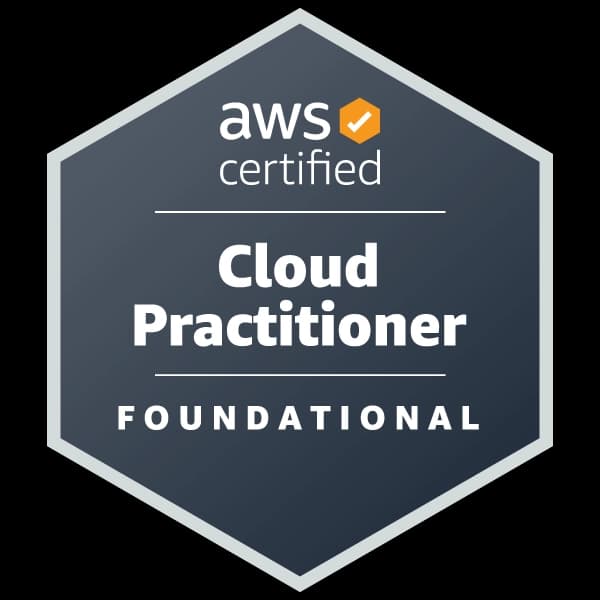
The AWS Certified Cloud Practitioner certification is designed to validate your understanding of the AWS Cloud, including its core services, benefits, basic architecture, and its impact on business. The exam covers a broad range of topics, ensuring that you have a foundational grasp of the AWS ecosystem. The exam consists of multiple-choice and multiple-response questions, and may include unscored content that does not affect your overall score.
The exam covers four key domains:
- Cloud Concepts (24%): Basic cloud principles and AWS infrastructure.
- Security and Compliance (30%): Security measures and compliance programs.
- Cloud Technology and Services (34%): Core AWS services and technologies.
- Billing, Pricing, and Support (12%): AWS pricing models and support plans.
Let's dive into each area to give you a sense of what to expect and what you need to know.
Domain 1: Cloud Concepts
Understanding cloud concepts is vital for leveraging AWS effectively.
- Benefits of AWS Cloud: AWS offers cost savings through economies of scale, global reach, and high availability and scalability. For instance, Amazon EC2 scales resources based on demand, ensuring optimal performance.
- Design Principles: The AWS Well-Architected Framework emphasizes operational excellence, security, reliability, performance efficiency, cost optimization, and sustainability. Using Amazon S3 for scalable storage and Amazon RDS for managed databases exemplifies these principles.
- Migration Strategies: The AWS Cloud Adoption Framework (CAF) supports migration with strategies like database replication and tools like AWS Snowball, reducing business risk and enhancing operational efficiency.
- Cloud Economics: AWS's pay-as-you-go model shifts costs from fixed to variable, allowing precise cost management. Tools like AWS Cost Explorer help forecast and manage expenses effectively.
By mastering these concepts, you'll be prepared to leverage AWS's full potential for innovative and cost-effective solutions.
Domain 2: Security and Compliance
Security and compliance are paramount in the AWS Cloud, ensuring that your data and applications are protected.
- Shared Responsibility Model: AWS and customers share security responsibilities. AWS handles security "of" the cloud (infrastructure, hardware), while customers manage security "in" the cloud (data, applications).
- AWS Security Services: Key services include AWS Identity and Access Management (IAM) for access control, AWS Key Management Service (KMS) for encryption, and Amazon GuardDuty for threat detection. For example, IAM enables the creation of fine-grained permissions for users and roles, ensuring the principle of least privilege is applied.
- Compliance and Governance: AWS provides tools like AWS Artifact for accessing compliance reports and AWS Config for monitoring resource configurations. Using AWS Shield and AWS WAF, you can protect against DDoS attacks and filter malicious traffic.
- Access Management: IAM supports secure access through multi-factor authentication (MFA) and credential management. AWS IAM Identity Center (AWS Single Sign-On) simplifies user access across multiple AWS accounts and applications.
By understanding these security and compliance fundamentals, you'll ensure robust protection and governance for your AWS environment.
Domain 3: Cloud Technology and Services
Mastering AWS's cloud technology and services is crucial for deploying and managing applications effectively.
- Deployment and Operation: AWS offers various deployment methods, including the AWS Management Console, CLI, and infrastructure as code (IaC) with AWS CloudFormation. For instance, you can deploy a web application using Elastic Beanstalk with minimal setup.
- Global Infrastructure: AWS's global infrastructure includes Regions, Availability Zones, and edge locations, ensuring low latency and high availability. Utilizing multiple Availability Zones enhances fault tolerance.
- Compute Services: AWS provides various compute services such as EC2, Lambda, and ECS. EC2 is ideal for scalable virtual servers, while Lambda supports serverless computing for event-driven applications.
- Database Services: AWS's database offerings include RDS for relational databases, DynamoDB for NoSQL, and Redshift for data warehousing. RDS supports various database engines and automates administrative tasks.
- Networking Services: AWS VPC allows you to define isolated networks within the AWS Cloud. Services like Route 53 for DNS management and CloudFront for content delivery enhance network performance and security.
- Storage Services: AWS offers robust storage solutions like S3 for object storage, EBS for block storage, and EFS for file storage. S3's different storage classes optimize costs based on access frequency.
- AI/ML and Analytics Services: AWS provides powerful AI/ML services like SageMaker for building machine learning models and analytics services like Athena for querying data in S3.
- Other In-Scope Services: AWS offers additional services for various business needs, including application integration (EventBridge, SNS, SQS), business applications (Connect, SES), customer engagement (AWS Activate, AMS), developer tools (CodePipeline, Cloud9), end-user computing (WorkSpaces, AppStream 2.0), frontend and mobile development (Amplify), and IoT management (IoT Core, Greengrass). These services enable seamless integration, development, and management of applications across different business domains.
By understanding these services, you can architect and manage efficient, scalable, and cost-effective cloud solutions on AWS.
Domain 4: Billing, Pricing, and Support
Understanding AWS's billing, pricing, and support options is essential for cost management and efficient resource use.
- Pricing Models: AWS offers various pricing models, including On-Demand, Reserved Instances, and Spot Instances. Each model caters to different usage patterns and can help optimize costs.
- Cost Management: Tools like AWS Cost Explorer, AWS Budgets, and the AWS Pricing Calculator enable precise cost tracking and forecasting. For instance, AWS Budgets allows you to set custom cost and usage limits to prevent overspending.
- Support Plans: AWS provides multiple support plans, from Basic to Enterprise, each offering different levels of assistance and resources. AWS Trusted Advisor and AWS Support Center provide insights and help manage resources effectively.
By leveraging these tools and understanding pricing models, you can ensure efficient cost management and receive the necessary support for your AWS projects.
Preparation and Learning
Embarking on the journey to achieve the AWS Certified Cloud Practitioner certification required a mix of dedication, strategic planning, and the right resources. While Amazon offers a plethora of free resources like the AWS Cloud Practitioner Essentials course, I chose a different path. My primary study resource was the "Ultimate AWS Certified Cloud Practitioner CLF-C02" course by Stephane Maarek on Udemy. This course stood out for its comprehensive coverage of the new CLF-C02 exam topics and practical insights into using AWS. It emphasized hands-on learning with the AWS Free Tier, followed a logical progression of topics, and included numerous quizzes and a full practice exam. With over 300 slides available for download, professional subtitles, and a fast-paced, to-the-point teaching style, it proved to be an invaluable resource.
In addition to the Udemy course, I utilized the AWS Certified Cloud Practitioner Practice Exams CLF-C02 (2024) from Tutorials Dojo. This resource is highly recommended due to its structured exam modes—timed, review, section-based, and final tests. Each question came with detailed explanations, reference links, and even cheat sheets. The inclusion of flashcards and an active Q&A discussion board provided extra support and clarity on key topics. The constant updates based on student feedback ensured the material remained current and relevant.
To further reinforce my knowledge, I reviewed the AWS Cloud Practitioner Study Notes (CLF-C02) available on GitHub. These notes provided a concise and well-organized overview of essential concepts, serving as an excellent supplementary resource. This thorough preparation strategy not only solidified my understanding of AWS but also built the confidence needed to excel in the exam.
For those interested in my detailed notes and study materials, I've made them available for download here. These resources more than ensured I was prepared and ready for the AWS Cloud Practitioner exam.
Taking the Exam
I scheduled my AWS Certified Cloud Practitioner exam at the Pearson VUE testing center at West Chester University, my alma mater. Returning to campus brought back fond memories. Although there's an option to take the exam online from home, I read it could be unreliable, so I opted for the testing center.
The exam cost $100, but I had a voucher from work. After checking in, signing forms, and securing my belongings in a locker, I entered the testing room, shared with others taking various exams. The room had a gentle white noise hum from the computers, so I didn't need the supplied earplugs or headphones.
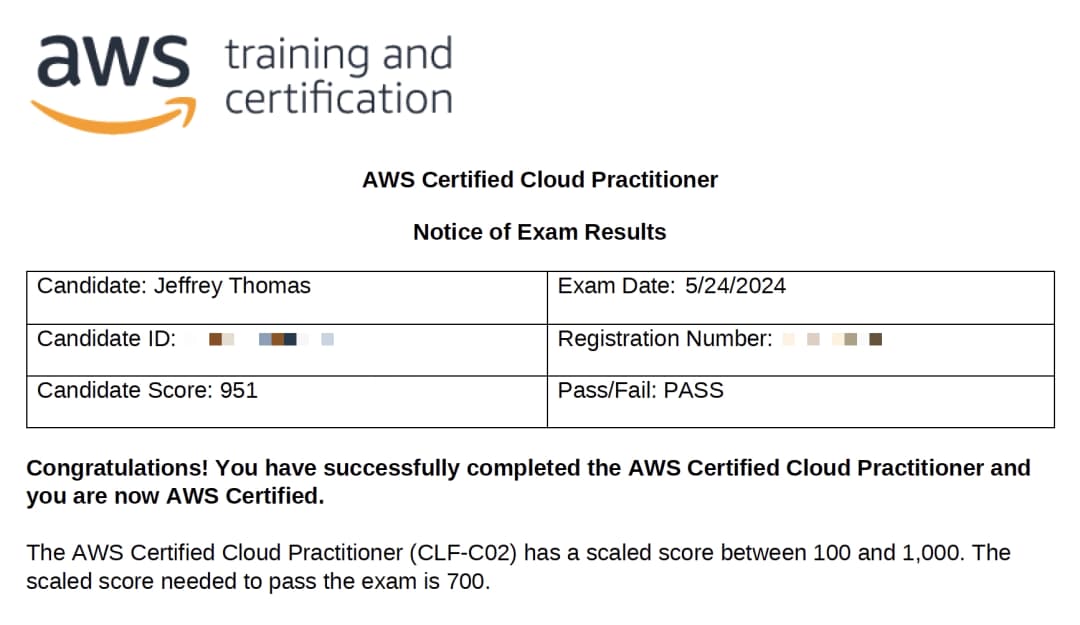
During the exam, I could flag questions for review. After answering all the questions, I completed a short survey. Upon finishing, I received a PASS result immediately, and a few hours later, an email with my score of 951 out of 1000, detailing my proficiency in each domain.
Conclusion
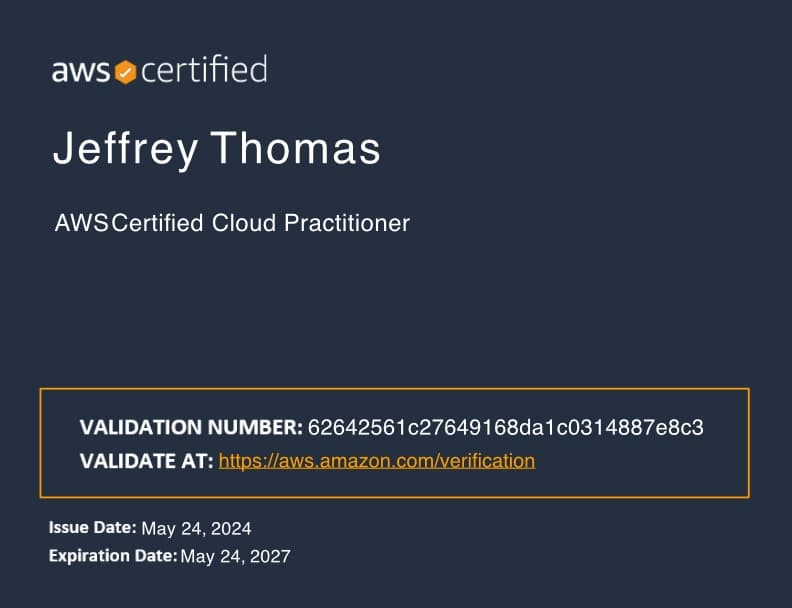
Achieving the AWS Certified Cloud Practitioner certification was a rewarding journey that reaffirmed my foundational knowledge of AWS and its vast ecosystem. This certification, beyond being a testament to cloud fluency, highlights the importance of continuous learning and adaptation in the ever-evolving field of technology. Through a combination of comprehensive courses, practice exams, and study notes, I was able to prepare thoroughly and succeed on the first attempt.
This experience not only equipped me with valuable skills but also underscored the growing need for cloud expertise within the Department of Defense. As cloud technology continues to advance, staying current is crucial for leveraging its full potential in both public and private sectors.
For those interested in pursuing this certification, I highly recommend the resources I used, including the Udemy course by Stephane Maarek, Tutorials Dojo practice exams, and the GitHub study notes. These tools were instrumental in my preparation and can significantly aid anyone looking to achieve the AWS Cloud Practitioner certification.
Verify My Credential
You can verify my AWS Certified Cloud Practitioner certification through Credly or directly via AWS Verification using my verification number. To check my credential, visit the Credly verification page or use the AWS Certification Verification tool. This will confirm the authenticity of my certification and provide additional details about my AWS Cloud Practitioner status.
This certification is just the first foundational step in my AWS cloud certification journey. Next, I plan to obtain the AWS Solutions Architect - Associate certificate to further deepen my expertise and expand my skill set in architecting robust and scalable cloud solutions.
By sharing my journey and resources, I hope to inspire and guide others on their path to certification and cloud proficiency. Let's continue to embrace learning and innovation in the cloud!
See the associated LinkedIn post.
Comments
To leave feedback or questions, simply login using your preferred social network. I will read and answer your comments promptly, but please keep in mind that they will be public.