

Introduction
Welcome back to the AI, ML & GenAI Demystified Series. If you've made it to Part 7, take a bow. Most folks get stuck somewhere between "AI is just a chatbot" and "it's definitely going to kill us." But not you. You've followed this series all the way through—from first principles to fine-tuning, from theory to threat assessment. And now? Now we land in the cloud.
This final post brings it all together: models, methods, metrics, and meaning—grounded in the actual platforms that power it all. AWS, Azure, and Google Cloud aren't just hosting environments. They shape how AI is built, governed, and scaled.
Before we dive in, here's a quick recap of where we've been:
- Part 1: Foundations of AI
What AI is, what it isn't, and why it matters more than the hype. - Part 2: Should AI Solve This?
On problem framing, solution fit, and when not to reach for machine learning. - Part 3: Good Data Beats Clever Models
A deep dive into data quality, bias, and the critical role of feature engineering. - Part 4: Training Day
Transformers, diffusion, transfer learning—how modern models actually get trained. - Part 5: Judgment Day
Evaluation, fairness, robustness, and trust. Because deploying without metrics is reckless. - Part 6: Skynet Activation
We explored autonomous agents, tool use, and the wild frontier of emergent AI behavior.
Now, in Part 7: Cloud Native Foundations, we step behind the curtain and look at where all of this actually runs. Cloud platforms don't just provide compute—they define your AI maturity curve, your tooling limits, and your operational guardrails. You'll get:
- A side-by-side breakdown of AWS, Azure, and Google Cloud's GenAI ecosystems
- A guide to how each platform supports the full AI/ML lifecycle
- A behind-the-scenes look at my journey earning all three foundational AI certifications in summer 2025—and what each one teaches differently
If the earlier posts were about ingredients, techniques, and recipes—this one is the kitchen itself. The heat source. The fire. The tooling that scales your side project into a production-grade AI capability.
So welcome to the final chapter. You didn't just learn how AI works. You learned how to use it well.
And if you've read this far through the entire AI, ML & GenAI Demystified Series—you're not just AI-ready. You're cloud-ready.
Let's finish strong.
Cloud Provider Services
Before you build anything with AI, you need to know what tools are in the box—and in the cloud, that toolbox is massive.
Each major cloud provider—AWS, Microsoft Azure, and Google Cloud—offers a full suite of AI and ML services covering everything from prebuilt APIs and foundation models to full-lifecycle platforms, vector databases, and RAG orchestration frameworks. While they often overlap in capability, they differ in emphasis, integration style, and user experience. Understanding those differences isn't just useful for deployment decisions—it's also key if you're pursuing certification.
Exam Tip Each of the AI certifications—AWS Certified AI Practitioner, Azure AI Fundamentals, and Google Cloud Generative AI Leader—will test your knowledge of that provider's services. You won't need to dive deep into the APIs or infrastructure, but you will need to know what each service does, how it's typically used, and where it fits in the AI/ML lifecycle.
In the following sections, we'll break down the service ecosystems of all three providers. We'll focus on:
- What each service does
- Which modalities it supports (text, image, code, etc.)
- How it handles customization, integration, and responsible AI
- Whether it supports edge deployment or retrieval-augmented generation (RAG)
Let's start with AWS. Their AI offerings center on Amazon SageMaker and Bedrock—but there's a whole lot more under the hood.
AWS
AWS offers one of the most comprehensive AI/ML ecosystems in the cloud. Whether you're experimenting with generative AI, deploying production-ready pipelines, or integrating prebuilt services for NLP, vision, or recommendations, AWS has a tool for nearly every level of the ML stack.
The flagship platform is Amazon SageMaker, which enables full-code custom model development, training, and MLOps. But AWS also provides no-code GenAI access through Amazon Bedrock, and a wide range of pretrained services for vision, language, and speech.
Exam Tip The AWS Certified AI Practitioner (AIF-C01) exam won't quiz you on SDK syntax—but you'll be expected to identify the right AWS service for a scenario, know which services are fully managed vs. customizable, and recognize what modalities each one supports.
Below, services are grouped by ML Pathway—from simple API calls to full custom model development. Each service is labeled for AI Type (Traditional, GenAI, or Both), and exam-aligned prompts are shown in the final column.
ML Pathway 1: Pretrained APIs
These services are fast, plug-and-play, and require no training. Ideal for well-scoped use cases with structured inputs and predictable outputs.
| Service | Function / Use Case | Modality | Customization | Integration | Pricing Model | Responsible AI | Edge Ready | RAG/Grounding | AI Type | What the Exam May Ask |
|---|---|---|---|---|---|---|---|---|---|---|
| Amazon Rekognition | Image/video detection, moderation | Image, Video | No | API | Usage-based | No | Yes | No | Traditional | Identify service for facial recognition or moderation |
| Amazon Comprehend | Sentiment, entity, language detection | Text | Yes (custom classes) | API | Usage-based | Limited | No | No | Traditional | Use case for text classification or key phrase extraction |
| Amazon Textract | OCR and form processing | Text, Image | No | API | Usage-based | No | No | No | Traditional | Service for extracting data from documents |
| Amazon Transcribe | Audio-to-text | Audio | Yes (vocabularies) | API | Usage-based | No | Yes | No | Traditional | Convert meeting recordings to transcripts |
| Amazon Polly | Text-to-speech | Text | Voice selection | API | Usage-based | No | Yes | No | Traditional | Add narration or speech output |
| Amazon Translate | Multilingual translation | Text | Yes | API | Usage-based | No | No | No | Traditional | Real-time translation needs |
| Amazon Fraud Detector | Transaction-level fraud detection | Tabular | No | API | Usage-based | Optional HITL | No | No | Traditional | Identify fraud detection tool |
| Amazon Personalize | Custom recommendations | Tabular | Yes | API, SDK | Usage-based | No | No | No | Traditional | Recommend products for a user |
| Amazon Kendra | Semantic document search | Text | Yes | API, GUI | Usage-based | No | No | Yes | Both | Find relevant documents using semantic search |
ML Pathway 2: Foundation Model APIs
You interact with foundation models using natural language prompts. Fast to prototype, best for creative, flexible, and generative tasks.
| Service | Function / Use Case | Modality | Customization | Integration | Pricing Model | Responsible AI | Edge Ready | RAG/Grounding | AI Type | What the Exam May Ask |
|---|---|---|---|---|---|---|---|---|---|---|
| Amazon Bedrock | Access to Titan, Claude, Mistral via API | Text, Code, Image | Prompting, fine-tune | API | Token-based | Bedrock guardrails | No | Yes (via Kendra + Agents) | GenAI | Choose a GenAI service for summarization or chat |
| Amazon Q | Business assistant, IDE helper | Text | Prompt config | Console, IDE | Usage-based | Bedrock-based | No | Yes | GenAI | Tool for enterprise assistant or DevOps chatbot |
| PartyRock | No-code GenAI app builder | Text, Image | Prompting only | GUI | Free | None | No | No | GenAI | Rapid prototyping of GenAI use cases |
ML Pathway 3: Fine-Tuned Foundation Models
Use your own data to fine-tune a model for domain-specific tasks.
| Service | Function / Use Case | Modality | Customization | Integration | Pricing Model | Responsible AI | Edge Ready | RAG/Grounding | AI Type | What the Exam May Ask |
|---|---|---|---|---|---|---|---|---|---|---|
| Amazon Bedrock | Fine-tune foundation models | Text, Code, Image | Yes | API | Token-based | Guardrails | No | Yes | GenAI | Select a service for GenAI fine-tuning |
| Amazon SageMaker | Full pipeline: data to deployment | All | Full control | API, SDK, GUI | Usage-based | Clarify, Model Monitor | SageMaker Neo | Partial (custom) | Both | Build, deploy, and monitor a custom model |
| Amazon A2I | Add human review to sensitive AI outputs | Text, Image | Integrated workflow | API / SageMaker | Usage-based | HITL | No | No | Both | Identify HITL workflow service |
ML Pathway 4: AutoML
Low-code, guided model building for structured data. Not used for GenAI.
| Service | Function / Use Case | Modality | Customization | Integration | Pricing Model | Responsible AI | Edge Ready | RAG/Grounding | AI Type | What the Exam May Ask |
|---|---|---|---|---|---|---|---|---|---|---|
| SageMaker Autopilot | AutoML for regression/classification problems | Tabular, Image | Limited | API, SDK | Usage-based | Clarify (opt-in) | No | No | Traditional | Choose AutoML for structured business data |
Pathway 5: Custom ML (Full Control)
Code-first, high-flexibility environment for ML teams.
| Service | Function / Use Case | Modality | Customization | Integration | Pricing Model | Responsible AI | Edge Ready | RAG/Grounding | AI Type | What the Exam May Ask |
|---|---|---|---|---|---|---|---|---|---|---|
| Amazon SageMaker | Full lifecycle ML, bring your own model | All | Full | API, SDK, CLI, GUI | Usage-based | Clarify, Model Cards | SageMaker Neo | Optional (custom) | Both | Use case for custom model training pipeline |
| Amazon EMR | Scalable ML data prep using Spark/Hadoop | Tabular, Text | Full | Apache ecosystem | Usage-based | No | No | No | Traditional | Processing large data sets for ML pipelines |
Once you've chosen your modeling approach, you'll still need the supporting services to handle data storage, security, compliance, and compute orchestration. These services are also in-scope for the exam and come up frequently in real-world AI/ML workflows.
AWS Supporting Services
These services aren't responsible for building or running models directly—but they enable, secure, monitor, and scale the AI/ML workflows that do. Every one of them is in-scope for the AIF-C01 exam, especially in scenario-based questions where you need to choose the right supporting infrastructure.
| Service | Function / Use Case | Category | What the Exam May Ask |
|---|---|---|---|
| Amazon S3 | Store raw data, training sets, models, logs | Data Storage & Integration | Choose a storage layer for ML workloads |
| Amazon S3 Glacier | Long-term, low-cost archival storage | Data Storage & Integration | Select a cold storage option for infrequent ML data access |
| Amazon DynamoDB | NoSQL database for fast reads/writes | Data Storage & Integration | Use case for real-time inference storage |
| Amazon RDS | Managed relational database (SQL) | Data Storage & Integration | Store structured ML inputs or outputs |
| Amazon DocumentDB | Managed document database (MongoDB-compatible) | Data Storage & Integration | Pick a NoSQL document store for ML pipeline |
| AWS Lake Formation | Create and manage secure data lakes | Data Storage & Integration | Enable a governed ML-ready data lake |
| AWS Data Exchange | Marketplace for licensed datasets | Data Storage & Integration | Import third-party datasets into ML pipelines |
| AWS IAM | Identity and access control | Security & Compliance | Set fine-grained access policies for ML services |
| AWS CloudTrail | Log API activity across services | Security & Compliance | Track who accessed what in an ML pipeline |
| AWS Config | Track and evaluate resource configurations | Security & Compliance | Ensure resources meet compliance requirements |
| AWS KMS | Encryption key management | Security & Compliance | Encrypt sensitive AI/ML data in storage or transit |
| AWS Secrets Manager | Store and manage secrets like API keys | Security & Compliance | Secure model API keys or database credentials |
| Amazon Macie | Detect and classify sensitive data (e.g., PII) | Security & Compliance | Identify personal data in S3 buckets |
| AWS Artifact | Access AWS compliance documents | Security & Compliance | Provide compliance evidence for regulated AI workloads |
| AWS Audit Manager | Automate audit preparation and assessments | Security & Compliance | Set up audit trails for AI/ML environments |
| Amazon EC2 | General-purpose compute | Compute & Orchestration | Launch ML training/inference jobs |
| Amazon ECS | Container orchestration (Docker) | Compute & Orchestration | Deploy AI models in containers |
| Amazon EKS | Kubernetes orchestration | Compute & Orchestration | Run ML workloads in managed Kubernetes |
| AWS Lambda | Serverless, event-driven compute | Compute & Orchestration | Trigger model predictions or preprocessing workflows |
| Amazon VPC | Isolated, secure networking for services | Compute & Orchestration | Create a secure ML environment with subnet and firewall |
| Amazon QuickSight | Visualize analytics and model predictions | Visualization & Cost Control | Build dashboards from ML output |
| AWS Budgets | Set budget alerts for service spending | Visualization & Cost Control | Control costs for AI workloads |
| AWS Cost Explorer | Analyze historical cloud usage and spending | Visualization & Cost Control | Review usage patterns for SageMaker or Bedrock |
AWS offers flexibility and depth across every stage of the AI/ML journey, from simple APIs to fully custom pipelines. But it's not the only player in town. Microsoft Azure takes a different approach—one that leans into responsible AI, enterprise integration, and tight alignment with productivity tools. Let's take a look.
Azure
Microsoft Azure takes a business-centric, integration-first approach to AI. It puts a strong emphasis on responsible AI, seamless integration with Microsoft 365, and curated services tailored to common AI domains like vision, language, speech, and decision intelligence.
Its core ML platform, Azure Machine Learning, supports traditional ML workflows with AutoML, pipelines, and responsible AI dashboards. On the GenAI side, the Azure OpenAI Service connects you to OpenAI's powerful foundation models, tightly integrated into Microsoft tools like Copilot, Teams, and Office.
Azure groups its services around key domains—Natural Language Processing (NLP), Computer Vision, Speech, Decision, and Generative AI. You'll see that reflected in the Focus Area column in the tables below.
Exam Tip
The AI-900 Azure AI Fundamentals exam tests whether you can map a use case to the right Azure service. You won't need to write code or configure deployments, but you should know:
- What each service does
- What data types it supports
- Whether it's part of traditional ML, GenAI, or both
- Which "AI domain" (e.g., NLP, Vision, Speech) it falls under
ML Pathway 1: Pretrained APIs
Fastest time-to-value. No training required—just call the API and get predictions. Azure offers pretrained APIs across NLP, vision, anomaly detection, and speech.
| Service | Function / Use Case | Modality | Customization | Integration | Pricing Model | Responsible AI | Edge Ready | RAG/Grounding | AI Type | Focus Area | What the Exam May Ask |
|---|---|---|---|---|---|---|---|---|---|---|---|
| Anomaly Detector | Detect spikes, dips, trends in time-series data | Tabular (time-series) | No | API | Usage-based | No | No | No | Traditional | Decision | Choose for detecting anomalies in IoT/sensor data |
| Language Understanding | Understand intent + entities in text | Text | Trainable models | API, SDK | Usage-based | Yes | No | No | Traditional | NLP | Use for chatbot intent detection or command classification |
| Azure AI Language | Sentiment, translation, key phrase extraction | Text | Customizable classifiers | API, SDK | Usage-based | Yes (label quality) | No | No | Traditional | NLP | Map to text analytics and summarization tasks |
| Azure AI Vision | Image classification, object detection, OCR | Image | Pretrained/custom models | API, SDK | Usage-based | No | No | No | Traditional | Vision | Identify service for reading license plates or forms |
| Form Recognizer | OCR with layout + structure (forms, receipts) | Image/Text (Docs) | Trainable forms | API | Usage-based | No | No | No | Traditional | Vision | Extract data from invoices or documents |
| Azure AI Speech | Speech-to-text, text-to-speech, speech translation | Audio, Text | Custom voice/language | API | Usage-based | No | Yes | No | Traditional | Speech | Convert audio files to text or synthesize voice output |
| Speech Translation | Translate live or recorded speech | Audio, Text | No | API | Usage-based | No | Yes | No | Traditional | Speech | Translate real-time voice communication |
| Azure Bot Service | Build conversational agents | Text, Voice | SDK-based workflows | SDK, GUI | Usage-based | Content moderation tools | Yes | Yes | Both | NLP / GenAI | Choose for building chatbots in Teams or web apps |
| Azure Cognitive Search | Search with semantics + vectors | Text | Query + vector tuning | API, GUI | Usage-based | No | No | Yes | Both | NLP | Enable semantic document search or RAG support |
ML Pathway 2: Foundation Model APIs
Prompt-based GenAI via OpenAI models (GPT, DALL·E, Codex), tightly integrated into Microsoft 365 experiences.
| Service | Function / Use Case | Modality | Customization | Integration | Pricing Model | Responsible AI | Edge Ready | RAG/Grounding | AI Type | Focus Area | What the Exam May Ask |
|---|---|---|---|---|---|---|---|---|---|---|---|
| Azure OpenAI Service | Prompt, chat, code, image GenAI (OpenAI models) | Text, Code, Image | Prompting, fine-tune | API, Azure Studio | Token-based | Content filters, Prompt Flow | No | Yes (via Semantic Kernel) | GenAI | GenAI | Choose GPT-4 for summarization or chat interfaces |
| Azure AI Foundry | Build, manage, fine-tune GenAI models | Text, Image | Full suite (fine-tune, monitor) | Portal, SDK | Usage-based | Governance, model tracking | No | Yes | GenAI | GenAI | Manage model lifecycle and track fine-tunes |
ML Pathway 3: Fine-Tuned Foundation Models
Azure supports fine-tuning through OpenAI and Foundry platforms with governance features built in.
| Service | Function / Use Case | Modality | Customization | Integration | Pricing Model | Responsible AI | Edge Ready | RAG/Grounding | AI Type | Focus Area | What the Exam May Ask |
|---|---|---|---|---|---|---|---|---|---|---|---|
| Azure OpenAI Service | Fine-tune OpenAI models for enterprise use | Text, Code | Fine-tuning | API | Token-based | Prompt Flow, filters | No | Yes | GenAI | GenAI | Fine-tune GPT for custom summarization or Q&A bots |
| Azure AI Foundry | Track and govern GenAI training pipelines | Text, Image | Fine-tune + MLOps | Portal, SDK | Usage-based | Audit tracking, model lineage | No | Yes | GenAI | GenAI | Use for enterprise GenAI model management |
ML Pathway 4: AutoML
Drag-and-drop or code-assisted model building. Strong on explainability and governance.
| Service | Function / Use Case | Modality | Customization | Integration | Pricing Model | Responsible AI | Edge Ready | RAG/Grounding | AI Type | Focus Area | What the Exam May Ask |
|---|---|---|---|---|---|---|---|---|---|---|---|
| Azure Machine Learning | AutoML, pipelines, MLOps, full ML lifecycle | Tabular, Text, Image | Yes (AutoML config) | SDK, GUI, CLI | Usage-based | Responsible AI dashboard | Yes (IoT Edge) | No | Traditional | ML Platform | Pick for building custom ML models fast |
ML Pathway 5: Custom ML (Full Control)
Azure ML supports Python/R-based ML development with pipelines, MLOps, and managed compute.
| Service | Function / Use Case | Modality | Customization | Integration | Pricing Model | Responsible AI | Edge Ready | RAG/Grounding | AI Type | Focus Area | What the Exam May Ask |
|---|---|---|---|---|---|---|---|---|---|---|---|
| Azure Machine Learning | Full ML lifecycle + training pipelines + MLOps | All | Full control | SDK, CLI, GUI | Usage-based | Responsible AI dashboard | Yes (IoT Edge) | No | Traditional | ML Platform | Build, train, evaluate, and monitor models |
While Azure AI services take center stage, a few supporting tools help bring it all together—especially for security, storage, monitoring, and data governance. These services may not be the focus of AI-900, but they're worth knowing for real-world AI deployment and occasionally show up in scenario-based questions.
| Service | Function / Use Case | Category | What the Exam May Ask |
|---|---|---|---|
| Azure Storage | Scalable object and blob storage for datasets and models | Data Storage & Integration | Where to store training data, logs, or ML artifacts |
| Azure Key Vault | Securely store secrets, keys, and credentials | Security & Compliance | Protect sensitive data like API keys for AI services |
| Azure Monitor | Track and visualize performance of deployed AI/ML services | Observability / Monitoring | Monitor inference latency or error rates for AI endpoints |
| Azure Synapse Analytics | Data warehouse + integrated analytics for ML prep and reporting | Data Integration / Analytics | Use for querying or aggregating large data sets for ML workloads |
| Azure Databricks | Apache Spark-based analytics platform (co-managed by Microsoft) | Advanced Analytics | Use for feature engineering or custom ML pipelines |
| Microsoft Purview | Enterprise-wide data catalog and governance | Data Governance | Ensure compliance and traceability in ML data pipelines |
| Azure Container Instances / AKS | Deploy and run containerized AI models | Compute & Orchestration | Host or scale AI models in production |
Azure's strength lies in its integration and governance—but Google Cloud takes a different approach. With an AI-first mindset, Google emphasizes openness, cutting-edge research, and developer-focused tooling. Let's explore how it compares.
Google Cloud
Google Cloud wears its AI-first DNA proudly. It leads with research-backed innovations (like Gemini, Imagen, and Chirp), and offers a highly integrated stack for both developers and enterprise teams. Its Vertex AI platform unifies model development, deployment, orchestration, and monitoring. Meanwhile, Google AI Studio and the Gemini ecosystem bring prompt engineering, agent tooling, and app deployment into a single GenAI workspace.
Expect to see terms like Gems, Gemini Nano, NotebookLM, and Agentspace in both the UI and the exam.
Exam Tip
The Generative AI Leader exam focuses heavily on GenAI concepts. You'll be expected to:
- Match use cases to services (e.g., Gemini vs. Imagen)
- Distinguish between tools (e.g., Google AI Studio vs. Vertex AI Studio)
- Understand edge capabilities (Gemini Nano) and responsible AI principles (SAIF)
- Know how components like Agentspace, Agent Builder, Vector Search, and RAG APIs interconnect
Below, services are organized by ML Pathway, with added clarity around AI Type, Focus Area, and Exam Framing.
ML Pathway 1: Pretrained APIs
Google offers classic ML APIs for vision, speech, language, and translation—many of which have been upgraded with transformer-based backends.
| Service | Function / Use Case | Modality | Customization | Integration | Pricing Model | Responsible AI | Edge Ready | RAG/Grounding | AI Type | Focus Area | What the Exam May Ask |
|---|---|---|---|---|---|---|---|---|---|---|---|
| Cloud Vision API | Label detection, OCR, object tracking | Image | No | API | Usage-based | No | No | No | Traditional | Vision | Extract text from images or identify objects |
| Document AI | Intelligent doc processing (invoices, forms) | Text/Image | Pretrained layout parsing | API | Usage-based | No | No | No | Traditional | Vision | Automate form data extraction |
| Natural Language API | Entity, syntax, sentiment analysis | Text | No | API | Usage-based | No | No | No | Traditional | NLP | Choose for text classification or NER |
| Translation API | Text translation + glossary support | Text | Glossaries | API | Usage-based | No | No | No | Traditional | NLP | Translate dynamic content between languages |
| Speech-to-Text API | Transcribe speech to text | Audio | Punctuation + diarization | API | Usage-based | No | Yes | No | Traditional | Speech | Real-time transcription from audio input |
| Text-to-Speech API | Convert text to spoken output | Text | Custom voice tuning | API | Usage-based | No | Yes | No | Traditional | Speech | Add narration or voice output |
ML Pathway 2: Foundation Model APIs
Google's foundation model access is centered on Gemini (proprietary), Gemma (open-source), and supported via both Google AI Studio and Vertex AI Studio.
| Service | Function / Use Case | Modality | Customization | Integration | Pricing Model | Responsible AI | Edge Ready | RAG/Grounding | AI Type | Focus Area | What the Exam May Ask |
|---|---|---|---|---|---|---|---|---|---|---|---|
| Gemini API | Prompt GenAI (GPT-class) | Text, Code, Image | Prompting, Gems | API, AI Studio | Token-based | Safety filters, moderation | Gemini Nano | Yes (via Search + RAG) | GenAI | GenAI | Use Gemini for GenAI Q&A, summarization |
| Gemma | Open-source Gemini-style models | Text | Local fine-tuning | Model Garden | Free | Community governed | Yes (local) | No | GenAI | GenAI | Select Gemma for local deployment or OSS builds |
| Imagen / Veo | Image/video generation with diffusion | Image, Video | Prompting | Model Garden, API | Usage-based | Safety filters | No | No | GenAI | Vision | Use Imagen or Veo for image/video GenAI |
| Chirp (Speech) | Next-gen ASR speech models | Audio | Prompting (limited) | Model Garden | Usage-based | Unknown | No | No | GenAI | Speech | Transcribe complex audio inputs |
| Google AI Studio | Prompt IDE for Gemini + rapid app prototyping | Text, Code | Gems, Notebooks | GUI (AI Studio) | Token-based | Yes | No | Yes | GenAI | GenAI IDE | Build, test, and deploy prompts using Gemini |
| NotebookLM | Personalized assistant with custom knowledge | Text, Documents | Grounding with user docs | Web | Free/Token-based | Yes | No | Yes | GenAI | GenAI | RAG-based assistant with private knowledge |
ML Pathway 3: Fine-Tuned Foundation Models
Model fine-tuning and evaluation can be done via Vertex AI, particularly with custom training pipelines or the Tuning Playground for Gemini.
| Service | Function / Use Case | Modality | Customization | Integration | Pricing Model | Responsible AI | Edge Ready | RAG/Grounding | AI Type | Focus Area | What the Exam May Ask |
|---|---|---|---|---|---|---|---|---|---|---|---|
| Vertex AI Studio | Full-code fine-tuning, prompt chaining | Text, Code | Fine-tune, eval tools | Notebook, SDK, GUI | Usage-based | Explainable AI | No | Yes | GenAI | GenAI | Fine-tune Gemini for domain-specific responses |
| Vertex AI (Custom) | Managed pipelines for model training | All | Full control | Jupyter/SDK/API | Usage-based | SAIF, explainability | Yes (LiteRT) | Optional | Both | ML Platform | Build + monitor fully custom ML workflows |
ML Pathway 4: AutoML
Google's AutoML tools are integrated into Vertex AI, designed for fast, structured model development on tabular/image data.
| Service | Function / Use Case | Modality | Customization | Integration | Pricing Model | Responsible AI | Edge Ready | RAG/Grounding | AI Type | Focus Area | What the Exam May Ask |
|---|---|---|---|---|---|---|---|---|---|---|---|
| Vertex AI AutoML | AutoML for vision, tabular, NLP | Tabular, Image, Text | Guided config | GUI, SDK | Usage-based | Yes (built-in eval) | No | No | Traditional | ML Platform | Use AutoML for business data or classification |
ML Pathway 5: Custom ML (Full Control)
Vertex AI supports advanced, containerized, and distributed model training using frameworks like TensorFlow, PyTorch, and JAX.
| Service | Function / Use Case | Modality | Customization | Integration | Pricing Model | Responsible AI | Edge Ready | RAG/Grounding | AI Type | Focus Area | What the Exam May Ask |
|---|---|---|---|---|---|---|---|---|---|---|---|
| Vertex AI (Custom) | Bring-your-own-code ML training | All | Full control | Docker, SDK | Usage-based | SAIF + Explainable AI | LiteRT | Optional | Traditional | ML Platform | Train a unique model for regulated environment |
Once you've selected a model, Google makes it easy to build full-featured AI applications with tools for orchestration, grounding, memory, and workflow integration. These services form the Agent + RAG (Retrieval-Augmented Generation) ecosystem, letting you go from prototype to production-ready copilots and assistants—all with built-in safety and enterprise readiness.
| Service | Function / Use Case | Modality | Customization | Integration | Pricing | Responsible AI | AI Type | Focus Area | What the Exam May Ask |
|---|---|---|---|---|---|---|---|---|---|
| Vertex AI Agent Builder | Build LLM-based agents with tools & memory | Text, Code | Gems, chaining, grounding | Studio, API | Usage-based | Yes | GenAI | Agents | Build an app with tools + retrieval + workflows |
| Agentspace | Deploy agents into apps and dashboards | Text | UI-configurable workflows | GUI | Usage-based | Yes | GenAI | Agents | Deploy agents into a live business context |
| Agent Engine | Runtime layer for agent orchestration | Text | Tool + function calling | Auto-wired by Studio | Usage-based | Yes | GenAI | Agents | Run multi-step reasoning agents in production |
| Vertex AI Search | Semantic + keyword hybrid document search | Text | Indexing, tuning, feedback | API, Studio | Usage-based | No | Both | RAG | Retrieve relevant docs as grounding input |
| RAG APIs | Retrieval-augmented generation API access | Text | Document setup, tuning | API | Usage-based | No | GenAI | RAG | Add RAG to a Gemini or Vertex workflow |
| Vertex Vector Search | Store and query vector embeddings | Embeddings | Tunable indexing | API, SDK | Usage-based | IAM | Both | Vector Store | Choose the vector DB for semantic or RAG workflows |
While the Generative AI Leader exam doesn't dive deep into big data architecture, it does expect you to understand how AI connects to large datasets—especially for grounding, semantic search, and enterprise use cases. These supporting tools help bridge the gap between data at scale and AI in action.
| Service | What to Know for the Exam |
|---|---|
| BigQuery | Used for querying large structured datasets—often a data source for AI |
| Vertex AI Search | Can index large enterprise datasets for semantic and hybrid search |
| Vertex AI + BigQuery ML | Lets you run ML models directly inside BigQuery |
💡 Exam Tip: You won't be asked to design a data warehouse—but you might be asked how a team could connect customer data in BigQuery to a GenAI app using RAG or prompt grounding.
Each cloud provider brings a distinct philosophy to AI—from AWS's full-stack flexibility, to Azure's responsible enterprise AI, to Google's GenAI-native experience. But how do they stack up side-by-side when it comes to capabilities, customization, and use case fit? Let's compare.
Cross-Cloud AI/ML Comparison
Choosing a cloud provider for AI/ML isn't just about cost or brand—it's about fit. Each platform brings a different philosophy to the table:
- AWS builds deep, configurable infrastructure for teams that want control and flexibility.
- Azure integrates tightly with enterprise tools and leans hard into responsible AI guardrails.
- Google Cloud pushes the envelope in GenAI, with an AI-native UX and tight grounding in its search and research pedigree.
💡 Exam Tip: All three certification exams—AWS Certified AI Practitioner, Microsoft Azure AI Fundamentals, and Google Cloud's Generative AI Leader—test for broad familiarity with cloud-specific AI services. They don't dive deep into implementation, but expect you to recognize which services solve which types of problems.
The comparisons below break this down into digestible layers to help you spot patterns, prep smarter, and choose tech that fits your use case:
AI/ML Stack Overview (High-Level Categories)
| Category | AWS | Azure | Google Cloud |
|---|---|---|---|
| ML Platform | Amazon SageMaker (Data Wrangler, Feature Store, Model Monitor, Clarify, Pipelines) | Azure Machine Learning (Designer, AutoML, Responsible AI dashboard, SDK, CLI, GUI) | Vertex AI (Studio, Model Garden, Pipelines, Feature Store, Model Monitoring) |
| GenAI Platform | Amazon Bedrock, PartyRock, Amazon Q | Azure OpenAI, Azure AI Foundry, Prompt Flow | Gemini (Gemini 1.5 Pro, Gemini 1.5 Flash, Gemini Nano), Imagen, Veo, Gemma, CodeGemma |
| Conversational AI | Amazon Lex, Amazon Q, Bedrock Agents | Azure Bot Service, Azure AI Studio, Azure OpenAI Chat APIs | Vertex AI Agent Builder, Agentspace, Gemini Chat, Gems |
| Speech Services | Amazon Transcribe, Amazon Polly | Azure AI Speech | Cloud Speech-to-Text, Text-to-Speech APIs, Chirp |
| NLP Services | Amazon Comprehend | Azure AI Language | Natural Language API, Document AI, Translation APIs, Vertex AI Search |
| Vision Services | Amazon Rekognition | Azure AI Vision, Face API, OCR | Cloud Vision API, Video Intelligence API, Imagen |
| Document Processing | Amazon Textract | Azure Form Recognizer | Document AI API, Document Translation API |
| Responsible AI | Clarify, Model Cards, Guardrails | Responsible AI dashboard, fairness monitoring, content filters | SAIF, Explainable AI, Responsible AI principles |
| Search / RAG / Grounding | Kendra, OpenSearch, Bedrock Agents with Knowledge Bases | Azure Cognitive Search, Semantic Kernel, RAG + integrated knowledge bases | Vertex AI Search, RAG APIs, Agent Builder with Knowledge Bases, Grounding via Google Search |
| AutoML Capabilities | SageMaker Autopilot | Azure AutoML | Vertex AI AutoML, low-code via AI Studio |
| Edge/On-device AI | SageMaker Neo, AWS Greengrass | Azure IoT Edge ML, Azure Percept | Gemini Nano, Edge TPU, Lite Runtime |
| Model Customization | SageMaker Fine-tuning, JumpStart, RAG, A2I | Azure ML fine-tuning, Prompt Flow, OpenAI customization | Vertex AI tuning, Vertex Studio, Prompt Engineering, Vertex RAG APIs |
| Vector DB Support | OpenSearch, Neptune, RDS for PostgreSQL, Aurora | Azure AI Search (vector), Cosmos DB, Azure SQL DB | Vertex AI Vector Search, BigQuery vector functions, Cloud SQL |
| Human-in-the-Loop (HITL) | Amazon A2I | Azure ML HITL integration | Gemini human validation, review workflows |
| Pricing Model Highlights | Pay-as-you-go, token-based (Bedrock), EC2 for SageMaker | Token-based (OpenAI), metered Azure APIs | Token-based (Gemini), metered APIs (Vertex), monthly tiers (Gemini Advanced) |
As you move from strategy to execution, model selection becomes essential. Each provider offers a unique mix of proprietary, open source, and edge-ready models.
Proprietary & Open Source Model Access
| Proprietary & OSS Models | AWS | Azure | Google Cloud |
|---|---|---|---|
| Proprietary Models | Titan (Text, Embeddings), Amazon Q | GPT-4, GPT-3.5 (via Azure OpenAI) | Gemini 1.5 Pro, Gemini 1.5 Flash, Gemini Nano |
| Open Source Models | Claude, Mistral, Meta Llama (via Bedrock) | Llama (OSS), Phi-2 (demo) | Gemma (OSS), Imagen, CodeGemma, Veo |
| Model Access Type | Closed + OSS via Bedrock | Closed (OpenAI) + Hosted OSS | Closed (Gemini), OSS (Gemma), Vertex Model Garden |
| Edge Models | — | — | Gemini Nano (on-device), Edge TPU |
Now that we've compared the software stack and model access, let's look at the hardware under the hood.
Hardware & Accelerator Comparison
| Cloud Provider | CPU | GPU | Custom AI Chips | Used For |
|---|---|---|---|---|
| AWS | EC2 (Graviton, etc) | NVIDIA A100, H100 | AWS Inferentia, Trainium | SageMaker, Bedrock Inference |
| Azure | Azure VMs | NVIDIA A100, H100 | NPUs (coming), FPGAs (limited) | Azure ML Inference, Fine-tuning |
| Google Cloud | Compute Engine | NVIDIA A100, H100 | TPU v4, Edge TPU | Gemini, Imagen, Edge ML, Vertex AI |
Each provider also publishes its own Responsible AI tooling and principles—especially relevant for regulated industries and customer-facing deployments.
Responsible AI Capabilities
| Provider | Responsible AI Tools | Core Principles |
|---|---|---|
| AWS | SageMaker Clarify (bias detection), Model Monitor, SageMaker Model Cards, Bedrock Guardrails, IAM fine-grained permissions | Fairness, Explainability, Privacy & Security, Safety, Controllability, Veracity & Robustness, Governance, Transparency |
| Azure | Responsible AI dashboard (fairness, accuracy, error analysis), Content filters, Human review workflows, AI Content Safety tooling (Azure AI Studio, OpenAI API) | Fairness, Reliability & Safety, Privacy & Security, Inclusiveness, Transparency, Accountability |
| Google Cloud | SAIF (Secure AI Framework), Explainable AI, Safety filters in Gemini, Model governance tools in Vertex AI, Privacy filters, Google Search grounding | Fairness, Accountability, Safety, Privacy |
Finally, the developer experience across these platforms can also shape adoption. Below is a table comparing their AI-specific tooling.
Developer Tooling Comparison
| Tooling Category | AWS | Azure | Google Cloud |
|---|---|---|---|
| Studio UI | SageMaker Studio, Bedrock Console | Azure AI Studio, ML Designer | Vertex AI Studio, Google AI Studio |
| Low-Code/No-Code | SageMaker Autopilot, PartyRock | Azure AI Studio Low-Code tools, Prompt Flow | AI Studio, NotebookLM |
| CLI & SDK Support | SageMaker SDK, AWS CLI, Boto3 | Azure ML CLI, Azure SDKs | Vertex AI SDK, gcloud CLI |
| Agent/Workflow Tools | Bedrock Agents, EventBridge + Lambda for orchestration | Azure Bot Framework, Logic Apps, Semantic Kernel | Agent Builder, Agentspace, Workflow Templates (Vertex AI Agents) |
| MLOps & Deployment | SageMaker Pipelines, Model Registry, CI/CD Integrations | Azure ML Pipelines, Azure DevOps | Vertex AI Pipelines, Model Registry, CI/CD GitHub integrations |
This rounded comparison of services, tooling, models, and principles should help you better assess which cloud platform aligns best with your team's AI strategy or your certification goals.
Certification Journey

Cloud providers love to say they're "AI-ready"—but how do you really compare them without months of hands-on work? One practical shortcut: take their entry-level certifications. In summer 2025, I earned three of them:
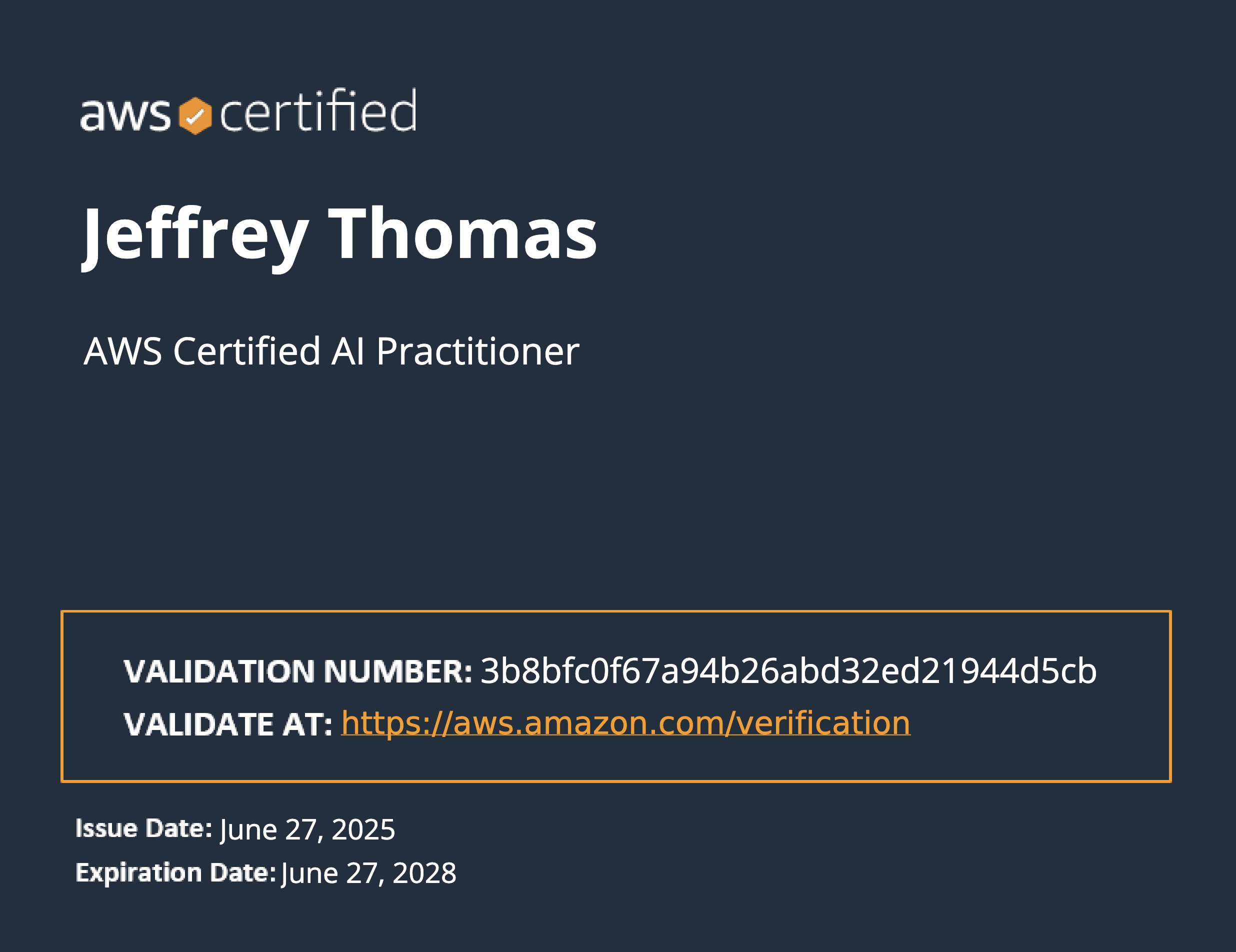
- AWS Certified AI Practitioner (AIF-C01)
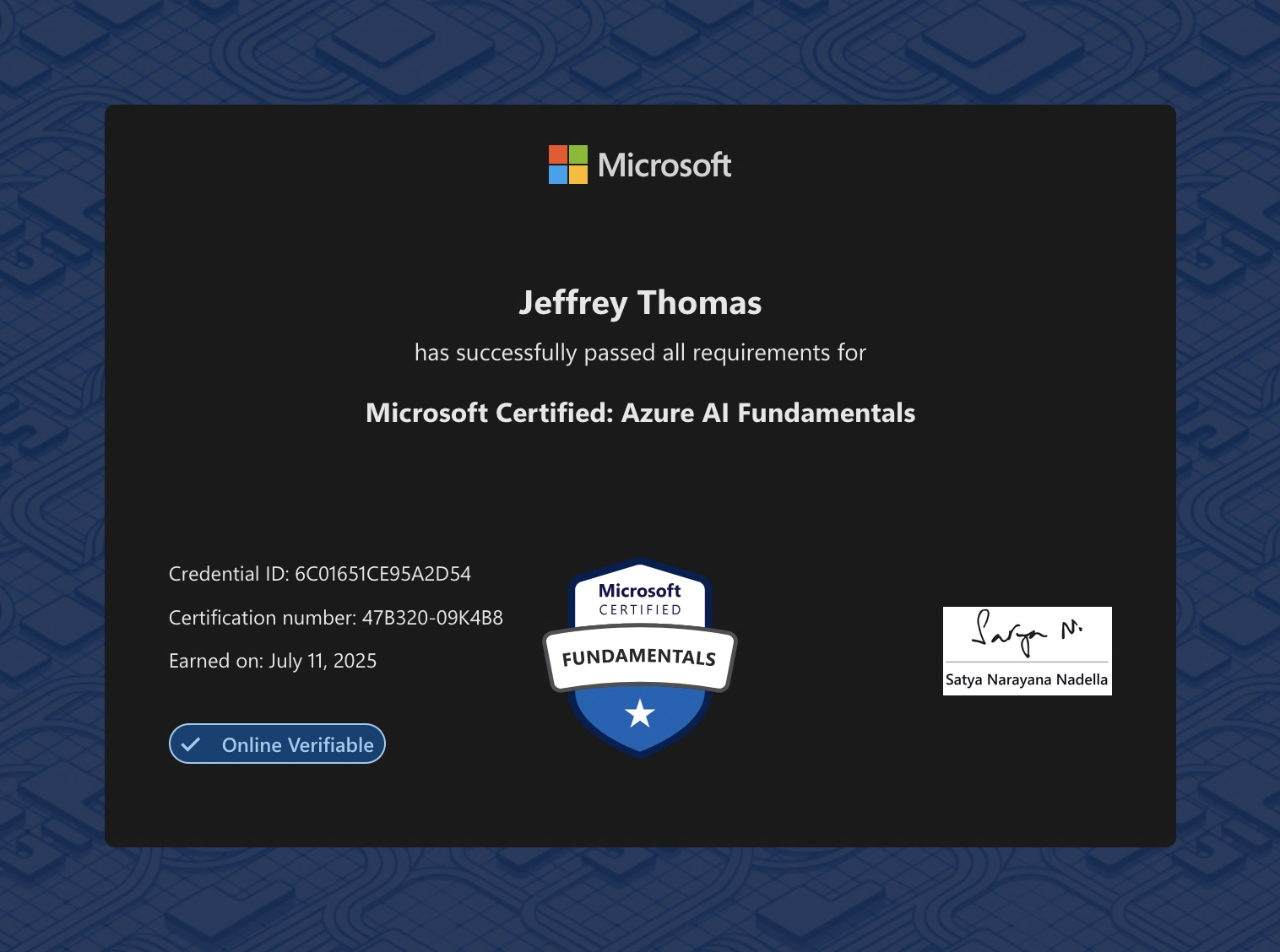
- Microsoft Azure AI Fundamentals (AI-900)
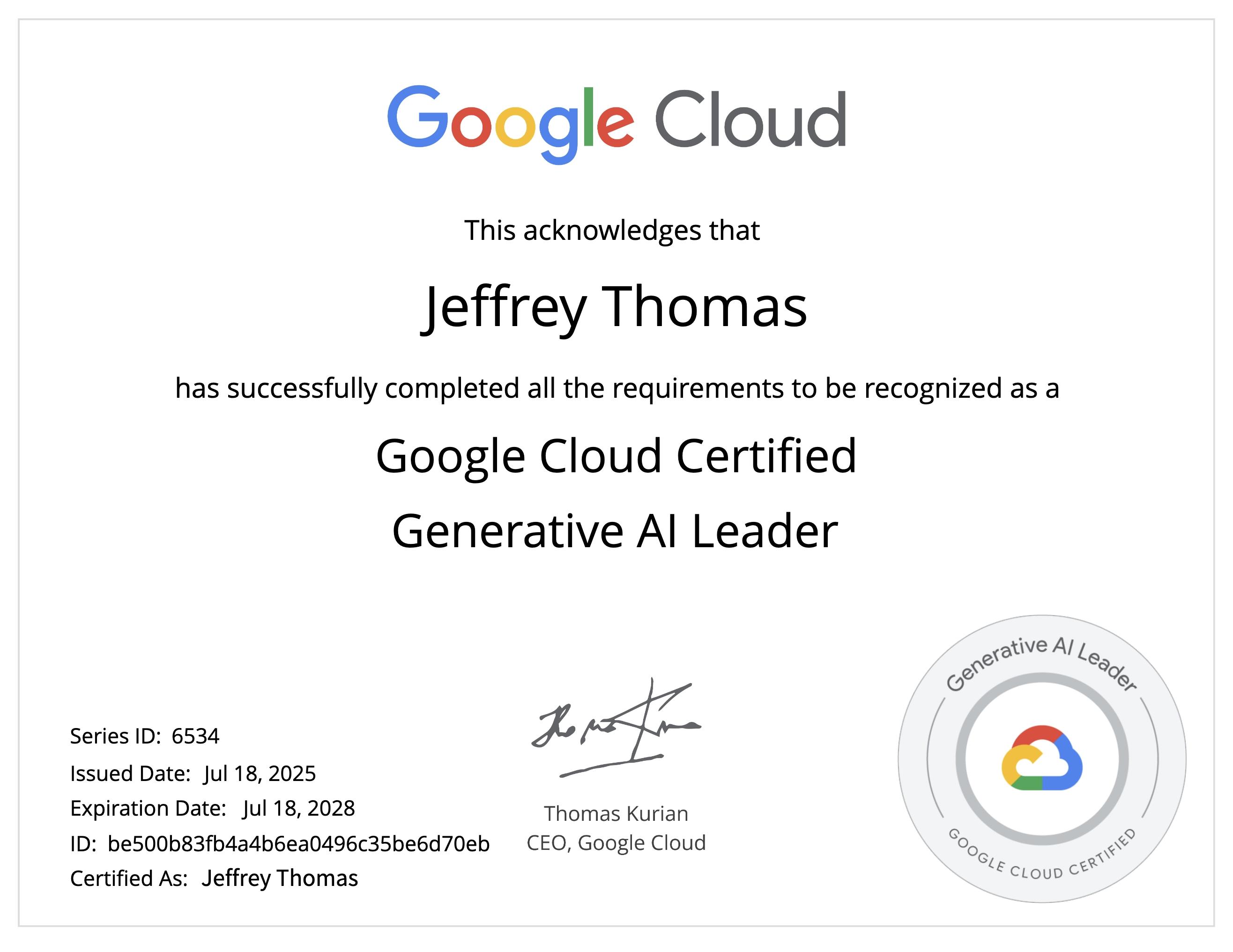
- Google Cloud Generative AI Leader
Each exam offers a unique lens into how its platform thinks about AI and GenAI—from tools and workflows to responsible AI and strategy. AWS favors service depth and full-stack control. Azure leans into ethical guardrails and practical workloads. Google focuses on GenAI leadership and enabling capabilities across business units.
This section breaks down each exam, what it tested, how I prepared, and what stood out—so whether you're studying for your own cert or just mapping out your AI career path, you can find the route that fits.
AWS Certified AI Practitioner (AIF-C01)
I sat for the AWS Certified AI Practitioner exam on June 27, 2025, at a Pearson VUE testing center. The test consisted of 65 questions, of which 50 were scored. It featured a range of formats—multiple choice, ordering, matching, and case studies. Results were issued the same day. The standard cost is $100, but I used a 50% discount voucher available through AWS training programs.
The exam is broken into five domains, each reflecting a key aspect of foundational AI and GenAI implementation on AWS:
| Domain | Description | Weight |
|---|---|---|
| Fundamentals of AI and ML | Covers supervised learning, deep learning, model types, and key terminology. | 20% |
| Fundamentals of Generative AI | Introduces foundation models, GenAI concepts, and business use cases. | 24% |
| Applications of Foundation Models | Focuses on real-world use, customization, evaluation, and deployment. | 28% |
| Guidelines for Responsible AI | Emphasizes fairness, bias, transparency, and ethical considerations. | 14% |
| Security, Compliance, and Governance | Covers secure practices and governance frameworks for AI systems. | 14% |
To prepare, I followed a blended strategy using official AWS resources, community-curated content, and targeted practice exams. The SkillBuilder course and Stephane Maarek's Udemy prep were especially useful for concept clarity and service mapping.
| AWS Resources | |
|---|---|
| Book | AWS Certified AI Practitioner Study Guide (Early Release) |
| Course | Udemy: Ultimate AWS Certified AI Practitioner AIF-C01 by Stephane Maarek |
| Exam Guide | AWS Certified AI Practitioner (AIF-C01) Exam Guide |
| Exam Prep Platform | AWS SkillBuilder |
| Practice Exams | Tutorials Dojo |
| Study Notes | GitHub @vicsz |
This exam provided a strong baseline in both traditional and generative AI concepts, while also reinforcing how AWS services fit together across the machine learning lifecycle. It's especially helpful for anyone building AI solutions in AWS or needing to map cloud services to real-world AI use cases.
Microsoft Azure AI Fundamentals (AI-900)
I took the Azure AI-900 exam on July 11, 2025, again at a Pearson VUE testing center. It consisted of 45 questions and incorporated a variety of interactive formats: multiple choice, drag and drop, list reordering, hot areas, and active screens. The cost was $99, and the exam leaned more toward practical understanding than deep technical theory. Azure placed strong emphasis on recognizing different AI workloads, applying responsible AI principles, and understanding the core services available within the platform.
The exam is organized into five key areas:
| Domain | Description | Weight |
|---|---|---|
| AI Workloads and Considerations | Covers AI types, fairness, and ethical principles. | 15-20% |
| Machine Learning on Azure | Explains ML fundamentals, AutoML, and training/validation workflows. | 15-20% |
| Computer Vision Workloads on Azure | Discusses image classification, object detection, OCR, and facial recognition. | 15-20% |
| Natural Language Processing (NLP) Workloads | Focuses on sentiment analysis, key phrase extraction, translation, etc. | 15-20% |
| Generative AI Workloads on Azure | Introduces GenAI tools, foundation models (like GPT), and ethical deployment. | 20-25% |
To prepare, I combined Microsoft's own documentation and study guide with hands-on resources like video courses, practice tests, and community-written guides. The free YouTube walkthroughs offered a great visual overview, while Tutorials Dojo's practice exams helped simulate the real test format.
If you're looking to build a strong foundation in both AI concepts and Azure-specific services, this exam is a great entry point. It balances strategy, ethics, and platform capabilities—all without requiring prior cloud experience.
Google Cloud Generative AI Leader
I wrapped up the certification journey with the Google Cloud Generative AI Leader exam on July 18, 2025. Unlike the other two, this one didn't use Pearson VUE—it was administered through Kryterion, which had far fewer testing locations near me. I opted for the online version, but it was a rocky experience. You're asked to scan the room with your webcam, check reflections, and re-position your setup multiple times before starting. It throws off your rhythm a bit. On the bright side, the exam itself was the easiest of the three.
The test had 50-60 multiple choice questions, ran for 90 minutes, and cost $99. I received a pass notification immediately after finishing, but the official score report and digital badge took a few days to show up via email and the online portal.
This exam leaned heavily toward strategic understanding of GenAI adoption—less technical, more organizational. It's clearly aimed at product managers, consultants, and business leaders exploring how to bring GenAI into their workflows.
| Google GenAI Leader | Description | Weight |
|---|---|---|
| Fundamentals of Generative AI | Covers LLMs, the model lifecycle, foundation models, and data quality. | ~30% |
| Google Cloud GenAI Offerings | Gemini, Imagen, Codey, Veo, Gemma, and tools across the Vertex ecosystem. | ~35% |
| Improving GenAI Output | Techniques like prompting, grounding, RAG, and sampling strategies. | ~20% |
| Business Strategy for GenAI | Governance, risk management, responsible deployment, and use case planning. | ~15% |
To prep, I followed Google's official study guide and Cloud Skills Boost learning path. There was also a set of practice questions published as a Google Form. While sparse, they were representative of the exam's tone—light on syntax, heavier on strategy and decision-making.
| Google Cloud Resources | |
|---|---|
| Courses | - Google Cloud Skills Boost: Generative AI Leader - Udemy: Become Generative AI Leader - Google Cloud Certification |
| Exam Guide | Generative AI Leader Certification Exam Guide |
| Practice Questions | Google Generative AI Leader Sample Questions (Form) |
| Study Notes | Google Generative AI Leader Certification Exam Study Guide |
If your goal is to understand how GenAI fits into enterprise workflows, product planning, or cloud strategy, this exam hits that mark. Just be ready for a different vibe—less hands-on, more leadership and framing.
Verification
Each certification provided a unique lens on how cloud providers approach AI and generative AI. AWS was the most technically rigorous, diving deep into services and full-lifecycle development. Azure struck a practical balance, emphasizing enterprise use cases, responsible AI, and tooling alignment. Google's exam was the most accessible—strategic, executive-facing, and high-level in nature.
In terms of difficulty, I'd rank them:
- Hardest: AWS Certified AI Practitioner
- Middle Ground: Azure AI Fundamentals
- Easiest: Google Cloud GenAI Leader
That said, none of these were overwhelming—they're all designed as foundation-level exams, meant to validate baseline knowledge rather than test advanced technical depth. With a bit of prep and familiarity with each platform's ecosystem, they're very passable, even for newcomers.
Together, they formed a well-rounded foundation that bridged theory with platform-specific practice. Here's a quick snapshot of all three:
| AWS Certified AI Practitioner | Azure AI Fundamentals | Google Cloud GenAI Leader |
|---|---|---|
 |  |  |
 |  |  |
✅ Verify These Credentials
You can confirm each certification using the official verification tools:
These exams aren't just theoretical—they reflect real-world cloud AI adoption patterns, use cases, and ethical considerations. If you're serious about cloud AI, they serve as great orientation tools. For deeper technical chops, consider layering in role-based certs and hands-on project experience.
Conclusion
Cloud certifications are more than just résumé badges—they're structured pathways for understanding how modern AI actually works in practice. Whether you're tuning a foundation model on Vertex AI, designing ethical AI workflows with Azure, or spinning up end-to-end solutions on SageMaker, each platform brings a different flavor to your skillset. This post—and the full AI, ML & GenAI Demystified Series—was designed to cut through the noise, demystify the jargon, and give you a clear-eyed view of how AI systems are built, evaluated, and deployed at scale.
If you've made it this far, you're not just following trends—you're learning how to lead with purpose. So wherever you are in your AI journey, whether you're coding models, shaping strategy, or just getting started, I hope this series helped sharpen your intuition and build your confidence.
Go build something great—and stay curious.
See the associated LinkedIn post.
Comments
To leave feedback or questions, simply login using your preferred social network. I will read and answer your comments promptly, but please keep in mind that they will be public.