
Introduction: Kicking Off the AI, ML & GenAI Demystified Series
You don't have to chase every trend. That was my original stance on generative AI—watch from the sidelines, let the hype settle, and come back if it still mattered. But it didn't just stick around; it accelerated. Fast. Seemingly overnight, AI stopped being a niche research topic or a Silicon Valley parlor trick. It started rewriting job descriptions, showing up in executive roadmaps, and embedding itself into the tools we already use every day.
So I decided to zoom out.
Rather than jumping straight into tools and APIs, I wanted to understand the bigger picture: What is generative AI really doing under the hood? How does it connect to the older AI and ML methods I've worked with for years? What concepts are foundational—no matter the vendor? And when you strip away the marketing language, how do AWS, Azure, and Google Cloud actually help you use this stuff in the real world?
That's the idea behind this blog series: AI, ML & GenAI Demystified.
Across a handful of posts, I'll walk through the core building blocks of modern AI—from the evolution of rule-based systems to today's foundation models, from prompt engineering to model tuning, and from ethical considerations to practical use cases across the major cloud platforms. Along the way, I'll share lessons from earning three major cloud provider AI certifications—from AWS, Microsoft Azure, and Google Cloud—over the past month. Each platform offers a different lens, but the core principles are consistent. This series distills those principles.
Who This Series Is For and What You'll Gain
Whether you're a software engineer, product manager, designer, business leader, CTO, or just trying to wrap your head around AI's rapid rise, this series is designed for you. You'll gain:
- A grounded, jargon-free understanding of how modern AI works
- Key mental models to evaluate tools and make informed decisions
- Practical insights that prepare you to take (and pass) any of the foundational AI certifications from AWS, Microsoft, or Google Cloud
This isn't just about learning to talk about AI—it's about understanding it deeply enough to use it wisely.
Before we start comparing tools and certifications, let's slow down for a minute. Forget vendor logos, dashboards, and APIs—what is artificial intelligence, really? And how did we get from rule-based programs to models that can write sonnets, generate code, and analyze massive datasets in seconds?
Let's begin with the Foundations of Modern AI, starting with a look back: The Historical Evolution of AI.
The Historical Evolution of AI

[Artificial intelligence is] the science of making machines do things that would require intelligence if done by men.
Artificial Intelligence (AI), a term evoking a spectrum of reactions from awe to apprehension, conjures images of magical capabilities and optimistic innovations, as well as fears of sentient machines and dystopian futures. Its rich history, dating back to the 1950s, spans across multiple disciplines, intertwining computer science, mathematics, psychology, biology, and more. This era of scientific discovery saw pioneers like Alan Turing introduce foundational concepts such as the Turing Test, designed to evaluate a machine's ability to mimic human intelligence. This concept laid the groundwork for what AI could aspire to achieve. John McCarthy later coined "Artificial Intelligence," giving a formal identity to a field that, contrary to some fantastical perceptions, is largely grounded in complex statistics and algorithms. AI's journey, marked by both groundbreaking milestones and formidable challenges, demonstrates its transformative impact across various domains, from computer science to everyday life applications.
A computer would deserve to be called intelligent if it could deceive a human into believing that it was human.
In both its early years and even today, the field of AI has a significant focus on 'narrow AI', systems expertly crafted for specific tasks. While these systems exhibit high proficiency in their designated areas, they typically lack the ability to generalize their skills across a wider range of functions. A quintessential example from the 1960s and 1970s was MYCIN, an expert system developed at Stanford University. Designed to assist doctors in diagnosing bacterial infections and recommending antibiotics, MYCIN exemplified the early form of narrow AI, using rule-based methods to emulate human decision-making in medical diagnostics. However, systems like MYCIN were limited; they couldn't learn or adapt beyond their initial programming, leading to the first AI Winter - a period characterized by dwindling interest and investment, as the initial excitement over AI's potential succumbed to the reality of these systems' constrained capabilities.
In the 1980s, AI witnessed a significant resurgence with a shift towards 'Machine Learning' (ML), where systems began to learn from data, marking the initial development of relatively simple neural networks. Geoffrey Hinton, a notable figure of this era, was instrumental in exploring backpropagation algorithms, essential for training these networks. However, this period also faced the second AI Winter in the late 1980s and early 1990s, due to inflated expectations and the limitations of existing technology, leading to a downturn in interest and funding. Despite these challenges, this era laid important groundwork, exemplified by IBM's Deep Blue, a chess-playing AI. Deep Blue's victory over world chess champion Garry Kasparov in 1997, though an example of narrow AI, showcased AI's potential for complex, strategic tasks and set the stage for more advanced developments in AI.
As we entered the 21st century, AI evolved into the era of Big Data and Deep Learning, navigating through its own hype cycle. 'Big Data' refers to the extraordinarily large datasets generated daily, providing a rich resource for training more sophisticated AI models. 'Deep Learning' involves neural networks with many layers (hence 'deep'), capable of learning complex patterns in large volumes of data. This era's advancements were propelled by researchers like Yann LeCun and Yoshua Bengio. LeCun advanced the field through his work on convolutional neural networks, pivotal for image and video recognition tasks, while Bengio made significant contributions to understanding and improving the training methods for deep neural networks. These developments led to AI feats like Siri's voice recognition and AlphaGo's victory over Go champion Lee Sedol, illustrating a quantum leap in AI's capabilities from specific tasks to handling complex, diverse challenges.
Today's AI landscape is on an ambitious trajectory towards Artificial General Intelligence (AGI) - an AI that mirrors human intelligence and adaptability across a broad spectrum of tasks. At the forefront of this evolution is Generative AI, with transformative models like GANs (Generative Adversarial Networks) and transformers. These technologies mark a significant departure from the specialized focus of early AI systems. GANs, for example, are adept at creating highly realistic images and videos, while transformers, as seen in models like OpenAI's GPT series, are proficient in generating text that closely mimics human writing. This progression towards GenAI not only highlights an advancement in technological capabilities but also edges us closer to an era where AI's outputs are perceived as remarkably close to human-level creativity and interaction, blurring the lines between automated responses and what is traditionally considered 'thinking'.
What we know for certain is that at some point in the early 21st century, all of mankind was united in celebration. We marveled at our magnificence as we gave birth to AI.
Understanding the history of AI, from its origins in narrow AI to the current pursuit of AGI, is essential. This journey illuminates how AI evolved from solving specific tasks to striving for human-like creativity and versatility. As we explore GenAI, this historical backdrop helps us grasp its present capabilities and future potential. The shift from task-specific systems like Deep Blue to the inventive realms of GenAI illustrates a profound evolution in both AI's abilities and its influence on our world.
From Rules to Reasoning
AI is no longer a niche topic—it's reshaping how we live, work, and create. In a world increasingly infused with intelligent systems, understanding artificial intelligence isn't just for data scientists or engineers. It's for anyone who wants to stay relevant in the age of automation and acceleration. This technology is evolving rapidly, transforming industries and daily experiences alike. Grasping how it works is no longer a luxury—it's a necessity.
To break it down, let's start with a simple metaphor: a kitchen.
In the early days, computers were like rigid recipe followers. You'd say, "If flour, then bake," and they'd obey without question. Traditional programming worked like this—explicit instructions, no improvisation. The result? Predictable, but inflexible.
But what if, instead of following recipes, we could teach the machine to cook?
That's the essence of AI. It's not just about executing steps—it's about learning how to learn, observing patterns, adapting, and even innovating. Imagine giving a computer access to thousands of recipes, cooking shows, and taste tests. Over time, it starts to understand food: which flavors pair well, how heat transforms ingredients, and when to break the rules to create something new. That's Generative AI (GenAI)—less a recipe follower, more a creative chef.
Give a man a fish, and you feed him for a day. Teach a man to fish, and you feed him for a lifetime.
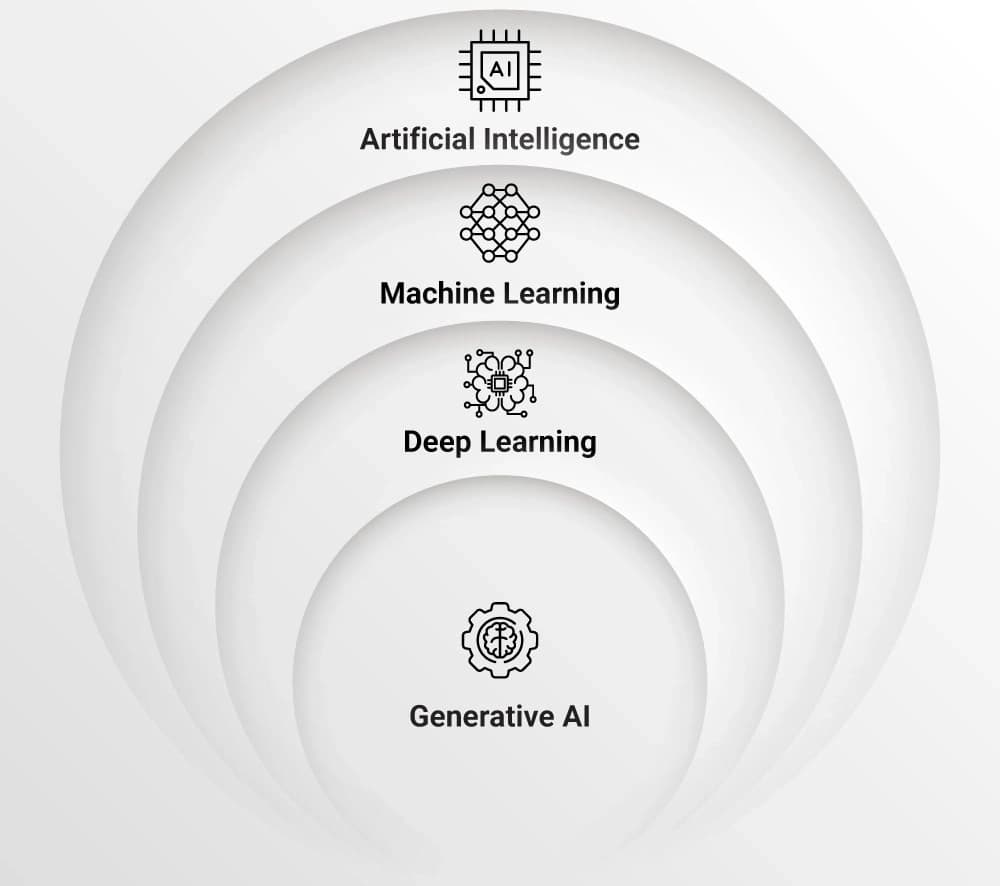
The evolution to get here wasn't instant. We've layered on capabilities over decades:
- Artificial Intelligence (AI) - The big umbrella. Any system that simulates intelligence: decision trees, rule engines, expert systems.
- Machine Learning (ML) - Instead of hardcoding rules, ML systems learn from examples. You feed them data, and they find patterns.
- Deep Learning (DL) - A subset of ML using multi-layered neural networks that can extract meaning from huge amounts of complex data.
- Generative AI (GenAI) - The cutting edge. These systems don't just analyze—they create. They write, paint, compose, simulate. Powered by foundation models, GenAI is the leap from smart assistant to creative partner.
So what's under the hood? Just like a chef has ingredients, tools, and techniques, AI has data, algorithms, and hardware. Large datasets are its raw materials. Algorithms are its cooking methods. Parameters are like seasoning—tuned to perfection. And specialized hardware like GPUs are the blenders, ovens, and knives of this digital kitchen.
We've moved from brittle, rule-based machines to systems that can imagine, iterate, and generate. GenAI isn't just smarter software—it's a fundamental shift in how machines interact with the world. And understanding that shift is the first step toward using it wisely.
Conclusion: From Past to Possibility
From the rigid logic of early expert systems to the creative potential of modern GenAI, the history of artificial intelligence reveals a steady—and accelerating—shift: from rules to reasoning, from mimicry to meaning. What began as a set of handcrafted instructions has evolved into systems that can learn, adapt, and now even generate original content.
But this journey isn't just technical—it's conceptual. Understanding how we got here gives us the footing to move forward confidently. And if AI is now a "creative chef," the next question is: what problem are we actually trying to solve?
Because whether you're writing a prompt, designing a system, or evaluating an AI-powered product, success doesn't start with the model—it starts with the mission.
Up Next: Should AI Solve This?
Before you choose a model or collect data, there's a critical question to answer: Is AI the right tool for this job? In the next post in the AI, ML & GenAI Demystified Series, we'll unpack how to frame problems the right way, define success metrics, and align your solution to the strengths—and limits—of modern AI. Whether you're building, buying, or just evaluating AI solutions, this post will help you think clearly before you commit.
See the associated LinkedIn post.
Comments
To leave feedback or questions, simply login using your preferred social network. I will read and answer your comments promptly, but please keep in mind that they will be public.