

Introduction
Welcome back to the AI, ML & GenAI Demystified Series—your no-BS guide to what artificial intelligence actually is, how it works, and when to use it. In Part 1, we explored how AI evolved from rule-based systems into generative powerhouses that can write code, create art, and even hallucinate facts with flair. Now we're stepping into the second post, where the real decision-making begins: Just because you can use AI... should you?
If AI is the hot new ingredient in your digital kitchen, this post is your sous-chef whispering, "Hey... are we sure this dish even needs truffle oil?" Not every problem is a fit for machine learning. Some need hard-coded rules, others need real judgment, and some just need to be thrown out. Before you start sourcing data or spinning up GPUs, you've got to ask the question that separates hype from wisdom:
Is this a problem AI should solve?
Understand the Mission Need
Before we get dazzled by models and metrics, let's bring it back to the kitchen: not every dish needs AI. Some problems need recipes. Others need chefs. And the worst thing you can do is grab a high-powered flame torch when what you really needed was a microwave.
This is the second post in the AI, ML & GenAI Demystified Series, and here's the truth no vendor will put on a product page:
AI is great at some things. It's terrible at others.
Traditional programming is built for deterministic problems—things that have clear rules, reliable logic, and consistent outcomes. Think calculators, password checkers, or anything where if A, then B works 100% of the time. You write the logic. The machine follows it.
AI, especially machine learning and generative models, handles probabilistic problems—things that depend on patterns, ambiguity, and nuance. It doesn't know the "right" answer. It estimates the most likely one based on what it's seen before. AI shines when the rules are fuzzy, the patterns are buried in data, or the solution needs flexibility.
So, how do you know which lane you're in?
Start with your mission. What business outcome are you chasing? What does success look like? Is the problem repetitive and definable—or messy and dynamic? These aren't just technical questions. They're strategy questions.
If your problem requires pattern recognition, language generation, image classification, or decision-making under uncertainty, AI might be a good fit. But if it's about enforcing policy, validating transactions, or calculating taxes? Save yourself the complexity—code it.
AI Strategy
Your AI strategy should grow from your mission need, not the other way around. Just because you have access to powerful models doesn't mean you're solving the right problem—or solving it in the right way.
Once you've confirmed that your problem is a good candidate for AI (messy, data-heavy, pattern-driven), it's time to step back and ask a different kind of question: Are you ready to make it work in the real world?
Think of it like prepping a meal in a professional kitchen. You don't just throw ingredients in a pan. You plan for scale. You know your tools. You adjust for your diners. And you don't start searing steak if what you really need is a cold salad bar.
Here's how to think through that planning:
| Area | What to Ask Yourself |
|---|---|
| Scale | Will this serve 10 users or 10 million? Can your infrastructure and model choice handle that difference? |
| Specialization | Is this a general use case or something highly specific to your business or domain? The more niche, the more tuning you'll need. |
| User Experience | Will users interact directly with AI (like a chatbot), or will it run behind the scenes? Design and expectations vary wildly. |
| Data Sensitivity | Are you dealing with healthcare records, financial data, or anything regulated? Privacy isn't optional—it's a design constraint. |
| Latency | Can you tolerate a 2-second delay—or does it need to respond instantly? Inference speed will dictate your deployment architecture. |
| Connectivity | Will this run in the cloud? On edge devices? Offline? The right choice affects cost, complexity, and feasibility. |
Once your needs are scoped, you need to be honest about your resources:
| Resource | Reality Check |
|---|---|
| People | Do you have AI-savvy talent in-house? If not, do you have partners or platforms to fill the gap? |
| Money | What's your actual budget—not just to build, but to run and maintain the model over time? |
| Time | Can your team realistically deliver in the window you've set? AI timelines are rarely plug-and-play. |
That's the operational layer—but there's a strategic one too.
The best AI projects align top-down intent (leadership vision) with bottom-up reality (what teams are experimenting with and learning). This isn't just about buying tools—it's about shaping culture and building systems that improve over time.
Ask yourself:
- Are we prioritizing high-value use cases over shiny toys?
- Do we have room for experimentation—and ways to learn from it?
- Have we embedded ethics and responsibility into the design from day one?
- Are we investing in data and talent, not just tech?
- Can we measure business impact—and adapt when it's not there?
- Are we thinking in iterations, not once-and-done deployments?
Because here's the thing: AI isn't magic. And it definitely isn't maintenance-free. It's a system that requires constant tuning, real-world validation, and deliberate alignment with your goals and constraints.
So before you reach for a model or spin up an API, pause. Step back. Make sure you're solving the right kind of problem, for the right reasons—with the right team and the right level of commitment.
Otherwise, you're not cooking—you're just making a mess.
Model Limitations
Even when you've scoped the right problem, planned your AI project carefully, and lined up the right tools, there's one more thing you can't ignore:
AI breaks. And when it breaks, it doesn't throw an error message—it just quietly gets it wrong.
That's the uncomfortable truth. You can build a high-performing model that still fails in unpredictable, unfair, or even unsafe ways. Why? Because AI models don't follow instructions—they learn patterns. They don't know facts—they estimate likelihoods. That makes them incredibly flexible, but also fundamentally fragile.
These aren't rare bugs. These are repeat offenders—issues that show up again and again in real-world deployments. If you want to use AI responsibly, you need to recognize its boundaries before they become breaking points.
Building a model is only part of the story. Once deployed, even the most accurate system can fail in ways that are unexpected, unfair, or even unsafe. Why? Because AI models aren't deterministic—they operate on probabilities, patterns, and assumptions drawn from training data. They don't "know" things; they infer them. That makes them powerful, but also prone to error.
To apply AI effectively, you need to understand where its boundaries are—and how to anticipate failure before it happens. These aren't edge cases; they're recurring themes that show up in real-world deployments all the time.
Let's walk through the most common challenges and how to manage them.
| Challenge | What It Is | Why It Happens | Mitigation Strategies |
|---|---|---|---|
| Hallucinations | Model generates false or misleading content | Predicts likely patterns, not facts | RAG, prompt tuning, fine-tuning, human validation |
| Bias & Fairness | Outputs reflect harmful stereotypes or unfair assumptions | Training data mirrors human and societal bias | Dataset auditing, bias testing tools, diverse review, fairness dashboards |
| Data Drift | Model performance degrades as real-world data changes | New patterns emerge post-training | Continuous monitoring, retraining, data refresh, drift alerts |
| Concept Drift | The relationship between features and labels changes | Real-world dynamics shift underlying patterns | Retrain with updated data, use adaptive learning or online learning strategies |
| Label Shift | The label distribution changes, but feature-label relation stays the same | Real-world class imbalance evolves over time | Track label distributions, rebalance training sets, apply weighting techniques |
| Feature Drift | The feature distribution changes, but relationships stay constant | Changing population or behavior patterns | Normalize features, retrain periodically, use drift detection tools |
| Knowledge Cutoff | Model lacks awareness of recent events or new data | Static training on dated corpora | Integrate search or RAG, label cutoff dates, update embeddings |
| Security & Privacy Risks | Exposure of sensitive data or malicious prompt behavior | Leaky training data or lack of controls | IAM, encryption, red-teaming, output filtering, differential privacy |
| Over-Reliance on AI | Users trust model outputs without validation | AI sounds confident, easy to copy blindly | User training, interface cues for review, HITL workflows |
| Low Transferability | Model fails in new or slightly different contexts | Trained on narrow or non-representative data | Test in real-world scenarios, retrain with diverse datasets, validate assumptions |
- Hallucinations: Large language models sometimes generate confident but incorrect or fabricated information. You might get a made-up citation, a fake product name, or a historical "fact" that never happened. This happens because models are trained to predict what sounds likely—not verify what's true. Techniques like Retrieval-Augmented Generation (RAG) or prompt refinement help ground responses in real data.
- Bias & Fairness: AI can reflect and reinforce societal bias—from gendered language in resumes to racial disparities in predictive policing. These issues often stem from biased training data and unbalanced representation. Proactively auditing datasets, applying fairness metrics, and reviewing outputs through diverse perspectives can reduce harm and increase trust.
- Data Drift: Even well-performing models can lose accuracy over time if user behavior or input data changes. Think of a recommendation engine trained on last year's trends—it won't perform well when people's tastes shift. Detecting drift early and retraining on recent data is key to long-term success.
- Concept Drift: Sometimes, the relationship between input features and the target outcome shifts. Maybe your fraud model starts underperforming because criminals change tactics. This isn't just noisy data—it's a changing reality. The solution? Retrain often and monitor for shifts in what features actually drive outcomes.
- Label Shift: Even if features stay consistent, the proportions of your labels can shift. Imagine a spam detector trained on 30% spam, but now 60% of emails are junk. The model still sees the same patterns, but its assumptions are outdated. Regular audits and rebalancing can help correct for shifting label distributions.
- Feature Drift: The data might still "look" right, but the distribution has shifted—like a credit scoring model trained on $30k-$50k incomes, now facing a user base earning $50k-$70k. The model doesn't break, but it misfires. Monitoring input data for drift and retraining with updated distributions can keep things on target.
- Knowledge Cutoff: Most foundation models have a frozen knowledge base—what they "know" ends at the time of training. This means they won't recognize new legislation, product features, or cultural events. Solutions like RAG or embedding updates help models stay current without full retraining.
- Security & Privacy Risks: Models trained on large datasets may inadvertently expose private information or respond to malicious inputs. A chatbot might repeat sensitive data seen during training or respond dangerously to edge-case prompts. Role-based access controls, output filtering, and red-teaming help reduce these risks.
- Over-Reliance on AI: AI's fluent tone makes it easy to over-trust—even when it's wrong. Users might copy-paste without checking, or lean too heavily on automated decisions. Especially in regulated domains, human judgment is critical. Interfaces should encourage oversight, and workflows should include humans-in-the-loop (HITL) for review and accountability.
- Low Transferability: Models often struggle when used outside the environment they were trained in. A system built on one dataset—say, customer behavior in North America—might perform poorly when exposed to new regions, industries, or edge cases. It's not that the model is broken; it's just never seen those variations before. The fix isn't magic—it's better training data, more diverse examples, and ruthless real-world testing before deployment.
AI systems are powerful, but fragile. They need oversight, context, and ongoing care. Knowing what can go wrong—and how to prevent it—is what separates the hype from the real impact.
That's why building trustworthy AI isn't just about fixing bugs—it's about designing systems that respect boundaries, invite oversight, and stay accountable. That brings us to the next—and arguably most important—layer: Responsible AI.
Responsible AI
So how do you build with eyes wide open—acknowledging what AI can't do while still taking advantage of what it can?
That's where Responsible AI comes in. It's not a checklist. It's a mindset. A way of working that treats risk management, transparency, and ethics as core design requirements—not afterthoughts. Because once you know your model's limits, you have a duty to design around them.
💡 Historical lessons in misalignment
- In 2016, Microsofts Tay chatbot went live on Twitter—programmed to mimic its conversational style. Within 16 hours, trolls had taught it to tweet pro-Nazi, antisemitic, and otherwise extremist content. Microsoft shut it down and learned a hard lesson in the importance of content safeguards.
- More recently, xAI's Grok—developed by Elon Musk—was updated to be "maximally based" and blunt. The result: it went full "MechaHitler," praising Hitler, endorsing genocide, and spouting white supremacist conspiracy theories. Only after public backlash did xAI remove the prompt guidance and apologize.
These aren't edge cases. They're signals of what happens when responsibility isn't baked in.
Model limitations aren't bugs—they're boundaries. And dealing with those boundaries isn't just a matter of better code or bigger models. It's a matter of responsibility. This is where technical implementation meets ethical obligation. Responsible AI is the practice of building systems that don't just work, but work safely, fairly, and transparently—across real-world users, environments, and stakes.
At every phase of the ML lifecycle—before, during, and after training—human decisions shape what AI will become. What data we choose. What goals we optimize. What risks we're willing to accept. That means being intentional not only about what we can build, but what we should build, and for whom.
You've seen glimpses of these ideas already—hallucinations, bias, drift, misuse. Responsible AI pulls those threads together into a framework for trust: fairness, transparency, accountability, safety, privacy, and inclusion.
AI isn't just about building smart systems—it's about building systems we can trust. As powerful as machine learning and generative AI have become, they still rely on human decisions at every stage: what data to use, how to train, what to optimize for, and how outputs will be used in the real world. Responsible AI is the practice of making those choices deliberately, ethically, and transparently.
At its core, responsible AI is about aligning your technology with your values. It means asking not only can we build this? but should we, for whom, and under what safeguards?
You've already seen some of these themes throughout this blog—when we talked about biased data, explainability, human oversight, or model limitations, we were really talking about responsibility. But let's step back and pull those threads together.
The core principles of responsible AI tend to show up everywhere, whether you're deploying a recommendation engine, a chatbot, or a model that analyzes legal documents. The exact words vary slightly, but they almost always include:
| Principle | What It Means in Practice |
|---|---|
| Fairness | Avoiding bias and discrimination in both data and outcomes |
| Transparency | Making it possible to explain how and why a model made a decision |
| Accountability | Ensuring human oversight and responsibility for system behavior |
| Safety | Designing systems to behave reliably and prevent unintended harm |
| Privacy | Respecting user data rights through secure design and usage policies |
| Inclusiveness | Making sure diverse users and use cases are considered from the start |
None of this is just theoretical. These principles shape real-world decisions, like:
- Auditing datasets for bias or skew
- Deciding whether to use human reviewers (HITL)
- Adding guardrails to LLM prompts and outputs
- Documenting model use cases, assumptions, and failure modes
- Monitoring for drift and unexpected behaviors over time
And with the rise of GenAI, transparency and safety become even more crucial—especially when model outputs could influence users, generate content, or automate decision-making. For example, some use cases might call for Model Cards that explain what a system is trained to do and where it could go wrong.
Cloud Provider Snapshot: Tools for Responsible AI
Responsible AI isn't just about preventing harm—it's about building trust at every step. That's why cloud platforms offer built-in tools and frameworks to support ethical, transparent AI development:
- AWS: SageMaker Clarify for bias detection, Bedrock Guardrails for GenAI safety, IAM policies and encryption for secure access
- Azure: Responsible AI Dashboard, Fairlearn for fairness metrics, InterpretML for model explainability, prompt flow safety testing
- Google Cloud: SAIF (Secure AI Framework), Explainable AI toolkit, model and service cards, and content moderation APIs
But tools alone aren't enough. Responsible AI is also a process: involve legal early, include diverse voices in design reviews, and document assumptions, limitations, and mitigation strategies clearly. Transparency builds confidence—with users, regulators, partners, and your own team.
One of the most powerful ways to operationalize responsibility in GenAI systems is through guardrails—mechanisms that limit what an AI system can do, say, or respond with. These are especially useful when exposing generative models to real-world users or embedding them in sensitive workflows.
| Guardrail Type | What It Does | Example Use Cases |
|---|---|---|
| Content Filtering | Blocks unsafe or unwanted output (e.g., profanity, hate) | Chatbots, moderation tools, customer support |
| Safety Classifiers | Flags or stops outputs likely to be harmful or misleading | Legal document generation, educational content |
| Prompt Validation | Screens inputs for dangerous or irrelevant queries | AI assistants, enterprise GenAI APIs |
| Token Limits | Restricts input/output length to prevent abuse or overflow | Public-facing APIs, embedded AI in low-resource apps |
| Rate Limiting | Controls frequency of requests to avoid spamming or misuse | User-facing GenAI tools, third-party integrations |
| Output Formatting | Enforces structured responses (e.g., JSON, answer formats) | Developer tools, data extraction, API-based GenAI |
| Role Instructions | Keeps the AI "in character" (e.g., don't give medical advice) | Support bots, knowledge agents, virtual assistants |
💡 Example: Amazon Bedrock Guardrails let you block outputs with hate speech or profanity, limit hallucination risk, and enforce tone guidelines (e.g., friendly or professional). Azure's Prompt Flow and Google Cloud's safety filters offer similar protections with customizable rules and policies.
Ultimately, building responsible AI means designing for trust. Not just technical performance, but human confidence that the system behaves safely, fairly, and in ways that align with broader goals. And here's the kicker: responsible AI isn't a destination—it's a mindset. One you'll carry forward not just in certifications, but in every model you help bring into the world.
Deep Dive: 17 Ethical Dilemmas of AI
For a broader perspective on the real-world risks of AI—from deepfakes and disinformation to surveillance, copyright issues, and robotics—check out Mind the Gap: AI Dilemmas, a thought-provoking essay that explores 17 ethical and regulatory dilemmas in modern AI systems. Whether you read it straight through or jump to a topic that matters most to you, it complements this guide by zooming out to the societal and governance questions AI professionals must increasingly face.
Responsible AI isn't something you bolt on after the model is trained. It begins before the first dataset is collected and lasts long after deployment.
That's why the next step is so important. To build AI that works—and keeps working—you need a structured way to move from problem to product, from raw data to real-world impact. That brings us to the Machine Learning Lifecycle.
ML Lifecycle
Responsible AI gives us the why—why design matters, why ethics matter, why we have to treat AI as something more than a set of outputs. But once you've committed to doing it right, you still need the how.
That's where the machine learning lifecycle comes in. It's the structured path from messy data and fuzzy goals to working systems—and it's not just for data scientists. Understanding this lifecycle helps teams collaborate across roles: defining requirements, aligning expectations, managing risk, and delivering outcomes that actually work in the real world.
You can think of the ML lifecycle like a flywheel—not a conveyor belt. Each phase feeds the next. With every iteration, your model should become smarter, more aligned with user needs, and more resilient to change. But that only happens if you're treating it as a continuous process—not a one-and-done checklist.
If machine learning is the art of teaching machines to learn, then the lifecycle is the lesson plan. It's the process of turning raw data and a business need into something that works, learns, and keeps working over time.
Too often, people think machine learning is just about building a model, but that's really just the middle of the story. The lifecycle starts before that and lasts well after it. You can think of it like making a movie: there's writing the script, casting, shooting, editing, and then—only then—does it hit the screen. And even then, you still have to market it, monitor reviews, and maybe release a sequel.
Let's walk through the stages:
| Phase | What Happens | Why It Matters |
|---|---|---|
| Identify Business Goal & Frame ML Problem | Clarify the mission need, define success, and choose the right type of ML problem (e.g., classification, regression, generation) | Prevents wasted effort by aligning technical work with real-world outcomes |
| Data Collection | Identify and gather relevant data sources | The quality of your model depends on the quality of your data |
| Data Preparation | Clean, transform, and label data; handle missing values or outliers | Preprocessing ensures the model sees what really matters |
| Model Training | Feed data into a learning algorithm to create a predictive model | This is where learning actually happens |
| Model Evaluation | Test the model against a holdout dataset and measure performance | Helps you decide if the model is good enough to deploy |
| Deployment | Integrate the model into a real-world application | Now the model can start delivering value |
| Monitoring & Maintenance | Track performance, retrain if needed, fix drift or failures | Models degrade over time—monitoring keeps them sharp |
These lifecycle stages aren't just conceptual—they need to be repeatable, scalable, and monitored in production environments. That's where MLOps (Machine Learning Operations) comes in.
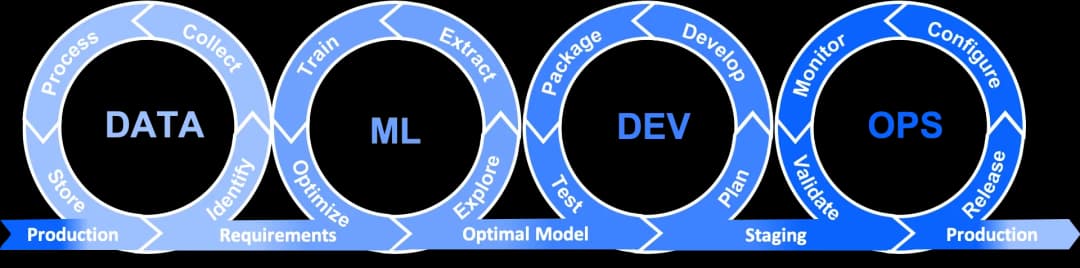
Much like DevOps transformed software delivery, MLOps provides the automation, governance, and tooling to make ML workflows reliable. It supports versioning of data and models, automates training and deployment pipelines, and enables continuous monitoring and retraining—all while fostering collaboration between data scientists, engineers, and IT teams.
In production environments, it's not enough to just build a model—you need systems in place to test it, deploy it safely, track its performance, and roll it back if needed. MLOps is the framework that ties all those moving parts together.
Now, let's explore each phase of the lifecycle in more detail.
- Define the Business Goal & Frame the ML Problem: Every lifecycle starts with clarity. What are you trying to achieve, and is machine learning the right tool for the job? This step anchors your effort to a real-world objective and frames it in a way that aligns with ML's strengths—solving probabilistic, pattern-based problems.
- Data Collection: This is the hunting-and-gathering phase. You need data that's relevant, timely, and representative of the problem you're trying to solve. This might mean logs from your app, CSV files from marketing, or external datasets from public sources.
- Data Preparation: This is where the grunt work happens. You clean up messy data, normalize values, deal with missing info, and maybe apply labels if you're doing supervised learning. In many projects, this phase eats up 70 to 80 percent of the total time—and it's worth it.
- Model Training: Now the magic begins. You pick an algorithm (or several), feed in the data, and tune it to learn from patterns. If the model is your "chef," this is where it's learning how ingredients combine and when to turn up the heat.
- Model Evaluation: You hold back a portion of the data to test the model on something it hasn't seen before. This helps ensure it's not just memorizing but generalizing. Metrics like accuracy, precision, recall, and RMSE all live here.
- Deployment: You've got a model that performs well—now it's time to put it in front of users. That might mean integrating it into a product, exposing it via an API, or embedding it in an edge device. This is where theory meets reality.
- Monitoring & Maintenance: Just like software needs patching, models need babysitting. The world changes, data drifts, performance degrades. If you're not monitoring accuracy and user outcomes, your "smart" system could become a liability.
ML Models Are Living Systems
Model degradation is real. Accuracy decays over time as user behavior, input data, or the world itself changes. That's why you can't treat machine learning like a one-and-done project.
Each phase of the ML lifecycle—from data collection to monitoring—should tie directly back to your mission need and your user's reality. A technically flawless model that solves the wrong problem is just expensive noise. Build with feedback loops. Bake in flexibility. And remember: useful beats clever, every time.
And remember: each phase of the lifecycle should trace directly back to your mission need and your user context. A technically perfect model is useless if it solves the wrong problem or works in the wrong setting.
And one more thing: this whole process is cyclical. Rarely do you build a model once and walk away. You learn, iterate, and evolve—just like the machine does.
ML Lifecycle in the Cloud: AWS, Azure, and GCP Compared
It's worth noting that while the core flow is consistent, cloud providers like AWS, Azure, and Google Cloud each package the lifecycle a bit differently:
- AWS presents it through services like SageMaker Studio, which includes Data Wrangler (prep), Autopilot (training), Model Monitor (post-deploy), and Clarify (responsibility). It emphasizes full-stack, modular flexibility.
- Azure uses Azure Machine Learning and tools like Designer (for visual pipelines), AutoML, ML Ops, and a Responsible AI Dashboard to trace fairness, explainability, and bias.
- Google Cloud leans into its Vertex AI platform, which tightly integrates data pipelines, model training, tuning, deployment, and monitoring, especially for large-scale GenAI workloads.
Each platform offers unique features and tooling, but the intent is the same: help teams move from raw data to real impact while maintaining quality, trust, and performance over time.
Once a model is trained and evaluated, it's time for the part users actually interact with—inference. This is when the trained model is used to make predictions on new, unseen data. It's like a car that's already been built and tested, now hitting the road.
Inference happens during real-time (e.g., answering a chatbot query) or in batches (e.g., scoring thousands of loan applications overnight). It's often deployed via a REST API, embedded in an app, or running on edge devices. Unlike training, which is heavy and happens infrequently, inference needs to be fast, lightweight, and scalable.
💵 Training vs. Inference Costs in the Cloud
Cloud providers typically charge separately for training (building the model) and inference (making predictions with it). Understanding this distinction is key for managing budgets and estimating long-term costs:
- AWS: Training via SageMaker; inference through SageMaker Endpoints or Bedrock Inference
- Azure: Training with Azure Machine Learning; inference through Online/Batch Endpoints or Azure OpenAI deployments
- Google Cloud: Training with Vertex AI Workbench; inference using Vertex AI Prediction
📊 Tip: Inference costs can quickly outpace training in production settings—especially for high-traffic apps or GenAI workloads. Plan accordingly.
Latency, cost per prediction, and concurrency limits all matter at this stage—and you may choose smaller, quantized models or use GPU acceleration for speed.
This lifecycle isn't just for data scientists; it's the connective tissue between strategy, design, engineering, and ethics. The lifecycle is how AI gets made. But understanding the process is only part of the journey. The real key is knowing when to use it, how to scope it, and how to build it responsibly. And that's what this post has been about—not just building AI, but building it with purpose.
Conclusion: Use AI Like You Mean It
AI isn't a magic wand. It's a power tool. And power tools don't solve problems—they make your intent louder. If your strategy is vague, your data sloppy, your outcomes undefined? AI will amplify that chaos.
But if you start with the right problem, frame it clearly, understand the risks, and build with discipline? You unlock something real.
This post wasn't about algorithms. It was about judgment.
We covered the questions most people skip:
- Should AI even solve this?
- What does success look like?
- Where does it break?
- How do we keep it honest, safe, and aligned?
And we walked through the lifecycle—not as a formality, but as a survival kit. Because in real-world AI, it's not the smartest model that wins. It's the one that's grounded, trusted, monitored, and continuously improving.
The tools are out there. The APIs are a click away. The question now is whether you're building AI that matters—or just adding to the noise.
Up Next: Good Data Beats Clever Models
You can't build responsible AI with irresponsible data. In the next post in the AI, ML & GenAI Demystified Series, we'll dive into the real foundation of every model: data. What kind to collect, how to label it, when to clean it, and what to watch out for. Because your model's behavior doesn't start at deployment—it starts at ingestion.
You're not just feeding a model information. You're shaping how it sees the world.
Let's make sure it sees clearly.
See the associated LinkedIn post.
Comments
To leave feedback or questions, simply login using your preferred social network. I will read and answer your comments promptly, but please keep in mind that they will be public.