

Introduction
Attending the inaugural NRO Standards Day was an excellent opportunity to engage with experts and leaders at the forefront of our national security landscape. This event, held at the National Reconnaissance Office, brought together voices from across the intelligence community and defense sectors to discuss standards—a critical foundation of interoperability and mission readiness. The day featured briefs from distinguished speakers and hands-on workshops where we brainstormed solutions to some of the most pressing challenges in standards development and adoption.
I can't get into all the specifics, but the event sparked deeper reflections on standards and their far-reaching impact on technology and intelligence. It reminded me of a blog post I'd written earlier this year, "The Map is Not the Territory ," where I touched on some thoughts following the Joint Command and Control (C2) Common Operational Picture (COP) Working Group (WG). This experience at the NRO, however, called for a more comprehensive exploration of standards, especially as I consider the diverse systems and technologies that our intelligence and defense communities rely on daily. In this post, I'll unpack my thoughts on the critical role of standards, using examples from the field and emphasizing the importance of consistent, adaptable frameworks for future innovation.
The National Reconnaissance Office (NRO)
The National Reconnaissance Office (NRO) has been a cornerstone of national security since its establishment, operating at the forefront of space-based intelligence capabilities. Conceived during the Cold War as an agency dedicated to advanced reconnaissance, the NRO has evolved alongside technology, continually pushing the limits of what's possible in intelligence gathering. While I work primarily in software architecture, I recognize the profound importance of standards across all domains—hardware, software, and data—especially when it comes to space-based assets like satellites, which form the backbone of the NRO's capabilities.
The NRO's mission focuses on the development, deployment, and maintenance of a sophisticated network of satellites and other space-based surveillance systems. These assets provide real-time data to intelligence analysts, military operators, and decision-makers across the IC and DoD, enabling informed and rapid responses to global events. From high-resolution imagery to signals intelligence, the data collected by NRO's satellite fleet is invaluable for both tactical and strategic planning.
With such critical technology, establishing and adhering to standards is essential for seamless interoperability. NRO satellites and ground systems must integrate with other hardware and software platforms, both within the NRO and across the broader defense and intelligence communities. Standards in hardware design, data formats, and communication protocols ensure that information flows smoothly across these diverse systems, allowing operators and analysts to work from a shared, unified intelligence picture.
While my background is in software, I've seen firsthand how software architecture principles can intersect with hardware requirements, particularly in environments as complex as the NRO's. Standardized interfaces, data structures, and even hardware components enable a level of interoperability and consistency crucial for mission success. Without these standards, cross-agency coordination would be compromised, potentially leading to delays, data mismatches, or even loss of critical intelligence. Moreover, as technology advances and new satellites are launched, standardized designs and protocols allow for smoother transitions and upgrades, making it possible to integrate cutting-edge systems without disrupting ongoing operations.
In a domain as specialized as space, where assets are often difficult to repair or upgrade once deployed, having rigorous standards in place from the outset is paramount. Not only does this streamline the initial deployment, but it also reduces costs and complexity in the long run. By creating an architecture that accounts for future expansion and compatibility, the NRO can more easily adapt to emerging technologies and threats.
Ultimately, while software serves as the connecting tissue that makes intelligence assets accessible and actionable, the importance of hardware standards cannot be overstated. They provide the foundation for interoperability, enabling the NRO's satellite network to seamlessly deliver high-quality intelligence across platforms. It's a powerful reminder that every component—whether hardware or software, standard or custom—must work in harmony to support the NRO's mission of safeguarding our nation through enhanced situational awareness.
Merch

One of the perks of attending Standards Day was a stop at the NRO store, where I picked up a few items to remember the experience—some patches, coins, and a zip-up hoodie. These aren't just souvenirs; they're small reminders of the NRO's mission as "the nation's eyes and ears in space." The patches and coins display the NRO emblem, with a satellite orbiting Earth, symbolizing the agency's commitment to space-based intelligence and national security. This emblem reflects the NRO's work—providing a watchful presence from above to inform and protect. The zip-up hoodie is a solid, practical keepsake from a day focused on the standards and teamwork that make this mission possible.
Standards and Governance
In today's rapidly evolving technological landscape, standards play a foundational role, but their development and application demand a collaborative and adaptive approach. Unlike the past "ivory tower" model, where architects imposed top-down mandates, modern standards architects work to support flow, interoperability, and independent evolvability. This shift requires standards architects to partner closely with internal and external groups, aligning on shared definitions and protocols that allow systems to evolve while remaining interoperable.
The creation of effective standards is as much about consensus-building as it is about technical precision. A standard is meaningful only when all stakeholders agree on what it represents. This requires working across departments, agencies, and industry partners to ensure that standards align with operational needs, leverage existing infrastructure, and remain adaptable for future advancements. In this cooperative model, standards become simple yet powerful tools for interoperability, uniting diverse systems by defining shared meanings and expectations. Through this collaborative, flexible approach, governance can support the broad and lasting adoption of standards that enhance both technical coherence and mission effectiveness.
Driving Behavior over Enforcing Rules
The value of software architecture lies not in the boxes, but in the lines that connect them.
In complex environments like the DoD and IC, standards are essential for achieving interoperability. However, enforcing standards as rigid requirements often leads to resistance, as users may view them as barriers rather than enablers. A more effective approach is to drive behavior over enforcing rules—fostering a culture that views standards as enablers rather than obstacles. This principle doesn't just promote compliance; it encourages adoption by aligning standards with the daily workflows, mission goals, and priorities of teams, creating a sustainable model for unified architecture as technology evolves.
One way to achieve this is by focusing on interface standards over product standards. Interface standards, such as TCP/IP and HTTP, allow diverse systems and tools to interoperate without locking teams into specific products. By prioritizing compatibility standards that foster connectivity, rather than rigidly standardizing on particular tools or software, organizations can achieve interoperability while allowing flexibility and innovation within teams. This approach encourages adoption by aligning standards with the daily workflows and priorities of teams, creating a sustainable model for unified architecture as technology evolves.
Additionally, incorporating feedback loops from end-users into the standards-setting process can help ensure that standards align with the realities of those who rely on them. In many cases, top-down enforcement fails because decision-makers lack hands-on experience with the tools being standardized. Gathering insights from those who actively use the tools fosters a culture of inclusivity, where teams feel that standards are tailored to their needs, rather than imposed from above. This user-centered approach transforms standards from obstacles into solutions, naturally driving compliance.
Finally, standardizing on connecting elements rather than endpoints—such as a shared version control system instead of a uniform IDE—provides the benefits of harmonization without stifling innovation. Connecting elements serve as the "glue" that holds different parts of the system together, supporting interoperability without forcing every team to use the same tools. This balance of freedom and cohesion empowers teams to work in ways that best suit their objectives while ensuring that core systems remain integrated.
By encouraging standards that align with desired behaviors and operational goals, organizations can foster a culture that values compliance naturally, viewing standards not as restrictions but as enablers of efficiency, flexibility, and interoperability.
Minimum vs. Optimum Compliance
The fundamental role of architecture is to manage complexity by enabling parts to interact seamlessly — it's the 'glue' that enables individual components to function as a cohesive whole.
Standards can be viewed through two levels of compliance: minimum and optimum. Minimum compliance is meeting the bare essentials, such as using specific protocols or ensuring basic security features, while optimum compliance goes further, integrating best practices to maximize the standard's benefits. For example, in software architecture, the minimum compliance might be using an approved programming language, whereas optimum compliance would mean implementing the most up-to-date versions, securing libraries, and optimizing performance. This approach of incentivizing desired behavior—such as by highlighting the efficiency and security of best practices—can encourage a deeper commitment to standards and increase alignment across projects.
Driving Desired Culture and Navigating Obstacles
Enforcing standards effectively requires identifying and addressing common barriers to compliance early on. In DoD and IC environments, these obstacles often include lack of funding, insufficient training, leadership buy-in, and cultural hesitancy about the benefits of standards. Other challenges, such as unclear roles and responsibilities in standards creation, governance gaps, and contractual constraints, can further complicate adoption.
Addressing these barriers requires a multifaceted approach:
- Training and Communication: Ensuring teams understand both the standards and the tools needed to comply with them. Clear guidance and accessible support resources are essential to equip teams effectively.
- Leadership Awareness and Buy-In: Engaging leadership early to champion standards and emphasize their importance can create momentum across departments. Strong leadership support often facilitates broader adoption and resource allocation.
- Positive Reinforcement and Strategic Friction: Recognizing early adopters or simplifying compliance processes can motivate teams to align with standards. Conversely, introducing friction, like additional approvals for outdated tools, can encourage compliance without being overly punitive.
- Defined Roles and Responsibilities: Establishing clear roles for standards creation and governance helps streamline accountability and ensure standards evolve with mission needs.
By balancing incentives with strategic obstacles, organizations can build a sustainable model for standards adoption that aligns with mission goals and fosters a culture that values interoperability and compliance.
Standards and Interoperability: Why One Doesn't Always Equal the Other
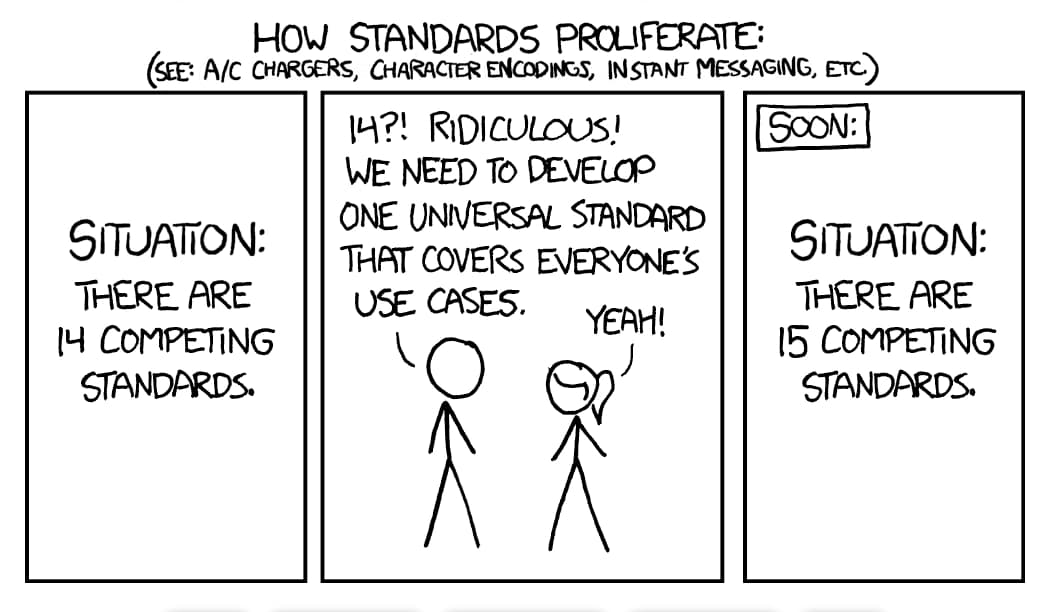
The nice thing about standards is that you have so many to choose from; furthermore, if you do not like any of them, you can just wait for next year's model.
While standards lay the foundation for interoperability, they don't automatically ensure it. Effective interoperability requires that standards be consistently implemented and adapted to fit varying operational needs. However, there are several key factors that often prevent interoperability, even in highly regulated environments:
- Variations in Implementation: Different organizations may implement the same standard differently, creating compatibility issues. For example, even with a common data format standard, variations in data processing and storage can lead to integration challenges. These seemingly minor discrepancies can significantly hinder the seamless integration of multiple systems, especially in environments where accurate data exchange is essential.
- Competing Standards: Sometimes, multiple standards emerge for similar functions, creating compatibility issues. A common consumer example is the fragmented experience in text messaging between Android and iPhone users—while SMS is a standard, differing implementations result in inconsistent quality and features. In defense and intelligence, competing standards can lead to incompatible systems that compromise the ability to create a cohesive operational picture.
- Business Incentives and Lock-In: In the commercial sector, companies may implement standards in ways that limit interoperability to retain customers within their ecosystems, an approach known as "vendor lock-in." While this may benefit companies by promoting brand loyalty, it poses a challenge in national security, where interoperability between systems is critical. A relevant example is USB-C, a universal charging and data port that has now become mandatory across the European Union. This mandate pressures companies like Apple, which previously used proprietary connectors, to conform to USB-C in their products, including the iPhone. While initially resisting, Apple's recent releases now incorporate USB-C ports to comply with this standard. This example underscores the effectiveness of regulatory mandates in driving standard adoption, ultimately enhancing interoperability and consumer convenience. In the defense and IC sectors, similar approaches might be needed to push for universal standards that enhance compatibility across different tools and systems.
Challenges of Incomplete Standards: Java Portals and WS-*
There is no single development, in either technology or management technique, which by itself promises even one order of magnitude [tenfold] improvement within a decade in productivity, in reliability, in simplicity.
Standards are meant to unify and simplify, but when they are incomplete or inconsistently implemented, they can create fragmentation and lock-in. A notable example is the Java portal and portlet specifications (JSR 168 and JSR 286), developed to standardize web applications by integrating modular components, or "portlets," within a single interface. Unfortunately, these specifications were often ambiguous, leaving many details open to interpretation, which resulted in a fragmented ecosystem with varied implementations across vendors.
To compensate, vendors introduced proprietary "value add" features to differentiate their offerings, but these vendor-specific additions effectively locked users into particular platforms. Portlets designed for one environment rarely worked in another, creating a barrier to true interoperability. Organizations faced the choice of committing to a single vendor or investing in costly reconfigurations to achieve cross-platform functionality.
Similarly, the WS-* (Web Services) family of standards attempted to provide a comprehensive framework for enterprise services, covering everything from security to messaging. However, overlapping standards and competing implementations led to a chaotic landscape, with vendors often developing proprietary versions that failed to work seamlessly across systems. For the DoD, phasing out WS-* took several years and required a shift to simpler alternatives like RESTful APIs, which offered streamlined, interoperable solutions without the complexity. These cases highlight the necessity for standards that are clear, complete, and practical across implementations—particularly in mission-critical defense environments.
Balancing Creativity and Compliance: The A4 Paper Principle
Simplicity is the soul of efficiency.
There's often a fear that standards might stifle innovation, but effective standards can actually facilitate creativity. A good example is A4 paper, which, by providing a consistent format, allows users to focus on the content rather than the format. In software and technology, interface standards like HTTP similarly enable communication across different systems without limiting the diversity of applications. For the DoD and IC, similar interface standards can provide the consistent "canvas" on which different teams and agencies can innovate while ensuring interoperability.
By prioritizing flexible, interface-based standards, agencies can create a foundation that allows diverse tools and technologies to communicate while maintaining alignment with mission needs. This approach encourages adaptability and resilience, allowing for innovation on top of a shared architecture.
Creating Standards for a Decentralized, Complex World

I think most people just make the mistake that it should be simple to design simple things. In reality, the effort required to design something is inversely proportional to the simplicity of the result.
As technology evolves, effective standards must balance centralized guidance with decentralized flexibility. This approach enables systems to adapt to unique, often unpredictable, environments while still achieving interoperability. In rapidly advancing fields like AI, cloud, and cybersecurity, traditional rigid standards are giving way to modular frameworks that allow for flexibility in implementation without sacrificing cohesion. For standards to succeed in this landscape, they must promote interoperability, embrace change, and manage complexity effectively.
To achieve this, the focus should be on areas where broad agreement exists, enabling widespread reuse and serendipitous alignment without attempting complete uniformity. By reusing what's common and overriding where necessary, standards can support adaptable, scalable systems that evolve in response to new demands. This approach not only facilitates interoperability but also avoids creating overly niche solutions that lack general applicability. Key principles include:
- Embrace Modular and Incremental Design: Encourage standards that allow small, adaptable components, which can be reused and independently evolved. Emphasize "small pieces loosely joined" to support growth without creating rigid dependencies.
- Balance Essential and Accidental Complexity: Recognize the difference between complexity that is inherent to the problem (essential) and that which is introduced by design choices (accidental). Standards should aim to reduce accidental complexity, making systems easier to build and maintain while acknowledging unavoidable complexities.
- Make Complexity Learnable: Structure standards in ways that make specialized functions understandable and repeatable. By describing complex behaviors in a standard way, organizations can make these systems more accessible and easier to manage.
- Design for Adaptability, Not Completeness: Standards should focus on fostering resilience rather than exhaustive detail. By prioritizing adaptive, modular standards over rigid, comprehensive specifications, agencies can implement solutions that evolve with technology.
- Decentralize Complexity: Use divide-and-conquer techniques to distribute complexity across the system. This approach allows individual parts to handle specialized tasks while maintaining overall coherence, supporting parallel innovation and reducing bottlenecks.
Data is a precious thing and will last longer than the systems themselves.
In a world of rapid change, standards that accommodate decentralized evolution and leverage common ground can serve as robust frameworks for innovation, interoperability, and sustainable growth.
Platforms as an Enabler of Innovation

Software is a gas; it expands to fill its container.
Modern platforms, like cloud and serverless computing, illustrate how standardization can accelerate innovation rather than limit it. By defining a common foundation for functions like storage, processing, and security, platforms free up teams to focus on mission-critical work rather than infrastructure. In the IC and DoD, platform standards could help streamline core functions like data management, cybersecurity, and information sharing, providing a solid base layer that supports flexibility and growth in the upper layers.
Platform standards combine the advantages of product and interface standards, allowing for both governance and flexibility. By standardizing core layers, such as networking and storage, the DoD and IC can create a cohesive, interoperable architecture that supports innovation at the mission level without being bogged down by infrastructure concerns. This layered approach enables agencies to optimize resources, reduce complexity, and foster interoperability while giving teams the freedom to innovate where it matters most.
Standards for National Security and Interoperability

Standards and governance are crucial to United States Government (USG) operations, providing the foundation for secure, interoperable, and reliable systems that support national security and broader government objectives. The development of these standards is led by agencies and organizations that set guidelines across various domains:
- National Institute of Standards and Technology (NIST): NIST is instrumental in creating widely adopted standards for cybersecurity, cryptography, and data protection, serving both government and private sectors.
- Defense Standardization Program (DSP): Managed by the Defense Standardization Program Office (DSPO), the DSP oversees the development and maintenance of standards specifically for the Department of Defense, ensuring consistency across defense systems and equipment, which is crucial for interoperability among military branches and allied forces.
- American National Standards Institute (ANSI) and Institute of Electrical and Electronics Engineers (IEEE): These organizations establish technical standards that impact fields from telecommunications to software interoperability, ensuring compatibility across systems essential to government and industry.
- International Organization for Standardization (ISO): ISO provides global standards that facilitate cross-border compatibility, essential for collaboration in defense and intelligence operations with allies and international partners.
- Internet Standards Organizations (IETF and W3C): The Internet Engineering Task Force (IETF) and World Wide Web Consortium (W3C) manage standards foundational to web and internet infrastructure, such as HTTP, HTML, and TCP/IP. These protocols enable secure, consistent communication across networks, essential to the smooth operation of government and defense systems.
Through participation in these standards bodies, the U.S. government can influence developments that impact both national security and economic competitiveness. Effective engagement in standards governance requires balancing regulatory considerations, fostering industry partnerships, and navigating legal constraints. For example, involvement in developing standards for emerging technologies like artificial intelligence and quantum computing is increasingly vital as the USG seeks to retain leadership in critical tech sectors.
As we move further into a data-centric world, the role of standards in ensuring interoperability, security, and global competitiveness is more essential than ever. A strong governance model for standards enables agencies to adapt to technological advancements while fostering resilience, cooperation, and innovation across all levels of government and industry.
USG Engagement in Industry Standards Bodies
The U.S. government, including the Intelligence Community (IC) and the Department of Defense (DoD), can and should actively participate in industry standards bodies to influence the development of technologies critical to national security. Historically, limited U.S. involvement in international standards organizations has allowed other nations, notably China, to exert significant influence over emerging technologies such as 5G. China's proactive engagement in 5G standards development has raised concerns about potential security vulnerabilities and dependencies on foreign technology. Increased U.S. participation could help steer these standards to better align with national security interests.
Several obstacles hinder greater U.S. government involvement in industry standards bodies. Legal and regulatory constraints, including antitrust laws, sometimes restrict federal agencies from joining or actively contributing to standard-setting organizations. Additionally, there are concerns about the government appearing to endorse specific private-sector companies or technologies, which complicates participation.
Recognizing these challenges, recent policy initiatives have aimed to enhance U.S. engagement in international standards development. The 2023 United States Government National Standards Strategy for Critical and Emerging Technology emphasized the importance of U.S. leadership in standards development to maintain economic and national security. Furthermore, the National Security Agency (NSA) and the Cybersecurity and Infrastructure Security Agency (CISA) released a report in July 2024 titled "Recommendations for Increasing U.S. Participation & Leadership in Standards Development," providing guidance for industry, academia, and government to sustain and grow engagement in standards-developing organizations.
These efforts underscore the necessity for the U.S. government to actively participate in industry standards bodies to safeguard national interests and maintain technological leadership.
Emerging Technology Standards

If you dislike change, you're going to dislike irrelevance even more.
As technology evolves, the DoD and IC face an increasing need to set standards for emerging fields like artificial intelligence (AI) and cybersecurity. These technologies offer transformative potential, but they also bring unique challenges in terms of interoperability, security, and ethical considerations. The rapid pace of AI development, for instance, means that new algorithms and models are constantly being introduced, each with varying data requirements, processing capabilities, and deployment protocols. Without standards, integrating AI systems into existing workflows can lead to compatibility issues, redundant work, and potential security risks.
Cybersecurity, meanwhile, demands constant vigilance and flexibility. As new vulnerabilities emerge, standards must evolve to keep pace with adversaries who are equally fast at exploiting weaknesses. In response, the DoD and IC are exploring adaptive standards that can shift in response to emerging threats. These might include modular security protocols that can be updated independently, as well as flexible data encryption standards that adapt to new hardware capabilities and threat landscapes.
Another promising direction is the use of "platform standards" for AI and cybersecurity, which define core requirements while allowing flexibility in specific implementations. For instance, the DoD could adopt a baseline standard for AI model governance that mandates tracking data provenance, auditing algorithmic decisions, and maintaining transparency in model performance. This type of standard ensures that AI systems meet minimum security and ethical requirements, while still allowing agencies to innovate and customize AI applications to meet mission-specific needs.
In both AI and cybersecurity, these adaptive and modular approaches to standards could provide a foundation for sustainable innovation, allowing the DoD and IC to leverage new technologies without sacrificing security or interoperability.
Conclusion
In reflecting on the discussions from NRO Standards Day, it's clear that standards are more than just technical requirements—they are the backbone of interoperability, security, and innovation in the intelligence and defense communities. From the examples of Java portals and WS-* to the importance of U.S. engagement in industry standards bodies, we've seen how incomplete or inconsistent standards can create fragmentation, lock-in, and security vulnerabilities. Moving forward, it's critical that we establish standards that are not only clear and adaptable but also actively foster collaboration across agencies and technology partners.
A guiding principle in this effort is "Driving Behavior over Enforcing Rules." Standards aren't truly effective if compliance is only checked off a list; they need to be adopted in a way that supports teams' daily workflows, mission goals, and overall productivity. By designing standards that align with desired behaviors, we encourage adoption through usefulness rather than enforcement, creating a more natural, integrated approach to compliance. When standards become tools that make teams' jobs easier and more effective, they evolve from mere rules into strategic assets.
As we face the rapid evolution of emerging technologies like AI and cybersecurity, the need for flexible, modular standards has never been more pressing. These technologies hold incredible potential but also introduce complex challenges that require a unified approach to maintain security and effectiveness. By prioritizing interoperability, the DoD, IC, and industry leaders can create a resilient foundation that encourages innovation while protecting national interests.
I encourage colleagues across the DoD, IC, and private sectors to take an active role in these conversations. Let's work together to develop standards that are more than just checkboxes, transforming them into meaningful tools for mission success. In a world that grows more interconnected by the day, effective standards and the behaviors they foster are essential—and now is the time to ensure they meet the demands of our shared future.
See the associated LinkedIn post.
Comments
To leave feedback or questions, simply login using your preferred social network. I will read and answer your comments promptly, but please keep in mind that they will be public.