
Introduction
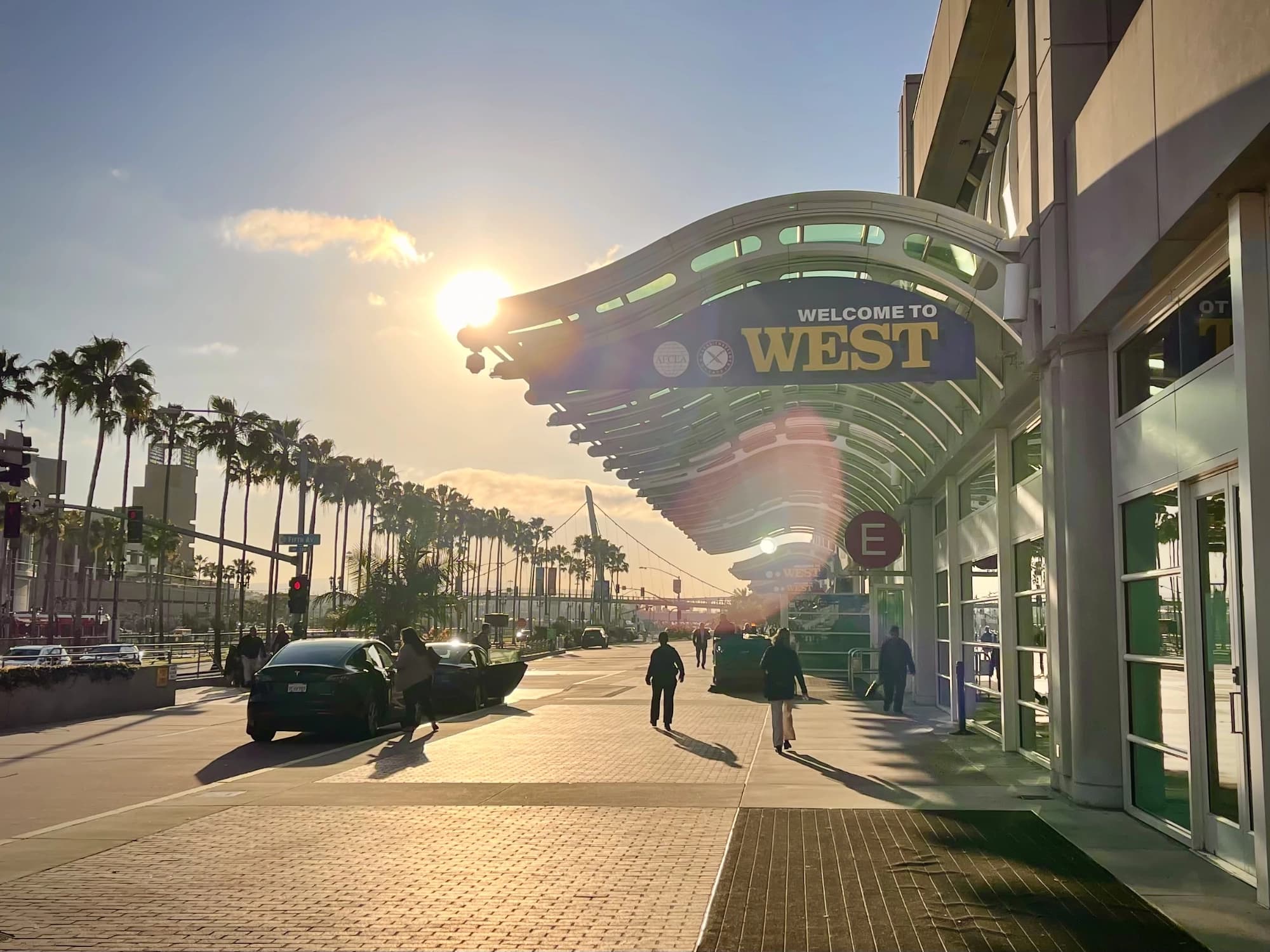
Stepping into the bustling halls of the San Diego Convention Center for WEST 2024, I was swept up in a wave of anticipation and curiosity. This event, co-sponsored by AFCEA International and the U.S. Naval Institute, stands as a pivotal gathering where the vanguards of technology and defense strategy converge to share, debate, and shape the future. For me, a first-timer at this celebrated conference, the air was charged with the promise of innovation and strategic insight, all centered around a pressing question: "Are Acquisition and Readiness on Pace to Meet Global Security Demands?"
My journey from Philadelphia to the West Coast is always filled with a sense of adventure, and this trip was no exception. San Diego, with its sprawling beaches and vibrant culture, has always held a special place in my heart. It was not just a return to a city I adore but also an opportunity to reconnect with colleagues from NIWC-PAC and NAVWAR - pillars of naval innovation that I've worked for and closely collaborated with over the years.
This blog post is a voyage through my experiences at WEST 2024, from the thought-provoking panels and keynotes to the spontaneous discussions and collaborations that sprouted in the fertile ground of the conference. It was a chance to delve into the ever-evolving world of naval technology and strategy, illuminated by the brightest minds in the field.
Beyond the formal agenda, the exhibit floor was a treasure trove of cutting-edge innovations, where vendors from around the globe displayed their latest contributions to naval readiness. Each booth and demonstration was a potential spark for future collaborations, expanding my horizons and connecting me to the pulse of the industry.
But the richness of WEST 2024 extended beyond the conference walls. San Diego, ever a backdrop of natural beauty and historical depth, offered countless opportunities for exploration and relaxation. Networking sessions and meetings seamlessly transitioned from the structured setting of the convention center to the city's picturesque locales, where conversations flowed as freely as the ocean waves.
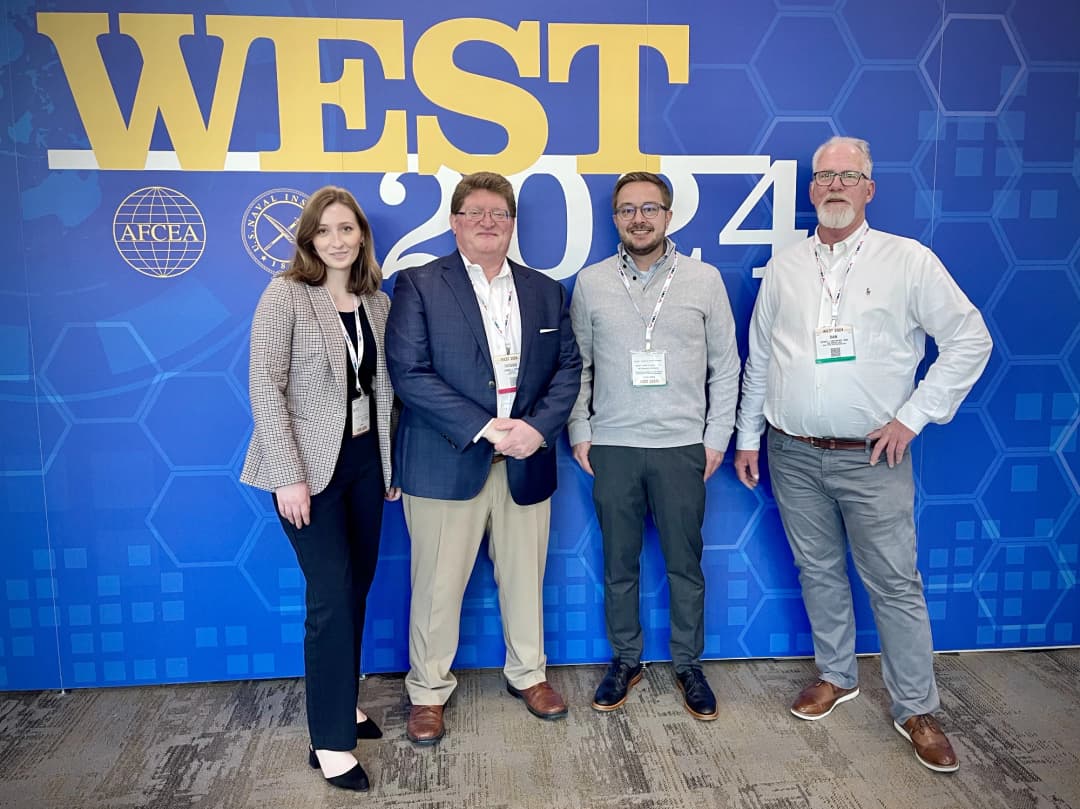
Accompanied by my teammates, each day was a blend of learning, sharing, and experiencing, all woven together by our collective passion for naval technology and strategy.
So, come along as I recount the memorable moments, insightful discussions, and personal reflections from WEST 2024, a journey that was as much about connecting with the community as it was about discovering the future of naval defense.
The reflections and summaries I've shared stem from my personal experience at WEST 2024 and do not reflect the opinions of my employer or others. They aim to objectively summarize the sessions I attended, acknowledging that I couldn't participate in all available sessions.
If you're interested in exploring any session from WEST 2024, all sessions were recorded and are available for viewing on the YouTube playlist for WEST 2024.
Day One
Day One of the WEST 2024 conference in San Diego unfolded as a tapestry of anticipation, innovation, and strategic discourse, setting the stage for what promised to be an enlightening series of discussions on the future of naval operations and defense technologies. The morning began with the simple yet essential ritual of badge collection, a tangible token of entry into a world brimming with the minds shaping the future of naval warfare and defense policy. Gathering with my team, there was a palpable sense of excitement in the air, a shared eagerness to dive into the wealth of knowledge and experience present at the conference.
The day's proceedings kicked off with a compelling keynote from the Chief of Naval Operations, who laid out a vision for the Navy's future, emphasizing adaptability, technological advancement, and strategic foresight. This set a high bar for the discussions that would follow, framing the urgency and significance of the topics at hand.
The first panel discussion, "What Changes are Community Leaders Making to Meet Global Security Demands?", brought together a diverse group of leaders to discuss the evolving challenges in global security and the innovative strategies being implemented to address them. The dialogue was rich with insights into how community leaders are navigating the complexities of modern security demands, offering a multifaceted perspective on the path forward.
Following was the "Challenges with Software Modernization and the Navy" panel, which delved into the intricate world of naval software systems and the pressing need for modernization. The discussion highlighted the unique challenges faced by the Navy in adapting to rapidly changing technology landscapes, underscoring the critical role of software in future naval operations.
The day concluded with a keynote from the Assistant Secretary of Defense for Sustainment, who provided an in-depth look at the logistical and operational challenges of sustaining a modern, ready, and capable force. His insights into the importance of readiness, innovation in sustainment practices, and the need for a cohesive strategy to maintain the fleet's operational capabilities were both enlightening and thought-provoking.
Day One of WEST 2024 was a testament to the vibrant and dynamic nature of naval defense discourse, filled with engaging discussions, critical insights, and forward-looking strategies. It was a day that not only set the tone for the conference but also highlighted the collective commitment to ensuring the Navy remains a formidable force in the face of evolving global challenges.
Keynote: Chief of Naval Operations
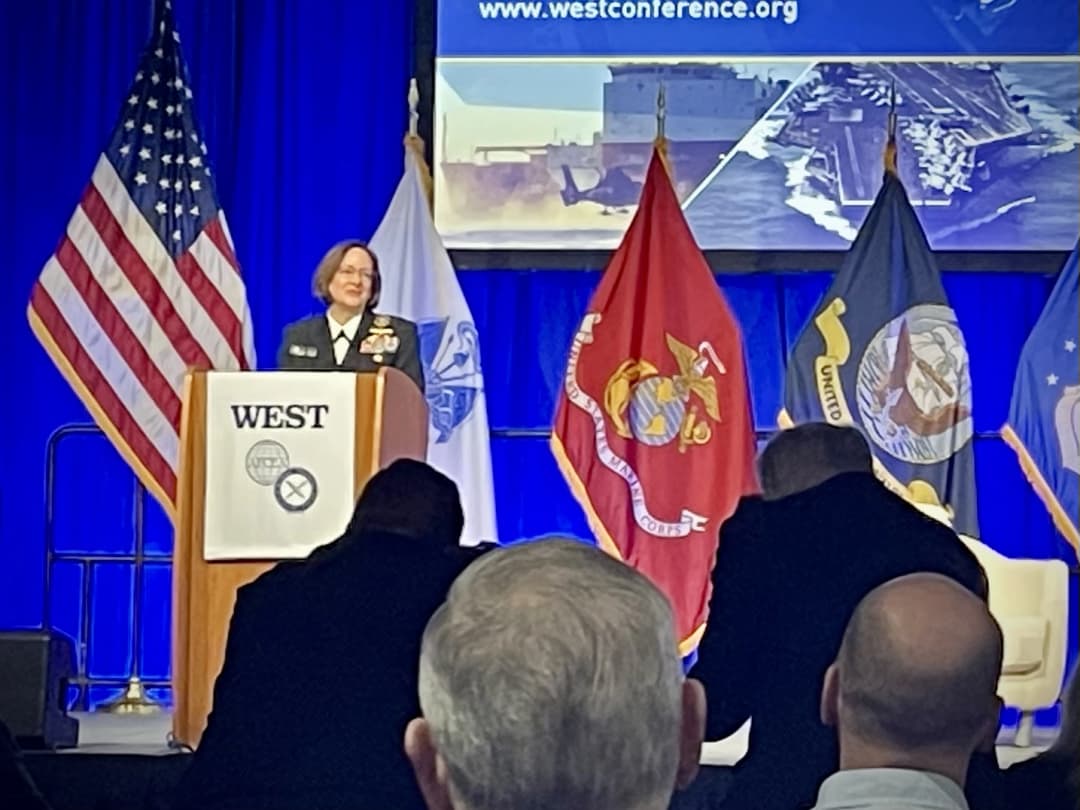
Speaker: ADM Lisa Franchetti, USN, Chief of Naval Operations (CNO)
In a stirring keynote address at the WEST 2024 conference in San Diego, CA, Admiral Lisa Franchetti, the Chief of Naval Operations, underscored the pivotal role and unparalleled prowess of the United States Navy in ensuring global peace and security. With conviction, she proclaimed the Navy as "the world's premier fighting force," highlighting its unmatched ability to "deliver decisive combat power in this century." Franchetti emphasized the Navy's ongoing efforts across the globe—from the Red Sea to the Pacific and beyond—to maintain freedom of navigation and support allies in hotspots such as Ukraine/Russia and Israel/Gaza. Her message was clear: the US Navy's scale and scope of operations are unrivaled, embodying the essence of combat power.
Admiral Franchetti outlined the Navy's priorities, focusing on warfighting, warfighters, and foundational support, all aimed at delivering "a navy the nation needs to deter, and if necessary fight and win our nation's wars." She stressed the urgency of adapting to the rapidly evolving warfighter environment, driven by technological breakthroughs that redefine the battlespace. Drawing parallels with historical shifts in naval strategy during the 1930s and 1970s, Franchetti underscored the need for forward-thinking and questioning existing assumptions to maintain a warfighting advantage.
The strength of any military organization lies in its combat power, which is in turn is the sum of two basic elements; its equipment, and its people. And so it goes for the Navy.
The Admiral detailed the Navy's approach to innovation and readiness, highlighting four key strategies: leveraging AI and new technologies for maintenance and repair, expanding the fleet's reach with unmanned systems, enhancing connectivity through Project Overmatch, and recognizing that the fusion of equipment and skilled personnel form the backbone of naval strength. She evoked the legacy of Admiral Arleigh Burke, underscoring that the "strength of any military organization lies in its combat power," which hinges on both its equipment and its people.
Warfighting, Warfighters, Foundation, All Ahead Flank.
Franchetti's vision for the Navy is one of relentless pursuit of warfighting excellence, with a clear acknowledgment of the challenges posed by an uncertain, complex, and rapidly changing world. She concluded her address with a resolute call to action: "Warfighting, Warfighters, Foundation. All ahead flank!" Her words not only paid homage to the Navy's storied past but also charted a course for its future, emphasizing partnerships, innovation, and the core value of courage to navigate the demanding seas ahead.
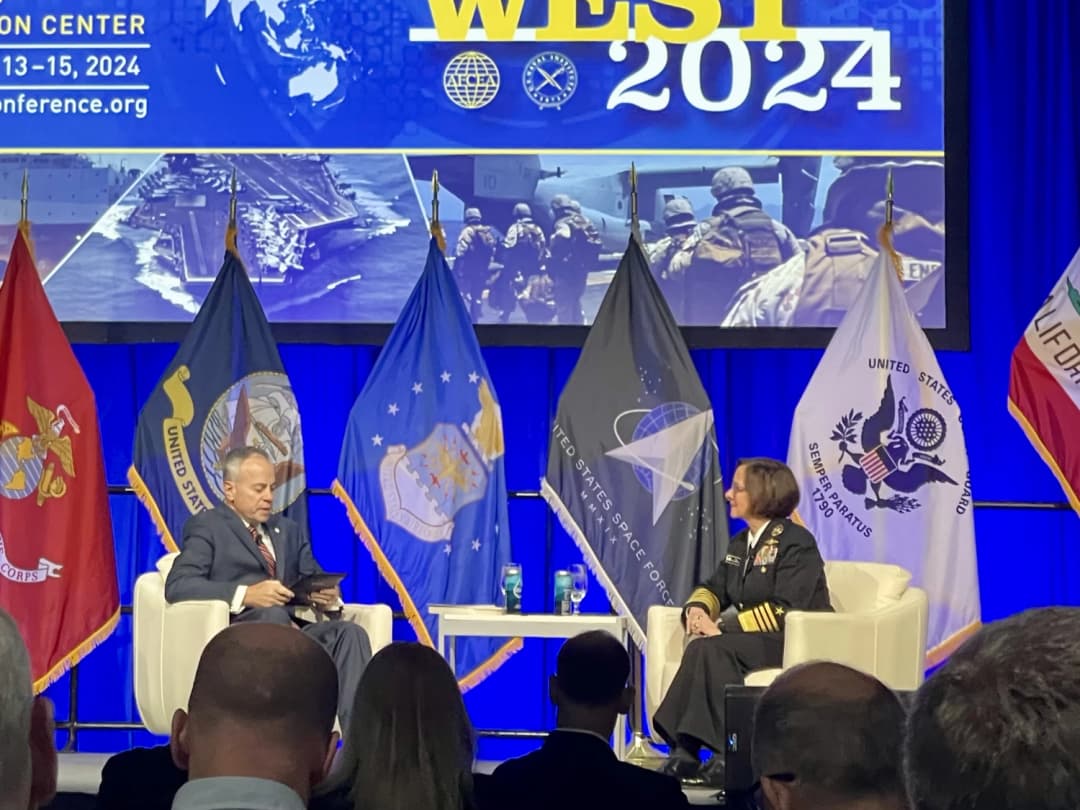
In the engaging question and answer session that followed Admiral Lisa Franchetti's compelling keynote at WEST 2024, she addressed key concerns and strategic initiatives shaping the future of the U.S. Navy. The discussion delved into the tangible measures being implemented to enhance the quality of life for sailors, recognizing the indispensable role of the workforce behind the Navy's operational success. Emphasizing a holistic approach, ADM Franchetti outlined initiatives aimed at improving living conditions, access to quality food, healthcare, and mental health services, alongside leadership's pivotal role in fostering a supportive environment.
The conversation transitioned to the evolution towards a hybrid manned-unmanned fleet, a topic of considerable interest given the rapid pace of technological advancement. ADM Franchetti presented a realistic timeline for this transition, emphasizing the current focus on prototyping and experimentation as foundational steps toward operationalizing such a fleet. This approach underlines the Navy's commitment to adapting its operational capabilities in response to emerging threats and technological opportunities.
Recruitment and retention emerged as a critical theme, with ADM Franchetti highlighting innovative strategies to attract and retain the talented individuals essential for the Navy's future readiness. She spoke to the importance of connecting with potential recruits to convey the Navy's mission and the unique opportunities it offers, underscoring the need for a concerted effort to address the challenges of recruitment and retention in a competitive environment.
The role of the Naval Sea Systems Command (NAVSEA) in supporting the foundational pillar of the Navy's priorities was also discussed, with a focus on enhancing ship maintenance efficiency to ensure the fleet's readiness and combat capability. ADM Franchetti's insights into NAVSEA's initiatives provided a clear view of the strategic importance of maintenance and modernization efforts in maintaining a robust and responsive naval force.
Lastly, the session addressed concerns regarding the competitive landscape of global naval power, particularly in relation to China's shipbuilding advancements. ADM Franchetti reiterated the strategic perspective that views the U.S. Navy's strength not merely in terms of ship count but as part of a comprehensive warfighting ecosystem, enhanced by alliances, technological superiority, and integrated force capabilities.
This question and answer session underscored ADM Franchetti's forward-looking leadership, highlighting a Navy in transition, embracing technological innovation, prioritizing the welfare of its personnel, and strategically positioning itself to maintain maritime dominance in the 21st century.
- 📄 Read the full transcription of the CNO's speech and Q&A session.
- 🎥 Watch the recording of this session.
Panel: What Changes are Community Leaders Making to Meet Global Security Demands?
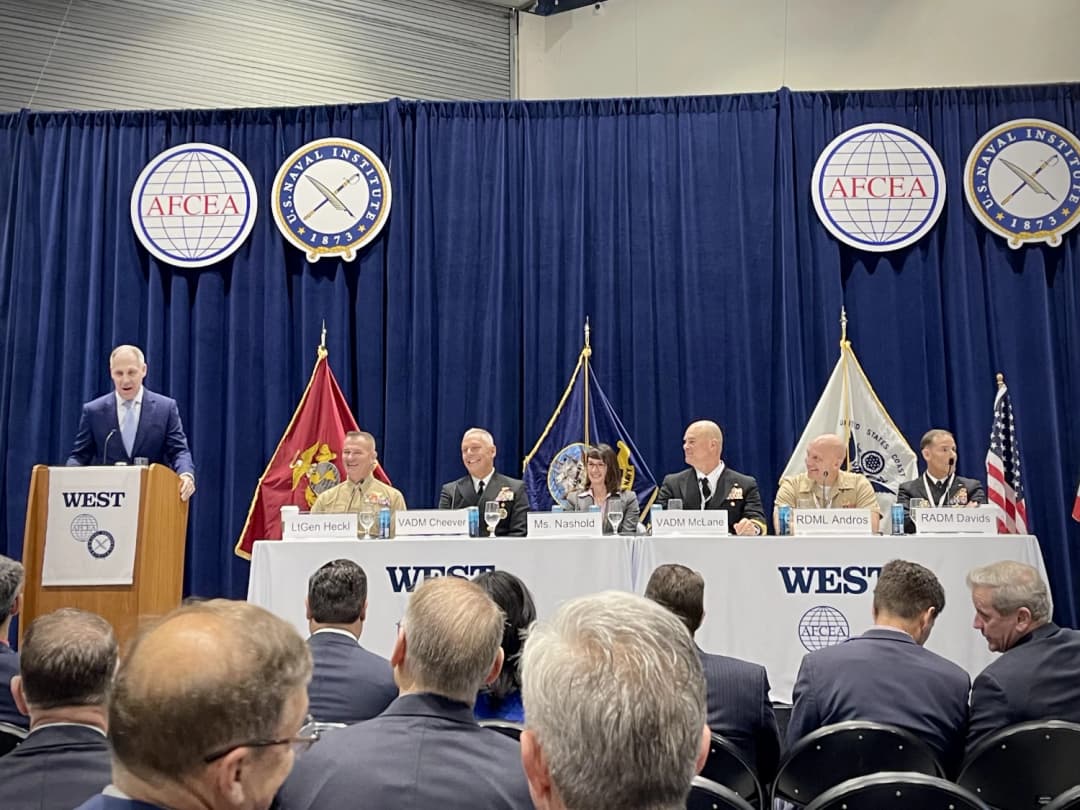
Moderator: VADM Peter H. Daly, USN (Ret.)
Panelists:
- RDML Brad Andros, USN
- VADM Daniel L. Cheever, USN
- RADM Keith B. Davids, USN
- LtGen Karsten S. Heckl, USMC
- VADM Brendan R. McLane, USN
- Ms. Elizabeth Nashold
In the heart of the WEST 2024 conference, a panel discussion unfolded that captured the essence of military leadership's response to the rapidly evolving global security landscape. VADM Peter H. Daly, USN (Ret.), served as the moderator, guiding the conversation with a critical eye on the tension between maintaining today's readiness and preparing for tomorrow's challenges. He set the stage by lamenting the perennial budgetary constraints and the strategic dichotomy between the immediate needs of Combatant Commands (CCMDs) and the long-term planning of the services. His call for a definitive budget, rather than a continuing resolution, resonated as a plea for stability in a world of uncertainty, particularly against the backdrop of mounting tensions in regions like China, Russia, and hot spots around the globe.
The panel, a distinguished ensemble of Navy and Marine Corps leadership, including RDML Brad Andros, VADM Daniel L. Cheever, RADM Keith B. Davids, LtGen Karsten S. Heckl, VADM Brendan R. McLane, and Ms. Liz Nashold, embarked on a deep dive into the nuances of modern military readiness and innovation. Each brought to the table their unique perspectives, shaped by their experiences and the current exigencies of their commands.
LtGen Karsten S. Heckl emphasized the constancy of his priorities amidst changing tides: maritime mobility, contested logistics, and the establishment of maritime kill webs. He drew attention to the strategic imperatives of logistics sustainment in the Red Sea and Black Sea, highlighting the adaptability and resilience required in these contested spaces.
VADM Daniel L. Cheever, recently unfettered by Senator Tommy Tuberville's blockade on military promotions, shared his alignment with the Chief of Naval Operations' (CNO) priorities: Warfighters, Warfighting, and the supporting Foundation. He pointed to the lessons learned from operations in the Red Sea, particularly on the USS Ford and Vinson, as emblematic of the Navy's agile learning process in all-domain conflicts.
Ms. Liz Nashold focused on the triad of her priorities: Training, Training, and Training. She underscored the critical role of Information Warfare (IW) and the innovative Live Virtual Constructive Training (LVCT) methodologies that allow for the honing of skills without revealing capabilities or resorting to actual conflict, a nod to the strategic subterfuge necessary in modern warfare.
VADM Brendan R. McLane spoke to the unchanged yet urgent priorities of leveraging new weapons and technologies, maximizing existing capabilities, and reinforcing the foundational industry partnerships essential for rapid innovation. He cited the example of the Red Sea cell's software updates as a testament to the importance of adaptability and industry support.
RDML Brad Andros championed the integration of Commercial Off The Shelf Software (COTS) into naval operations, pointing to the NECC's reliance on such innovations. His priorities were clear: building the capacity and confidence of the force, empowering small teams with the skills and leadership necessary for success, and simplifying the equipment arsenal to focus on operational needs, from the subsea to the air.
RADM Keith B. Davids brought to light the existential threats that forge unprecedented partnerships with the industry. His priorities—force generation, fleet integration, and innovation—speak to a strategy of optimizing for warfighting through joint force effectiveness and the leveraging of two decades of warfare experience to innovate and scale operations without relying on mass.
The panelists collectively tackled questions on force generation, sustainability, and adaptation, offering insights into the challenges of maintaining a ready and capable force amidst the demands of global deployments and the stresses on equipment and personnel. They discussed the implications of aircraft groundings, the strategies for sustainable ammunition, and the nuanced views on morale, retention, and recruiting across the forces. Highlighting the financial asymmetry in warfare, LtGen Karsten S. Heckl astutely remarked on the need to address the cost curve dynamic, emphasizing that industry's role is pivotal in developing solutions where, for instance, a $50K unmanned vehicle could potentially neutralize multimillion-dollar defense systems, thus urging a strategic reevaluation of cost-effectiveness in military procurements.
As the discussion opened to the floor, questions from the audience, including one from Megan Eckstein of DefenseNews, prompted the panelists to reflect on recent engagements and the textbook responses that have evolved in the face of new threats, such as anti-ship cruise and ballistic missiles. Further illuminating this topic, VADM Brendan R. McLane pointed attendees to an extensive chronicle by Military Times, providing a comprehensive overview of the Houthi-U.S. Navy incidents in the Middle East, underscoring the evolving nature of maritime threats and the necessity for adaptive engagement strategies. They deliberated on contested logistics, the sustainability of ammunition supplies, and the overarching needs of the forces ranging from cost, schedule, and performance to the acceleration of training and capability deployment.
In a moment of levity, yet underscored by the intensity of the discussions, it was humorously noted that my pen—a simple yet essential tool for capturing the wealth of knowledge being shared—had run out of ink. This minor incident, in the sea of vendors offering pens and amidst the exchange of groundbreaking ideas, served as a metaphor for the relentless pursuit of innovation and readiness in an ever-changing world.
The panel at WEST 2024, through its exploration of current priorities, challenges, and innovations, painted a comprehensive picture of a military in transition, steadfast in its commitment to securing a future defined by readiness, adaptability, and strategic foresight.
Panel: Challenges with Software Modernization and the Navy
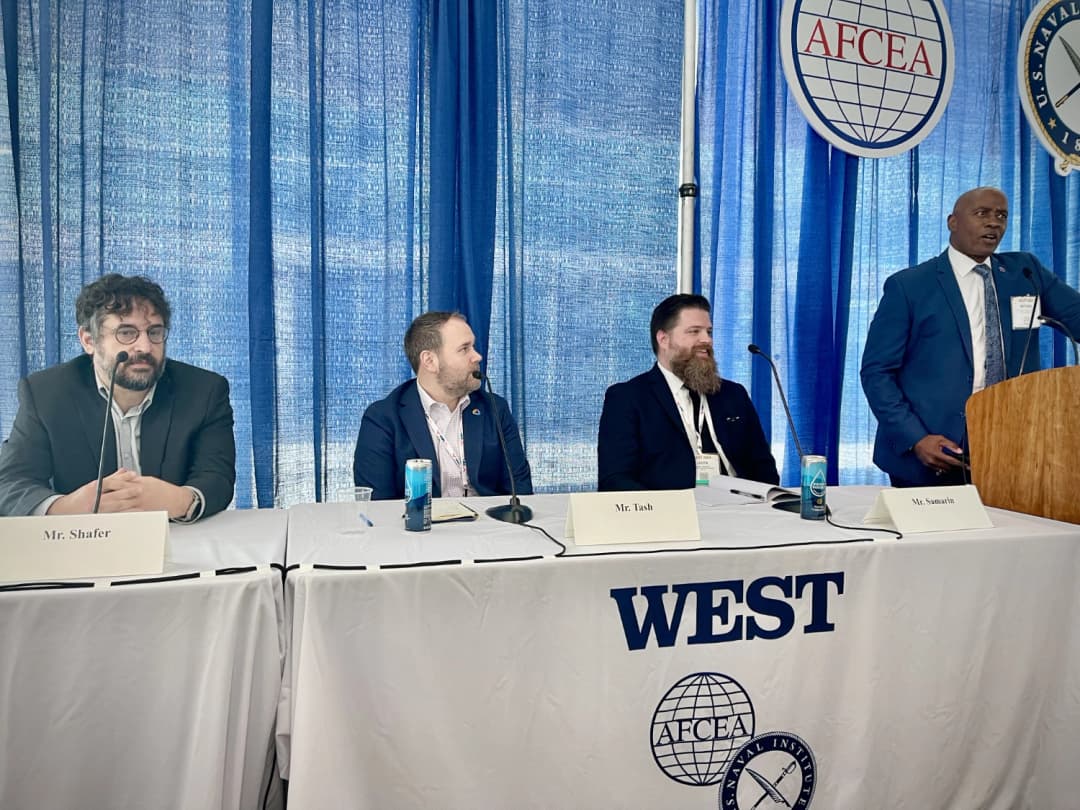
Panelists:
- Mr. Jason Samarin, Principal Software Engineer at PEO C4I
- Mr. Andrew Clay Shafer, Principal Ergonaut at Ergonautic
- Mr. Andrew Tash, Head of Architecture at Google Public Sector
In the lively ambiance of the Sails Theater during the WEST 2024 conference, a panel titled "Challenges with Software Modernization and the Navy" unfolded, led by an insightful moderator. This session brought together esteemed figures: Jason Samarin, Principal Software Engineer at the Program Executive Office (PEO) Command, Control, Communications, Computers, and Intelligence (C4I); Andrew Clay Shafer, Principal Ergonaut at Ergonautic; and Andrew Tash, Head of Architecture at Google Public Sector. The panelists embarked on a deep dive into the pressing challenges the Navy faces in aligning its software engineering practices with the cutting edge of technological advancements. They tackled issues ranging from the deficit of tech-savvy leadership to the complexities of deploying tactical cloud solutions in contested environments, navigating through legal and regulatory hurdles, addressing the dynamics of Navy Enterprise Licenses, and managing a 'mercenary' contractor workforce.
The dialogue commenced with the moderator posing a critical question on the adoption of software practices, sparking a discussion that highlighted the nuanced decision-making process in choosing between Agile, SAFE, and Wardley Mapping methodologies. Andrew Clay Shafer eloquently argued that Agile methodologies shine in scenarios where problems are poorly understood, while Lean principles are more suited to well-defined issues. Andrew Tash, from his vantage within the Navy enterprise IT landscape, underscored the significance of Agile methodologies across the IT portfolio, crediting such practices with enabling rapid progress in initiatives like Flank Speed.
Shafer passionately critiqued the prevalent "lift and shift" strategy for its inefficiency and high costs, advocating instead for a "shift then lift" approach that emphasizes developing cloud-native applications before their transition to the cloud. This strategy, according to Shafer, ensures that applications are primed to leverage the full spectrum of cloud computing benefits. Jason Samarin reiterated the value of cloud-native software, especially given the unique operational contexts of naval ships that often operate without continuous cloud connectivity, highlighting the flexibility and deployment advantages of such solutions.
As the discussion turned to reducing software development friction within the Department of the Navy's IT operations, Samarin pointed out several friction points in onboarding, testing, deployment, and the segmentation of work. He emphasized the need for streamlined processes and zero-trust architecture. Tash celebrated the successes of initiatives like the Overmatch Software Armory (OSA) and Black Pearl, advocating for the use of domain-agnostic enterprise services and cautioning against the creation of redundant environments. Shafer, drawing from his extensive industry experience, critiqued processes "born into a world that no longer exists" and highlighted the critical need for automating governance and compliance to enhance the developer experience.
The conversation further delved into leveraging CI/CD pipelines beyond greenfield development, recognizing the necessity for a culture shift towards Agile/DevOps mindsets and the implementation of Site Reliability Engineering (SRE) principles. The panel acknowledged the challenges of integrating legacy systems into modern pipelines, emphasizing the importance of fostering a culture of quality and confidence in pipeline outputs.
Show me your org chart and funding model, and I'll show you what's wrong with you.
In discussing how the commercial industry can facilitate cultural change within the Department of the Navy, Shafer pointed to the alignment of contracting incentives with organizational goals and outcomes, invoking a common phrase that has been echoed by various business leaders and organizational experts over the years: "Show me your org chart and funding model, and I'll show you what's wrong with you." This sentiment underscores how deeply organizational structure and financial planning can impact effectiveness and adaptability. Tash, reflecting on his recent experience at Google, advocated for outcome-driven approaches and succinct documentation over the Navy's cumbersome RFP processes, which often predetermine solutions rather than focusing on mission outcomes.
In discussing cloud technology adaptation for Denied, Disrupted, Intermittent, Limited (DDIL) environments, Andrew Tash lauded the JWCC contract for its forward-thinking strategy of bringing cloud capabilities directly to the edge, suggesting an innovative approach of starting with DDIL and edge scenarios and then integrating these learnings back into more conventional cloud environments. Andrew Clay Shafer further nuanced the conversation by highlighting the unique and emergent nature of each segment within the DDIL spectrum. He advocated for bespoke solutions, emphasizing the importance of carefully tailoring industry practices to meet the specific operational needs and constraints of military deployments, underscoring the complexity of applying one-size-fits-all solutions in such varied and challenging contexts.
As the panel discussion approached its conclusion, the conversation broadened to encompass significant concerns such as vendor lock-in, the pivotal role of the industry in steering Navy IT towards modernization, and the transformative potential of Generative AI in the realm of software engineering. The speakers delved into the nuances of vendor lock-in, with a consensus emerging around its inevitability in certain contexts but also acknowledging the strategic maneuvers that could mitigate its impact, such as embracing open standards and prioritizing open-source software. The dialogue underscored the critical need for the Navy to foster more dynamic and collaborative relationships with the tech industry, not just as a client but as an active partner in innovation. This partnership is envisioned as a two-way street, where the Navy benefits from cutting-edge technological advancements, and industry gains from the unique challenges and requirements presented by military operations, driving broader innovations in the field.
The discussion on Generative AI, particularly, sparked interest in its potential to revolutionize software engineering within the Department of the Navy (DoN). Panelists speculated on a future where natural language processing could enable sailors to swiftly develop solutions in the field, thereby democratizing software development and significantly reducing the time from concept to deployment. This vision for Generative AI represents not just a shift in how software is developed but a fundamental transformation in the role of personnel as creators and innovators within the naval ecosystem.
In wrapping up, the panelists emphasized the critical importance of agility, innovation, and strategic alignment in overcoming the myriad challenges of software modernization in a military context. They advocated for a culture that values continuous learning, adaptability, and the willingness to experiment and fail as essential components of this journey. The Navy's path forward, as outlined by the experts, is not without its hurdles, but with a concerted effort towards embracing new technologies, methodologies, and partnerships, it can surmount the barriers to modernization. This blueprint for progress, underscored by the panel's insights, sets a course for the Navy to not only navigate the complexities of today's technology landscape but to lead in the creation of tomorrow's innovations, ensuring its continued strategic and operational superiority.
Keynote: Assistant Secretary of Defense for Sustainment
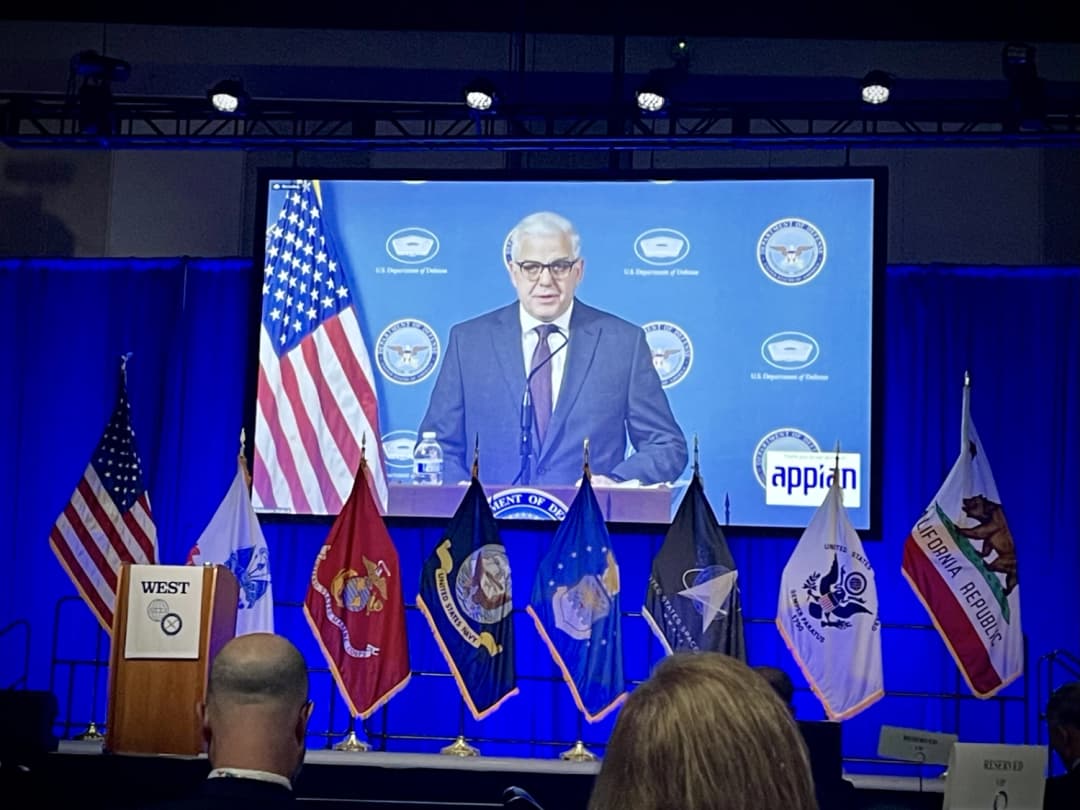
Speaker: The Hon. Christopher J. Lowman
The afternoon keynote at the WEST 2024 conference featured The Honorable Christopher J. Lowman, the Assistant Secretary of Defense for Sustainment, who brought his extensive experience as a career logistician to the fore. Addressing a strategic environment increasingly marked by contention, Lowman outlined how adversaries are not just challenging the U.S. but also reshaping the landscape of modern warfare into a realm far from static and predictable.
Lowman delved into the four pillars of the National Defense Strategy (NDS), highlighting the imperative to defend the homeland with a strategic posture paced to the multifaceted threats posed by the People's Republic of China (PRC). The strategy also emphasizes deterring strategic attacks against the U.S. and its allies, deterring aggression—especially from the PRC in the Indo-Pacific and Russia in Europe—and enhancing the resilience of the Joint Force and the broader defense ecosystem.
Central to his keynote was the concept of operationalizing the NDS through several key initiatives. He emphasized the shift towards a proactive logistics stance, ensuring unit-level readiness, and enhancing material availability across all points of the supply chain. A novel "cost per day of availability" metric was introduced, aiming at evaluating the cost-effectiveness and operational availability of assets, marking a significant pivot from reactive to proactive logistics operations.
Lowman also introduced the Regional Sustainment Framework (RSF), designed to ensure warfighters have uninterrupted access to necessary resources, leveraging global partnerships and aligned regional strategies to lay the groundwork for flexible and adaptive acquisitions within the Department of Defense (DoD). This initiative is pivotal in enhancing the DoD's logistic agility and resilience, as detailed further in a publication by AFCEA's SIGNAL.
Addressing the logistics IT transformation, Lowman underscored the urgent need to consolidate and modernize the DoD's sprawling logistics systems—over 450 in total, costing upwards of $1 trillion. This initiative aligns with the goals outlined in the DoD Logistics Strategy, which seeks to deliver sustainable logistics, cost-effective material readiness, enable warfighting capabilities, and optimize logistic resupply chains and workforce readiness, thereby enhancing economic deterrence.
If technology is not in production, we are not providing our warfighters with what they need.
Lowman stressed the importance of achieving these goals at the speed and scale necessary to confront near-peer adversaries effectively, cautioning against investments in technologies not ready for production, which he likened to "a bridge to nowhere." He highlighted the role of Joint Capabilities Integration and Development System (JCIDS) and Competitive Advantage Pathfinders (CAPs) in maintaining the competitive edge.
In his concluding remarks, Lowman underscored the necessity of a collective resolve to address global security readiness, from leveraging the RSF to reevaluating macro process questions, thereby enhancing distributed contested environments.
During the Q&A session, Lowman addressed the complexities of global conflicts and logistics challenges. He argued that the current logistics and sustainment landscape, exemplified by the coalition efforts in Ukraine, doesn't significantly deviate from the challenges faced over the last two decades. The key, according to Lowman, lies in the coalition's ability to adapt and scale sustainment efforts across multiple nations. He called on the industry to enhance the DoD's flexibility, particularly in scaling sustainment strategies to meet the demands of contested environments, suggesting that industry innovations could greatly contribute to modernizing sustainment efforts and supporting forces through advancements like additive manufacturing. Lowman emphasized that the RSF, alongside other top-level strategies, is instrumental in this modernization effort, ensuring that the DoD's approach to sustainment is as dynamic and resilient as the operational theaters it supports.
Day Two
Day Two of the WEST 2024 conference in San Diego continued the momentum, delving deeper into the strategic imperatives that define the future of naval power and defense acquisition. The day was heralded by a keynote address from the Commander of the U.S. Pacific Fleet, who presented a compelling narrative of the geopolitical landscape of the Indo-Pacific region, the strategic priorities of the U.S. Navy, and the critical need for innovation and readiness in the face of rising challenges. His insights painted a vivid picture of the maritime domain's centrality to global security and the pivotal role of naval forces in maintaining a balance of power.
Following the keynote, the panel discussion "Is Acquisition Innovating and Adapting to Meet the Different Requirements Presented Near Term and Far Term?" took center stage. This session brought together leading figures from various branches of the defense acquisition community to explore the evolving landscape of defense procurement and development. The conversation spanned the gamut from the current state of acquisition innovation to the long-term strategies needed to ensure that the Navy and its partners can quickly field the capabilities required to meet both present and future challenges. The dialogue was rich with perspectives on the balance between agility, efficiency, and the imperatives of national security, offering a nuanced understanding of the complexities inherent in defense acquisition in an era of rapid technological change.
Despite the packed schedule of keynotes and panels, Day Two was also marked by the invaluable opportunity to engage in networking and offsite meetings. These interactions provided a chance to explore collaborations, gain insights from industry peers, and discuss the themes of the conference in a more informal setting. The conversations that unfolded in these spaces were as enlightening as they were varied, covering a wide range of topics from technological innovations to strategic partnerships, underscoring the importance of community and collaboration in addressing the multifaceted challenges facing naval defense.
Though the day was busy and I wasn't able to attend the full slate of events at the conference, the time was maximized through productive discussions and meetings that extended the dialogue beyond the conference venue. These engagements complemented the formal sessions of the day, enriching the overall experience of WEST 2024 with a deeper dive into the practical applications and collaborative efforts that underpin the themes discussed during the day's formal proceedings.
As Day Two came to a close, it was clear that the WEST 2024 conference was not just a platform for presentations but a catalyst for ongoing dialogue, strategic thinking, and partnership-building, all aimed at navigating the complex waters of modern naval warfare and defense strategy.
Keynote: Commander, U.S. Pacific Fleet
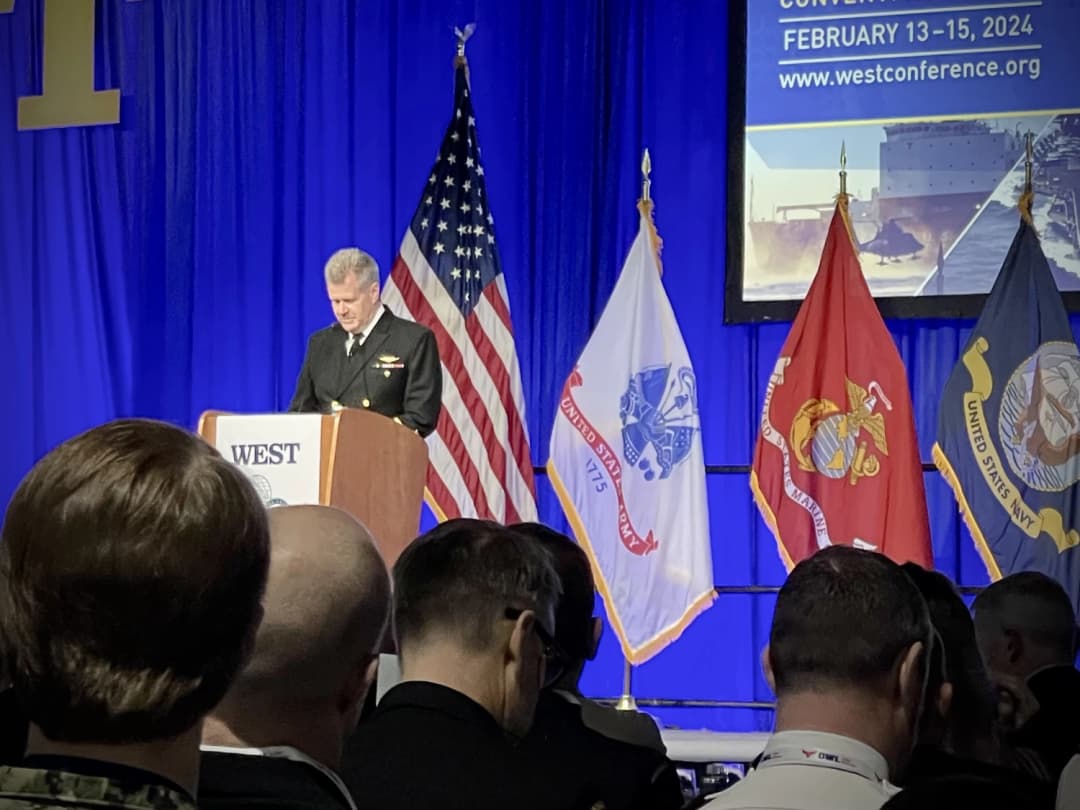
Speaker: ADM Samuel J. Paparo, USN
On the second day of the WEST 2024 conference, attendees were greeted with a powerful keynote from ADM Samuel J. Paparo, USN, Commander of the U.S. Pacific Fleet, marking his third consecutive year presenting at the event. ADM Paparo opened his address by painting a picture of a world increasingly descending into chaos, highlighting significant, non-random shifts in the global landscape. He pointedly mentioned the People's Republic of China (PRC) informing the Russian president that the world hasn't seen such changes in a century, with the implication that they are the orchestrators of these shifts. The admiral stressed the necessity of building resilience amidst this strategic competition, aimed at reshaping the international order.
Roll up our sleeves and get after it!
ADM Paparo then directed the audience's attention to the INDOPACIFIC strategy publication, released two years prior, urging everyone to engage with its contents. He outlined the strategy's goals, which pivot on securing a free and open Indo-Pacific. This vision is anchored in the belief that governments should have the autonomy to make their own choices, with shared domains governed lawfully, and that the prosperity of everyday Americans is intricately linked to the Indo-Pacific. The strategy calls for strengthening resilience, building collective capacity for a new age, adapting alliances, organizations, and rules, and enhancing capabilities to defend interests and deter aggression. The admiral emphasized the importance of allies and partners in achieving these objectives, declaring naval power, inclusive of the US Navy, USMC, and USCG, as an essential element in the national and interdimensional environment. He highlighted the strategic pivot towards maritime dominance and warned of the dangers posed by land powers turning to the sea.
ADM Paparo critically examined China's expansionist ambitions and their growing naval fleet, labeling these actions as revisionist, revanchist, and expansionist. He underscored the dawn of the information revolution, where the integration of data, computing, and AI will be decisive. The admiral introduced additional principles to guide this era, including the preference for machines over humans in risk scenarios, the pairing of human and machine capabilities, and maintaining human accountability in decisions involving human life. Despite the advancements, ADM Paparo expressed dissatisfaction with the current pace of progress.
He identified four critical battlegrounds essential for prevailing in the 21st century: data, compute, talent, and policy. In this context, he introduced the DoD Replicator, a process designed to deliver innovative capabilities to warfighters at speed and scale. This initiative exemplifies the commitment to "roll up our sleeves and get after it," embodying the proactive approach required to navigate the challenges ahead.
We are all part of this team!
ADM Paparo concluded his address by reflecting on the unchanging nature of warfare as a battle of wills and the imperative to learn and adapt faster to survive. He posited that effective deterrence is the primary goal of their efforts, where success means history may never know their names. This collective responsibility underscores the admiral's closing remark: "we are all part of this team," rallying the audience to a unified approach in facing the trials of the 21st century.
Following his illuminating speech at WEST 2024, ADM Paparo, engaged in a thought-provoking question-and-answer session with the audience, delving deeper into the complexities of modern naval strategy and logistics.
An app is not going to feed a troop in the field.
ADM Paparo discussed the intricacies of sustaining a force with hundreds of ships, emphasizing the critical partnership with the NSC and NORAD. He underscored that the 21st century does not diminish the principle of mass and the necessity of sustainment, highlighting the narrow margins on which the defense industrial base operates. The focus, he argued, should be on efficacy rather than effectiveness, pointing out that technology alone cannot fulfill all logistical needs. "An app is not going to feed a troop in the field," he remarked, stressing the unmatched efficiency of sea lift. ADM Paparo raised an alarm about the precarious state of logistics, particularly as red teams consistently target these systems in wargames.
Addressing the PRC's aggressiveness in the South China Sea (SCS), ADM Paparo clarified there was no intention of engaging in reckless confrontations. He outlined the priorities in dealing with this threat as safety, adherence to rules, and resoluteness. He affirmed the right of every crew and captain to defend themselves against excessive claims by the PRC and emphasized the U.S. commitment to supporting allies' sovereign will.
In response to concerns about domestic recruiting challenges, ADM Paparo expressed confidence in the continued respect and appreciation the American public holds for the military. He cited love of country, personal betterment, and the allure of adventure as timeless motivations for joining the service. The Admiral highlighted the importance of engaging with influencers in young people's lives to showcase the benefits of military service, acknowledging the added difficulty during times of high employment.
On integrating unmanned capabilities, ADM Paparo hinted at the discretion surrounding these efforts, emphasizing the principle of surprise in military strategy. He described a rich program integrating USVs, UUVs, and UAVs and the formation of the PACFLT's 2nd USV squadron. His strategy focuses on denying the PRC's use of the sea, through smart undersea, surface, and aerial capabilities, rather than matching their capacity one for one.
ADM Paparo praised the State Department, emphasizing the interdependence of military and diplomatic efforts. He argued for adequate funding for the State Department, suggesting that skimping on its budget necessitates a disproportionate increase in defense spending. He expressed satisfaction with the current level of partnership.
Reflecting on recent exercises with allies, ADM Paparo detailed efforts to modernize alliances, citing joint exercises like Keen Edge, FMS case sales, and Japan's counterstrike capabilities. He emphasized the growing partnerships and combined formations as daily occurrences, showcasing a united front.
Regarding the PRC's ambitions toward Taiwan, ADM Paparo contended that while the PRC remains undaunted, Taiwan's fate is not inevitable. He stressed the importance of quick execution to avoid protracted conflict and the goal of deterring conflict until a regime amenable to dialogue emerges. The U.S. strategy seeks to maintain a constant state of overmatch, preparing for a conflict it aims to prevent.
ADM Paparo likened operating under a Continuing Resolution (CR) to shopping at a convenience store, highlighting the inefficiency and planning challenges posed by CRs. He discussed the impact on munitions and weapon systems, emphasizing the need for prudent management to mitigate these constraints.
On deterring the PRC without revealing new technologies, ADM Paparo discussed the balance between deterrence, information operations, and operational security. He underscored the importance of working with partners in the press and maintaining the element of surprise, integral to strategic maneuvering.
This session provided a deeper insight into ADM Paparo's perspectives on sustaining naval power amidst evolving global threats, emphasizing innovation, strategic partnerships, and the critical balance between showing strength and maintaining secrecy. His responses highlighted the Navy's strategic and operational priorities, offering a glimpse into the nuanced approach required to navigate the challenges of modern naval warfare and diplomacy.
Panel: Is Acquisition Innovating and Adapting to Meet the Different Requirements Presented Near Term and Far Term?
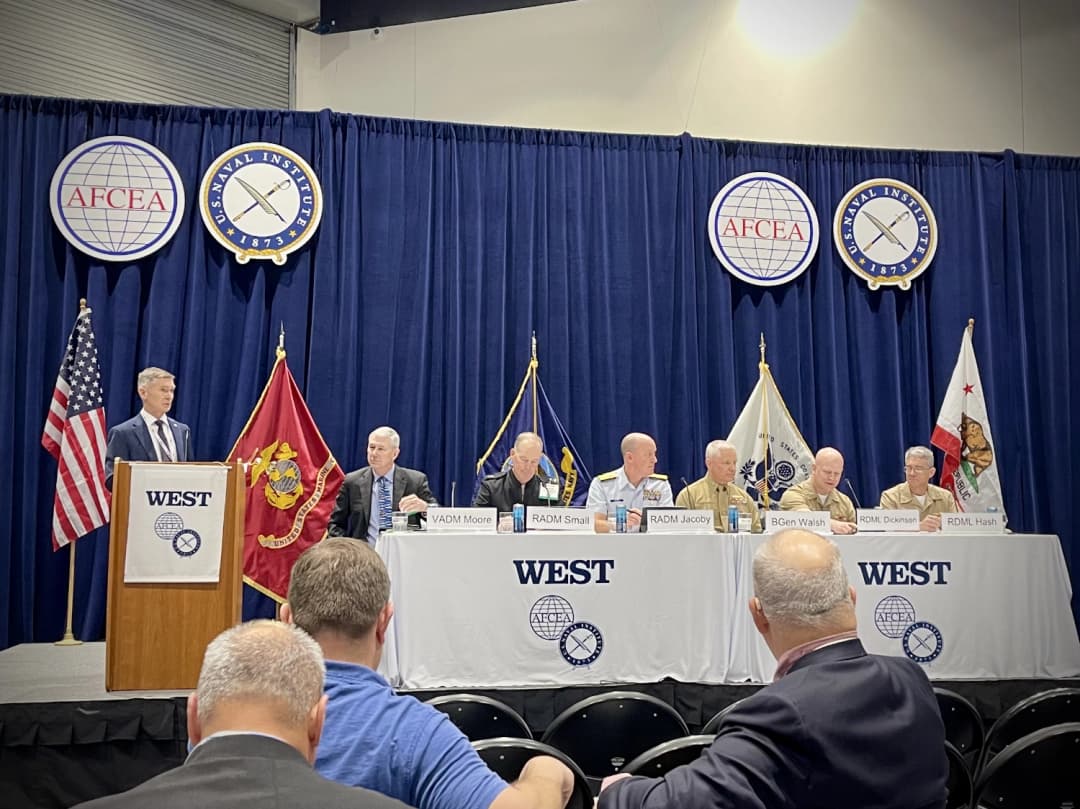
Moderator: VADM Tom Moore, USN (Ret.)
Panelists:
- RDML Thomas J. Dickinson, USN
- RDML Keith A. Hash, USN
- RADM Chad L. Jacoby, USCG
- RADM Douglas W. (Doug) Small, USN
- BGen David C. Walsh, USMC
The second day of WEST 2024 featured an engaging panel discussion, skillfully moderated by VADM Tom Moore, USN (Ret.), who previously led the Naval Sea Systems Command. This session brought together a distinguished group of Systems Command leaders: RDML Thomas J. Dickinson, USN, from the Naval Surface Warfare Center; RDML Keith A. Hash, USN, of the Naval Air Warfare Center, Weapons Division; RADM Chad L. Jacoby, USCG, the Assistant Commandant for Acquisitions and Chief Acquisition Officer at the United States Coast Guard; RADM Douglas W. (Doug) Small, USN, the head of Naval Information Warfare Systems Command (NAVWAR); and BGen David C. Walsh, USMC, who commands the Marine Corps Systems Command. Each panelist brought their unique perspective to the discussion, focusing on the imperative to innovate and adapt within the acquisition process to meet both near-term and long-term challenges facing the U.S. defense industrial base.
The focal point of the discussion was "Is Acquisition Innovating and Adapting to Meet the Different Requirements Presented Near Term and Far Term?" This question sparked an engaging conversation about the challenges and innovations within the U.S. defense industrial base against the backdrop of increasing strategic competition and the rising threats from China and Russia.
[NAVWAR is] the Navy's geek squad.
RADM Douglas W. Small began by echoing ADM Paparo's sentiment that satisfaction is ever elusive in this domain. He highlighted NAVWAR's role as the Navy's "geek squad," emphasizing the importance of people, readiness, and digital modernization. He cited successful acquisition examples like Starlink, software factories, and various PEO initiatives that underscore NAVWAR's commitment to innovation.
Focus on unleashing the creativity of sailors and marines.
RADM Chad L. Jacoby discussed the Coast Guard's innovative strides, particularly in global fleet integration with projects like the heavy icebreaker and maritime search and rescue operations. He emphasized the importance of acquisition and sustainment working in tandem to bridge gaps and stressed the necessity of life cycle management for sustained operational readiness.
BGen David C. Walsh talked about the Marine Corps' approach to ensuring Marines have what they need when they need it. He highlighted the importance of hiring the right people, partnering with industry, and establishing fusion cells to transition from Science and Technology (S&T) to rapid Programs of Record (PoR), advocating for a culture that is comfortable with risk and prioritizes effectiveness over efficiency.
RDML Thomas J. Dickinson celebrated the innovation inherent within the Warfare Center enterprise, boasting of 145 technical capabilities across 10 divisions. He affirmed that innovation is not just alive but thriving, driven by the Navy's best warfighters and a foundation of acquisition community support.
RDML Keith A. Hash focused on fleet readiness and the criticality of partnerships in delivering outcomes. He shared a sobering statistic that 70% of capabilities are delivered late, underscoring the need for a cultural shift towards a data-driven and growth mindset where learning is paramount.
The discussion ventured into the realm of transition teams and cultural change, especially in embracing risk. RDML Dickinson highlighted the specialized expertise within the divisions and the alignment with the SECNAV for OTA contracting. BGen Walsh emphasized the importance of enduring capabilities from experiments and aligning funding to sustain innovation.
Addressing the challenges of living with the Federal Acquisition Regulations (FAR), the panelists shared insights on improving the acquisition process. RADM Jacoby mentioned a task force that generated recommendations for contracting efficiency, while RDML Hash called for better utilization of existing tools and communication with industry. BGen Walsh and RADM Small both advocated for applying congressional authorities more effectively and embracing risk.
The role of contracting offices and approaches to acquisition saw the panelists advocating for continuous processes and strong communication with industry. RADM Jacoby and BGen Walsh discussed strategies for flexibility and portfolio management to respond to emergent needs.
On the industry base, RADM Small emphasized the need for industry to invest in solutions the Navy needs, while RADM Jacoby highlighted efforts to support small businesses and grow the shipyard capacity.
Regarding innovation initiatives like DIU or Replicator, RDML Dickinson mentioned NavalX Tech Bridges as key to integrating new industry into the Defense Industrial Base (DIB), while RDML Hash talked about rapid capability offices and aligning efforts for faster outcomes.
We encourage critical thinking over checklist mentality.
The panel also tackled the role of legal reviews in the acquisition process, with consensus that early inclusion of legal teams facilitates smoother processes. Lastly, the discussion touched on acquisition security, supplier risk identification, and the challenges of munitions sustainability in prolonged conflicts, emphasizing increased collaboration with industry and organic collaboration for surge capacity.
This panel provided a comprehensive overview of the systemic efforts to innovate and adapt acquisition processes within the U.S. defense apparatus, offering insights into the challenges and strategies employed to ensure that the military remains equipped to meet both present and future threats.
Day Three
Day Three of the WEST 2024 conference in San Diego epitomized the convergence of strategic insights and collaborative energy that had characterized the event from the start. The day commenced not from my hotel room, where I participated in an early morning remote meeting focused on the ongoing transition efforts from the Modernized Integrated Database (MIDB) to the Machine-Assisted Analytic Rapid-Repository System (MARS). This meeting underscored the importance of continuous integration and adaptation in defense intelligence and operations, setting a tone of forward-thinking and proactive engagement for the day ahead.
The centerpiece of the day's events was the keynote address by the Secretary of the Navy, The Hon. Carlos Del Toro. His speech was a deep dive into the pivotal role of the Navy and Marine Corps in addressing the array of challenges confronting global security, from the strategic competition with China to the imperatives of climate instability and the enduring impacts of COVID-19. Secretary Del Toro articulated a vision for a Navy and Marine Corps that are not only equipped to meet today's demands but are also evolving to confront the challenges of tomorrow. His commitment to inclusiveness, respect, and ensuring the readiness and well-being of all personnel resonated throughout his address, highlighting the human dimension at the core of naval strength and resilience.
Beyond the formal sessions, Day Three allowed for an exploration of the exhibit floor, showcasing a range of innovations and technologies integral to naval missions. This experience highlighted the rich ecosystem of partners and advancements shaping naval warfare and defense, with more details on specific technologies and swag to follow.
The day went beyond the conference, leading to valuable meetings with industry partners that highlighted the crucial role of public-private partnerships in fostering innovation. These sessions, set to be detailed later, showcased the productive collaboration between the defense sector and private industry. Additionally, I took the opportunity to explore San Diego, enriching the experience with the city's vibrant culture and scenery.
Day Three of WEST 2024 was a fitting conclusion to a conference that had consistently highlighted the complexities of contemporary naval operations and the collaborative efforts required to navigate them. From strategic keynotes to hands-on demonstrations on the exhibit floor, and the invaluable networking and collaboration opportunities that framed the day, the final day of the conference encapsulated the spirit of innovation, partnership, and forward-looking strategy that will continue to guide the naval community in the years to come.
Keynote: Secretary of the Navy
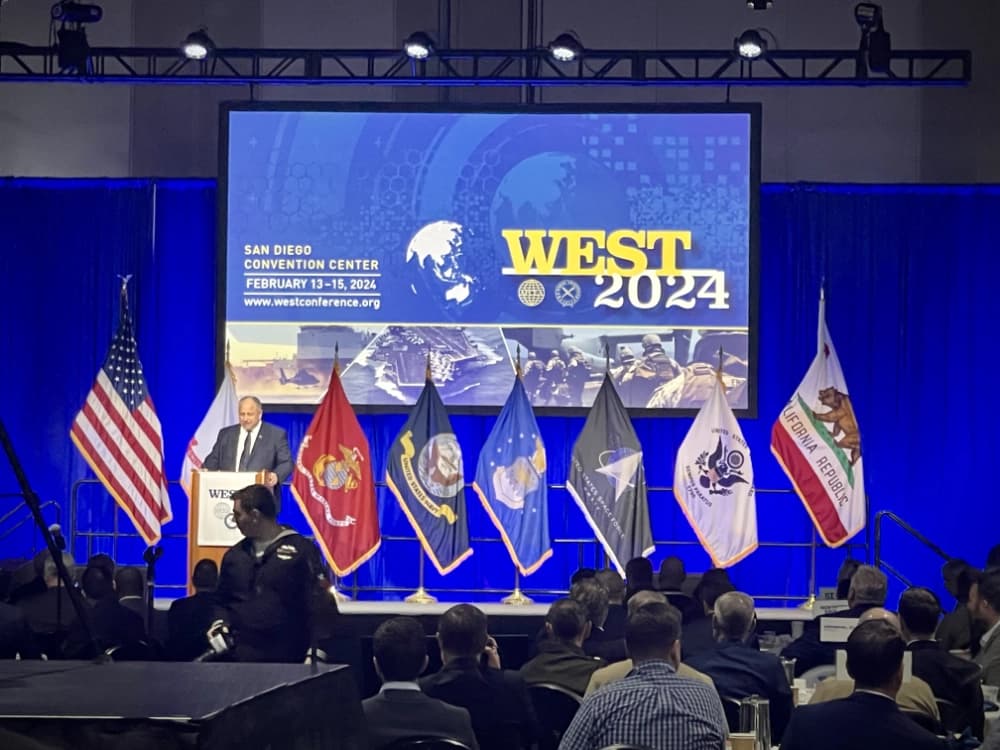
Speaker: The Hon. Carlos Del Toro
On the final day of the WEST 2024 conference, attendees gathered to hear from The Hon. Carlos Del Toro, Secretary of the Navy, who brought a wealth of experience and insight to the podium. With a distinguished career spanning over two decades in the Navy, followed by significant contributions to defense through his company, SBG Technology Solutions, Inc., Secretary Del Toro’s perspective on the current state and future of naval operations was eagerly anticipated.
Hindsight is notably cleverer than foresight.
Secretary Del Toro began his speech with a nod to the importance of strategic foresight in naval planning, echoing Fleet Admiral Chester Nimitz's sentiment that "hindsight is notably cleverer than foresight." He stressed that the true measure of leadership lies in the ability to act decisively in the present, shaping history through the crucible of action rather than the comfort of hindsight. In this vein, he outlined his vision for a new approach to Maritime Statecraft, emphasizing the critical role of both Navy and industry leaders in identifying and executing the best courses of action to support our Sailors, Marines, and the broader national interest.
I will submit to you that history is forged in the crucible of action, not the comfort of hindsight.
A central theme of Secretary Del Toro's address was the urgent need for a comprehensive budget to maintain and enhance naval readiness and safety. He highlighted the detrimental impact of operating under Continuing Resolutions (CRs), likening it to shopping for groceries at a convenience store—a stopgap measure that falls short of meeting the Navy's extensive requirements. The Secretary's call to action was clear: the House of Representatives must pass a full-year budget to prevent the risks to readiness and safety that a full-year CR would entail.
Without a full budget, our safety and readiness will suffer...lost time in readiness cannot be bought back through future funding.
Secretary Del Toro also articulated a vision for using naval power to deter and prevail without fighting, underpinning a strategy to uphold a free and open international order. This strategy, he noted, is crucial in the face of provocations from the People's Republic of China and other adversaries seeking to undermine global security and stability.
Maritime Statecraft is about using naval power to deter and prevail without fighting.
Addressing the future of shipbuilding, the Secretary called for greater investment and innovation to build a larger, more lethal Navy. He underscored the necessity of recruiting 150,000 new workers over the next decade to rejuvenate America's shipbuilding workforce, blending traditional skills with cutting-edge technologies to forge a modern fleet capable of meeting the challenges of the 21st century.
We need 150,000 new, qualified workers to choose a career in shipbuilding over the next ten years to make it happen.
Secretary Del Toro emphasized the importance of collaboration between industry, academia, and government to spur innovation and maintain a competitive edge. He praised the contributions of industry partners while expressing concerns over the prioritization of stock buybacks and executive compensation over essential investments in the defense industrial base. The Secretary was unequivocal in his commitment to holding organizations and individuals accountable for delivering on time, on budget, and to the required standards of excellence.
Overall, many of you are making record profits—as evidenced by your quarterly financial statements—and while I am happy for you, you can't be asking for the American taxpayer to make greater public investments while you continue to goose your stock prices through stock buybacks, deferring promised capital investments, and other accounting maneuvers that—to some—seem to prioritize stock prices that drive executive compensation rather than making the needed, fundamental investments in the industrial base at a time when our nation needs us to be all ahead flank.
In a forward-looking statement, Secretary Del Toro declared the arrival of the hybrid fleet, highlighting the seamless integration of unmanned systems into naval operations. This transformation, he argued, is not a distant future but a current reality, showcasing the Navy's adaptability and commitment to innovation.
Innovation is more than gadgets, gizmos, or whizbangs. Innovation is about culture.
Innovation, according to Secretary Del Toro, is rooted in culture—a culture that encourages questioning the status quo, values every voice, and explores every idea. He called on the Navy and its partners to empower Sailors and Marines to think differently and strategically, fostering an environment where innovation thrives.
Concluding his speech, Secretary Del Toro paid tribute to the Sailors and Marines who recently lost their lives, reminding the audience of the inherent risks of naval service. He called on everyone to honor their sacrifice by committing to serve with excellence and to continuously strive for improvement.
These incidents highlight the dangerous nature of our work—we must honor these patriots and their ultimate sacrifice by remembering why we all choose to serve and committing ourselves to do better.
Through his speech, Secretary Del Toro painted a vivid picture of the challenges and opportunities facing the Navy, calling for unity, innovation, and decisive action to secure the future of American naval power.
In a dynamic question and answer session, Secretary Carlos Del Toro engaged with the audience on a diverse array of topics, spanning space operations to shipbuilding and the challenges of recruitment.
Delving into space and its significance for defense, Secretary Del Toro highlighted the Navy and Marines as primary operational users of space assets. Despite initial reservations about the establishment of the U.S. Space Force, he assured the audience that Navy requirements remain a priority, with a collaborative effort across forces to support joint warfighter missions.
On leveraging international shipbuilding capabilities, particularly from Korea and Japan, Secretary Del Toro acknowledged the strategic necessity of such collaborations. He shared ongoing efforts to expand the scope for overseas voyage repairs, pointing out the potential for international shipbuilders to invest in the U.S. market.
Addressing the involvement of private equity in U.S. shipbuilding, Del Toro revealed ongoing discussions aimed at identifying incentives to bolster the shipbuilding industry, exploring the potential benefits of private equity investments.
The conversation turned to the pressing issue of recruitment shortfalls. Secretary Del Toro called for a collective effort in recruitment, pointing out the unique challenges posed by a robust economy. Highlighting the Marine Corps' success in meeting their recruitment targets, he emphasized the need for innovative strategies to attract talent to the Navy and the military at large.
Finally, when asked about the shipbuilding gap between the U.S. and China, Secretary Del Toro underscored the necessity of pursuing a dual strategy that encompasses both traditional shipbuilding and the development of unmanned systems. This approach, he suggested, is crucial for maintaining competitive maritime capabilities.
Throughout the session, Del Toro provided insightful responses that underscored his commitment to addressing the Navy's challenges through innovation, strategic collaboration, and a forward-looking approach. His engagement with the audience reflected a deep understanding of the issues at hand and a resolve to guide the Navy through the evolving landscape of global security threats.
Exhibit Hall
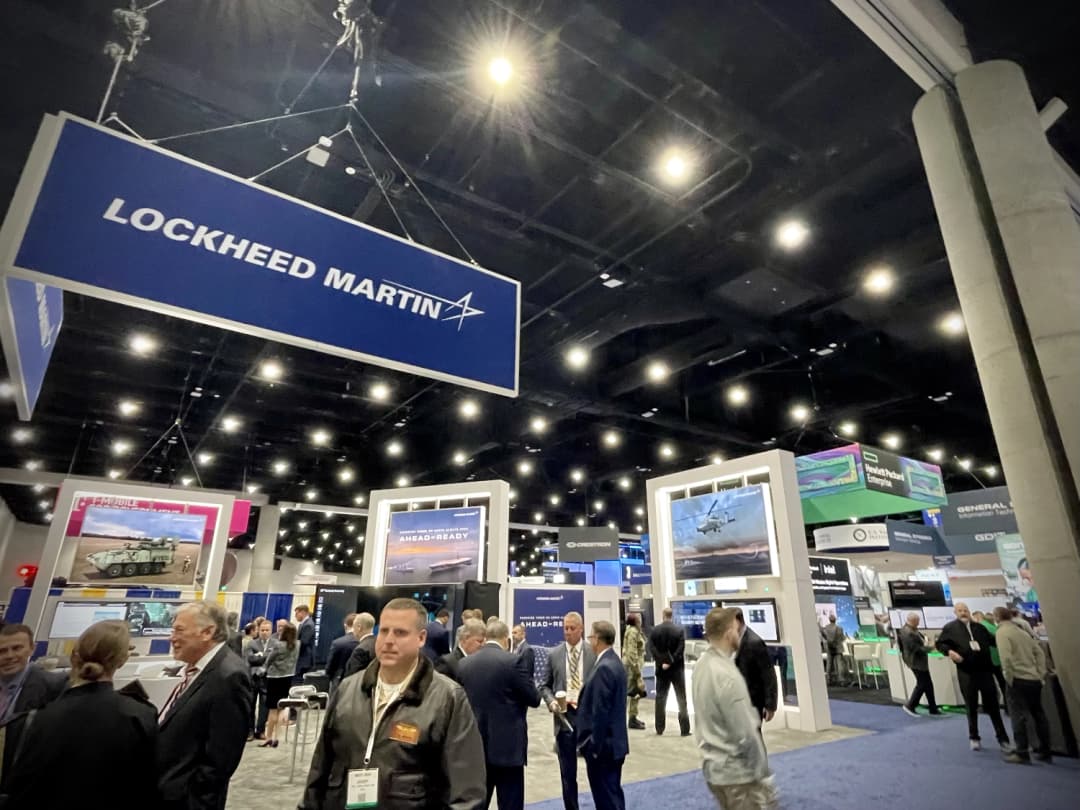
The exhibit hall at WEST 2024 was nothing short of a technologist's wonderland, a sprawling canvas where the latest in cutting-edge naval technology and solutions came to life. Vendors, ranging from established defense giants to nimble startups, had set up their booths with an air of pride and anticipation, ready to showcase their innovations to the world. Each step through this vibrant maze revealed another aspect of the future of naval operations, from AI-driven surveillance systems to the latest in unmanned underwater vehicles. It was as if every booth was a portal to the future, offering glimpses of what's possible when technology meets strategic defense needs.
Wandering through the exhibit hall, the sheer brilliance of innovation on display was unmistakable. Vendors, brimming with enthusiasm and expertise, were on hand to show how their innovations could transform naval capabilities. From notepads that remained steadfast and usable in the relentless downpour of a forward-deployed mission to sophisticated, drone-operated surveillance systems engineered for stealth and efficiency at sea, the array of products was a testament to the future of naval warfare. These weren't mere gadgets and services for sale; they symbolized a leap toward a future where naval operations are not only more secure but also smarter and seamlessly integrated with cutting-edge technology.
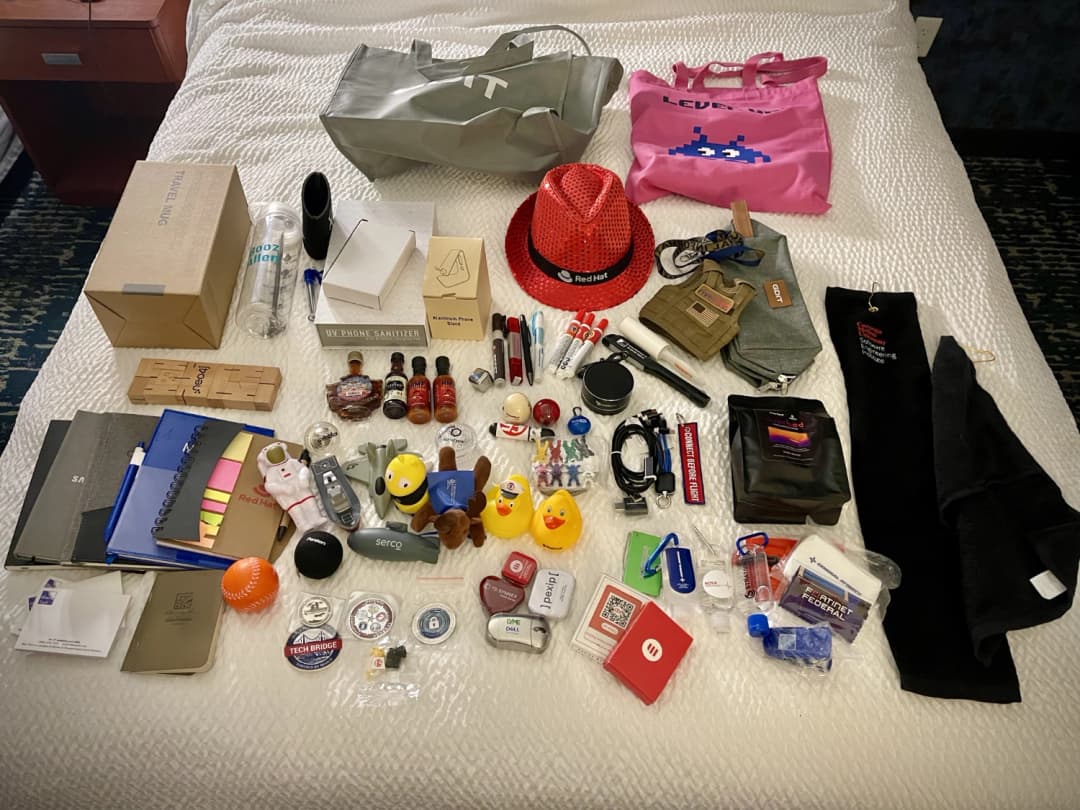
Amidst the serious discussions of capabilities and contracts, there was also a lighter side to the exhibit hall - the quest for swag. It started as a casual collection of pens and notepads, but before I knew it, I had amassed an impressive hoard of gadgets, t-shirts, and other paraphernalia, each item a token of the innovative spirit that filled the room. The haul was so generous, in fact, that I began to worry whether my suitcase could contain this treasure trove without incurring the wrath of American Airlines' baggage policies. I imagined the check-in counter's raised eyebrows as I explained that, yes, all these tech-themed stress balls and LED flashlights were essential souvenirs from a defense technology conference. It was a humorous reminder of the abundant creativity and generosity that characterized the exhibit hall, a testament to the vibrant community gathered at WEST 2024.
Reflecting on my time in the exhibit hall, it was clear that the heart of the conference beat strongest here, among the rows of booths and the buzz of excited conversations. The vendors, with their groundbreaking wares and solutions, had not only showcased what the future of naval defense might look like but had also fostered an environment of collaboration and imagination. And as I contemplated how to strategically pack my suitcase, I couldn't help but smile at the thought that, in addition to knowledge and connections, I was taking home a little bit of the spirit of innovation that WEST 2024 so brilliantly encapsulated.
Collaboration and Networking
Amidst the whirlwind of sessions and exhibits at WEST 2024, a core theme that truly resonated with me was the unparalleled value of collaboration and networking. This section delves into two crucial aspects of my experience: the enriching meetings and discussions with the brilliant minds from NAVWAR and NIWC-PAC, and the insightful vendor discussions that spanned both the bustling conference floor and the more intimate settings offsite. Whether it was finally putting faces to the names of colleagues I'd interacted with remotely or engaging in deep dives with vendors about the latest in naval technology, each interaction was a building block towards fostering stronger partnerships and exploring innovative solutions for the challenges at hand.
NAVWAR and NIWC-PAC
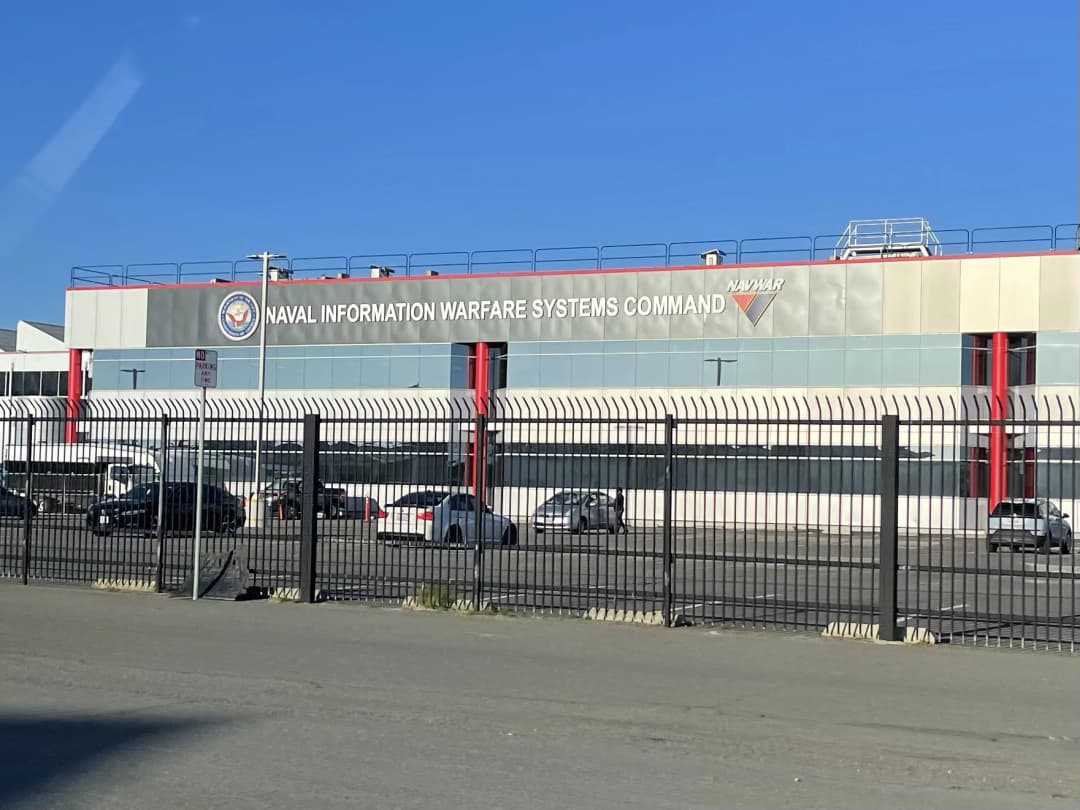
The WEST 2024 conference wasn't just an opportunity to absorb the latest in naval technology and strategy; it served as a vibrant platform for collaboration and networking, particularly with key partners like NAVWAR and NIWC-PAC. Meeting some of the folks I've been communicating with via email over the past few months was a highlight. Finally putting faces to names, I was embraced by the NIWC-PAC culture—a community of like-minded individuals dedicated to supporting each other in delivering winning outcomes for our warfighters. This culture, characterized by agility, innovation, and a warfighter-focused mindset, truly resonated with my own experiences and aspirations.
During my visit to the NAVWAR offices, the conversations flowed effortlessly as we delved into our respective missions and explored potential areas for collaboration. With tight budgets and overlapping requirements in intelligence support to Command and Control (C2) Space, the discussions around projects like the Force Disposition Tracker (FDT) and the transition from MIDB to MARS were particularly fruitful. We reviewed challenges and brainstormed potential solutions, laying the groundwork for future cooperative efforts.
The collaborative spirit I encountered at NAVWAR and NIWC-PAC San Diego deeply reflected the culture we cultivate at NIWC-PAC Philly, where Agile, Lean, and User-Centered Design are not just methodologies but mindsets and principles that guide our every product effort. During our discussions, it became evident that our shared commitment to these approaches could foster meaningful collaborations. I offered the support of our product teams at NIWC-PAC Philly, highlighting our extensive experience in the ISC2 domain and our capacity to deliver outcomes that directly benefit our warfighters. This gesture of support was aimed at bridging any gaps between our commands, ensuring that we can collectively leverage our strengths to advance the mission-critical projects. The potential for our teams to support each other's efforts in these areas opens up exciting avenues for innovation and efficiency, embodying the collaborative ethos that drives our work.
Although time constraints meant I couldn't connect with everyone I had hoped to, the interactions I did have were incredibly valuable. They reinforced the importance of collaboration across commands and disciplines, especially in an era of constrained resources and shared challenges. I left feeling inspired by the potential of our combined efforts to make a real difference in the field and looking forward to deepening these partnerships in the future.
Vendor Discussions
The WEST 2024 conference was not just a confluence of ideas and innovations but also a fertile ground for discussions with key vendors who are pushing the boundaries in defense technologies. Each conversation offered insights into how their solutions could be woven into the fabric of our naval capabilities, enhancing our operational effectiveness and security posture.
Second Front emerged as a standout with their GameWarden solution, promising to streamline deployments to both unclassified and classified environments. Meeting with Trevor Alexander and David Pollreisz, I was struck by their agility and commitment to delivering rapid solutions. A significant factor contributing to their agility and understanding of defense's dynamic requirements is their founding team, which includes Kessel Run alumni like Enrique Oti. This lineage ensures that Second Front is well-equipped to navigate the complexities of national security, making their solution an ideal fit for deploying applications within my portfolio to classified networks efficiently and securely. Their foundational principle of equipping defense professionals for sustained technological competitiveness resonates deeply with our strategic aims.
Trinity IT has long been a cornerstone of support, offering IT consulting solutions that have been instrumental to the success of numerous Department of Defense programs. Tom Buck and Emily Sims, who have been with me through various initiatives, represent the essence of Trinity IT's invaluable contribution. Their participation at the WEST 2024 conference reinforced my trust in their expertise and the exceptional engineering talent they provide. With a profound understanding of both the current landscape and future directions, Tom and Emily have become indispensable allies. Their ability to tackle complex IT challenges with historical insight and sharp problem-solving skills has solidified Trinity IT's role as a trusted partner in my endeavors.
Meeting Jim Scarpello from Data Intelligence was another highlight. As one of our prime contractors, Data Intelligence's focus on systems engineering, software development, and cybersecurity solutions aligns perfectly with our mission objectives. Their contributions, particularly in intelligence and data architecture, have been instrumental in crafting sophisticated solutions for IT and C5ISR systems. Jim's presence at the conference was an excellent opportunity to align on current efforts and reinforce the value they bring to our programs.
Lastly, the leadership team from Gnostech provided an intriguing glimpse into their capabilities. Conversations with Sarah Carter, James Espino, and Jamie Schlosser were enlightening, offering a preview of how their expertise could benefit NIWC-PAC projects. Gnostech's involvement in defense solutions presents an exciting avenue for potential collaborations, and I look forward to exploring how their offerings can be integrated into our technological ecosystem.
These vendor discussions, both during and after the conference, underscored the importance of partnership between the defense community and the private sector. As we navigate the complexities of modern warfare and defense readiness, these collaborations are essential for fostering innovation, securing our networks, and ensuring we remain at the cutting edge of technological advancement.
San Diego Tourism
San Diego, with its sun-kissed beaches and laid-back vibe, is the kind of place that makes you wonder how anyone manages to clock in for work. Strolling through the city, you can't help but feel a tug of envy for the locals who call this paradise home. I found myself fantasizing about living here, albeit briefly, before the reality of real estate prices brought me back down to earth. But let's be honest, if daydreaming could pay the bills, I'd have a beachfront property by now!
My explorations took me to three iconic locales, each with its unique charm and history. The Gaslamp Quarter, with its pulsating energy and architectural elegance, offered a glimpse into San Diego's vibrant nightlife and culinary scene. Old Town, the birthplace of California, transported me back in time with its historic sites and authentic Mexican fare. And La Jolla Cove? It was a serene escape, where the natural beauty of the coastline met upscale dining and leisure.
The city's allure extends far beyond its picturesque landscapes; it's a haven for foodies and adventurers alike. I indulged in the freshest fish tacos at the Cove House, savored authentic Mexican cuisine at Casa Guadalajara, and treated myself to the inventive dishes at Ketch Grill and Taps. Not to mention the mouthwatering burgers at Burgers, Bait & Beer and the unforgettable sampler of fish tacos at Baja Rick's. Each meal was a story in itself, from the casual elegance of Lou & Mickey's to the cozy ambiance of Miguel's Cocina and the lively atmosphere of Union Kitchen & Tap.

San Diego is more than just a beautiful destination; it's a vibrant tapestry of cultures, flavors, and stories waiting to be experienced. From the historic charm of Old Town and the dynamic nightlife of the Gaslamp Quarter to the tranquil beauty of La Jolla Cove, this city captivates the heart and the palate. And while the dream of calling San Diego home might remain just that—a dream—the memories of its culinary delights and scenic wonders are treasures I'll carry with me always.
Old Town

Nestled in the heart of San Diego's vibrant history, Old Town is a living canvas that blends the rich tapestry of its 19th-century origins with the lively pulse of modern life. My stay at the Marriott Courtyard Old Town placed me just two blocks away from the main strip, making every exploration a convenient and immersive journey back in time. The hotel itself, with its modern amenities and welcoming atmosphere, was the perfect base from which to dive into the cultural richness of Old Town.
Walking through the streets of Old Town, I was transported to an era where California was just beginning to take shape. Adobe buildings, historical landmarks like the Whaley House Museum, and the Old Town San Diego State Historic Park offered a window into the lives of those who walked these streets generations before. The air was filled with the aroma of authentic Mexican cuisine from nearby restaurants enticing visitors with flavors that speak to the area's heritage.
The marketplace buzzed with activity, with local artisans showcasing their crafts—each piece a testament to the area's rich cultural tapestry. Beyond the historical significance, Old Town is a testament to the enduring spirit of community, where past and present merge in a celebration of Mexican heritage and Californian history.
Staying so close to the heart of Old Town allowed me to fully immerse myself in its charm and vibrancy. The convenience of being a short walk from the main attractions meant that I could wander through the bazaars, dine on traditional dishes, and soak in the historical ambiance at my own pace. Old Town, with its unique blend of history, culture, and lively community, proved to be more than just a destination—it was an experience, a place where every corner held a story, and every moment was a step through time.
Gaslamp Quarter

Just a stone's throw from the San Diego Convention Center, the Gaslamp Quarter stands as a vibrant testament to the city's dynamic nightlife and historic charm. As the sun dipped below the horizon each day of the conference, this lively district beckoned with the promise of relaxation and entertainment, making it the perfect locale for happy hour and beyond.
In the shadow of the day's formal proceedings, the Gaslamp Quarter unfurled as a canvas of culinary and social delights. Its proximity to the convention center made it an irresistible magnet for post-event gatherings, where the exchange of ideas could flourish amidst a backdrop of casual eateries, sophisticated bars, and lively pubs. The transition from the last conference session to the first sip of a well-crafted cocktail was nearly seamless, facilitated by the short walk that separated intense learning from deserved relaxation.
The Quarter's allure wasn't just in its accessibility but in the diversity of experiences it offered. Rooftop bars presented stunning vistas of the downtown skyline, while hidden gems tucked away on side streets promised intimate conversations and unique drinks. The Gaslamp Quarter thrived as a dynamic playground for professionals seeking to decompress, network, and savor the city's culinary innovations and mixology.
This vibrant neighborhood served as a reminder that the essence of San Diego lies in its ability to marry the historic with the contemporary, creating an environment where professionals could both celebrate the day's achievements and anticipate tomorrow's opportunities. The Gaslamp Quarter, with its juxtaposition of the convention center's structured learning and its own freewheeling enjoyment, encapsulated the perfect balance of work and play, making every evening an extension of the conference's collaborative spirit.
La Jolla Cove

La Jolla Cove, a picturesque jewel nestled along San Diego's coast, offers an escape into a world where nature's beauty and upscale refinement converge. Far from the structured environment of the conference, this serene spot provided a perfect counterbalance with its breathtaking ocean views, the playful banter of sea lions, and the tranquil ambiance that defines the area.
The Cove's charm is undeniable, with its crystal-clear waters and rugged cliffs forming a backdrop that feels almost painted by an artist's hand. As I explored, the sounds of the ocean and the calls of seabirds created a symphony that underscored the natural beauty of this coastal retreat. The presence of sea lions, basking in the sun or playfully navigating the waters, added a sense of wonder and delight, reminding me of the simple joys that nature bestows.
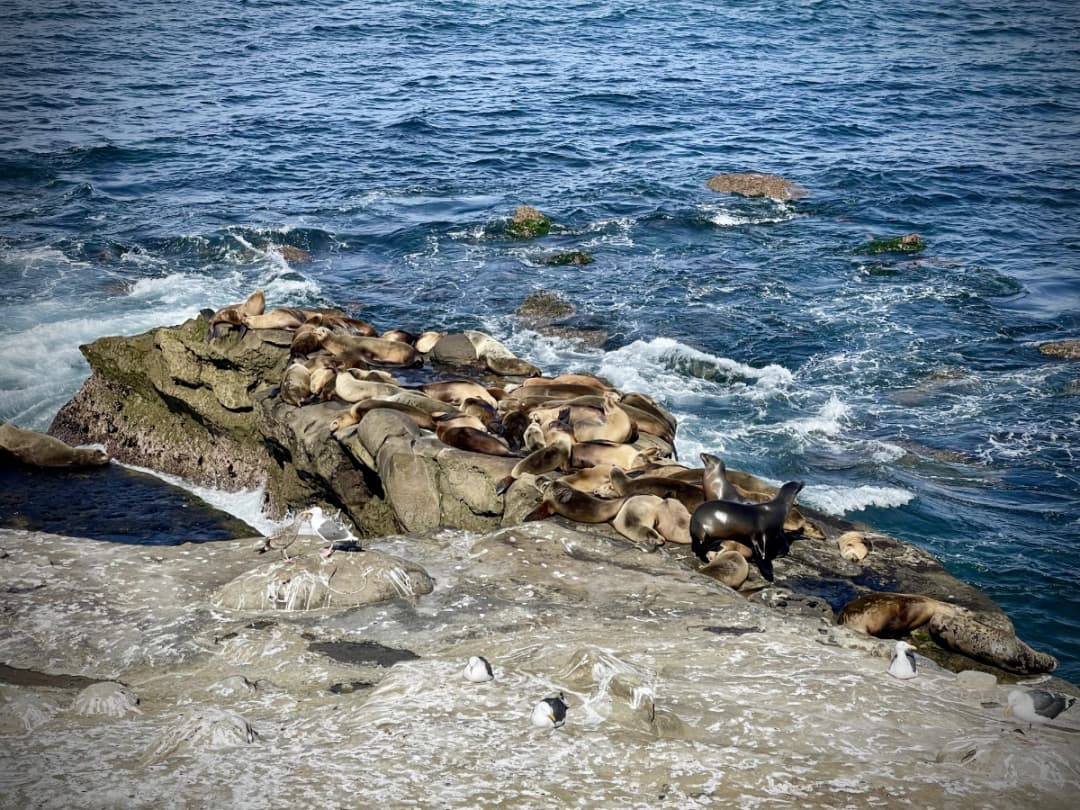
Beyond the natural allure, La Jolla Cove is framed by a quaint yet sophisticated village atmosphere, where boutique shops and art galleries invite leisurely exploration. Each store offered unique finds, from local artisan crafts to high-end fashion, making the stroll through La Jolla as much a treasure hunt as a sightseeing tour.
Dining in La Jolla was an experience unto itself, with restaurants like Cove House providing not just exquisite meals but awesome views that turned our meal into a memorable event. The culinary scene here is as diverse as it is impressive, ranging from casual seaside eateries to fine dining establishments, all capitalizing on the fresh, local produce and seafood that San Diego is renowned for.
La Jolla Cove, with its combination of stunning natural beauty, playful wildlife, and cultured dining and shopping, stood out as a highlight of my San Diego visit. It was a place where the bustling energy of the conference seemed worlds away, replaced by the calming rhythms of the sea and the laid-back elegance of the Cove's lifestyle. This enchanting locale not only provided a scenic respite but also enriched my trip with moments of reflection and appreciation for the beauty that surrounds us.
See the associated LinkedIn post.
Comments
To leave feedback or questions, simply login using your preferred social network. I will read and answer your comments promptly, but please keep in mind that they will be public.