

Introduction
Embarking on a journey to master the cloud can feel a bit like setting sail on an uncharted sea. With the wind at my back and curiosity as my compass, I recently achieved my second milestone in the realm of Amazon Web Services (AWS) by earning the AWS Certified Solutions Architect - Associate certification. This achievement follows closely on the heels of my first AWS certification, AWS Certified Cloud Practitioner, which I documented in a recent blog post. For those interested in the details of that initial foray into AWS, you can find it here.
This certification is not just another feather in my cap but a stepping stone towards the loftier goal of attaining the AWS Professional level certifications. While I've spent most of my career steering clear of the traditional IT waters, focusing instead on software development and architecture, the tides have shifted. Today's IT and cloud computing landscapes overlap so significantly with modern software development and architecture that a high-level understanding is no longer sufficient. I found myself drawn to the depths of Amazon Web Services, with a particular focus on Solutions Architecture, eager to dive deeper and emerge with a richer, more comprehensive knowledge.
It's truly remarkable to witness the vast array of out-of-the-box services provided by AWS. These services effortlessly shoulder much of the undifferentiated heavy lifting that used to bog down the process of designing and developing solutions. It's akin to having a treasure chest of tools at your disposal, each one designed to make the voyage smoother and more efficient.
In learning, you will teach, and in teaching, you will learn.
As I charted this course, I couldn't help but be reminded of a quote that perfectly encapsulates the essence of this journey: "In learning, you will teach, and in teaching, you will learn." The world of cloud computing is as expansive as the ocean, and every certification earned is a lighthouse guiding us to new horizons.
Stay tuned as I delve into the specifics of the exam, the domains covered, my preparation and learning process, and the experience of taking the exam. This voyage is far from over, and I invite you to join me as we navigate these waters together.
AWS Certified Solutions Architect - Associate SAA-C03 Exam Areas
Stepping into the realm of becoming an AWS Certified Solutions Architect - Associate is akin to taking the helm of a ship designed for the most ambitious of voyages. This certification is intended for those who play a pivotal role in shaping and crafting solutions within the AWS ecosystem. Unlike the foundational AWS Certified Cloud Practitioner certification, which provides a broad overview of the AWS Cloud, the SAA-C03 exam dives much deeper into the intricacies of designing solutions that are secure, resilient, high-performing, and cost-optimized.
The AWS Certified Solutions Architect - Associate exam is crafted to validate your ability to design solutions based on the AWS Well-Architected Framework. It tests your skills in creating architectures that not only meet current business requirements but are also scalable to accommodate future needs. With this certification, you prove your capability to review existing solutions and recommend improvements, ensuring they align with best practices in security, performance, and cost management.
To excel in this exam, the target candidate should have at least one year of hands-on experience designing cloud solutions using AWS services. This practical experience is crucial, as the exam focuses on your ability to apply theoretical knowledge to real-world scenarios.
The SAA-C03 exam covers four key domains, each with its own weight and focus areas:
- Design Secure Architectures (30%): This domain emphasizes the creation of architectures that incorporate robust security measures, ensuring that your solutions are protected against various threats and comply with relevant regulations.
- Design Resilient Architectures (26%): Here, the focus is on designing architectures that can withstand and recover from failures, ensuring business continuity and minimizing downtime.
- Design High-Performing Architectures (24%): This domain tests your ability to create architectures that deliver optimal performance, addressing latency, throughput, and overall efficiency.
- Design Cost-Optimized Architectures (20%): Finally, this domain assesses your skills in designing solutions that are not only effective but also economically efficient, leveraging AWS services to minimize costs while maximizing value.
In the following sections, we'll delve into each of these domains, providing insights and tips to help you navigate the complexities of the SAA-C03 exam. So, let's set sail on this journey and explore the depths of designing solutions with AWS.
Domain 1: Design Secure Architectures
Designing secure architectures is the cornerstone of creating robust and reliable AWS solutions. This domain focuses on ensuring that your AWS environment is fortified against potential threats and adheres to best practices in security. Here's a high-level overview of what you need to master:
- Secure Access to AWS Resources: Implement access controls and management across multiple AWS accounts, and utilize AWS federated access and identity services like AWS IAM and AWS IAM Identity Center (AWS Single Sign-On). Understand the AWS global infrastructure, including Availability Zones and AWS Regions, and apply AWS security best practices, such as the principle of least privilege. Secure IAM users and root accounts using multi-factor authentication (MFA), design flexible authorization models with IAM users, groups, roles, and policies, and implement role-based access control strategies and cross-account access.
- Secure Workloads and Applications: Protect application configurations and credentials, manage AWS service endpoints, and control network traffic. Secure application access and use appropriate AWS security services like Amazon Cognito, Amazon GuardDuty, and Amazon Macie. Design secure VPC architectures with security groups, route tables, and network ACLs, implement network segmentation strategies using public and private subnets, and integrate AWS services such as AWS Shield, AWS WAF, and AWS Secrets Manager to enhance security.
- Data Security Controls: Govern data access and manage data recovery, retention, and classification. Encrypt data at rest using AWS Key Management Service (KMS) and in transit using AWS Certificate Manager (ACM). Implement and manage access policies for encryption keys, ensure compliance by aligning AWS technologies with regulatory requirements, and establish data backups, replications, and lifecycle policies. Rotate encryption keys and renew certificates regularly to maintain data security.
Domain 2: Design Resilient Architectures
Creating resilient architectures is all about ensuring that your AWS solutions can withstand failures and recover quickly. This domain focuses on designing scalable, loosely coupled, highly available, and fault-tolerant architectures. Here's a high-level overview of what you need to master:
- Design Scalable and Loosely Coupled Architectures: Learn how to create and manage APIs using services like Amazon API Gateway, and understand the appropriate use cases for AWS managed services such as Amazon SQS and Secrets Manager. Develop caching strategies and design principles for microservices, distinguishing between stateless and stateful workloads. Embrace event-driven architectures, and understand both horizontal and vertical scaling. Utilize edge accelerators like content delivery networks (CDNs) and migrate applications into containers. Grasp load balancing concepts, multi-tier architectures, and queuing and messaging principles. Implement serverless technologies and patterns, and choose appropriate storage types. Orchestrate containers using Amazon ECS or Amazon EKS, know when to use read replicas, and manage workflow orchestration with AWS Step Functions.
- Design Highly Available and/or Fault-Tolerant Architectures: Understand the AWS global infrastructure, including Availability Zones and AWS Regions, and utilize services like Amazon Route 53 for DNS management. Familiarize yourself with AWS managed services and their use cases, basic networking concepts, and disaster recovery (DR) strategies. Apply distributed design patterns and failover strategies, and embrace immutable infrastructure. Use load balancing and proxy concepts, manage service quotas and throttling, and choose appropriate storage options. Enhance workload visibility with tools like AWS X-Ray, determine automation strategies to ensure infrastructure integrity, and select AWS services to provide high availability and fault tolerance. Identify key metrics for delivering a highly available solution, mitigate single points of failure, ensure data durability and availability, and select the right DR strategy for your business requirements. Leverage AWS services to improve the reliability of legacy applications and those not built for the cloud.
Domain 3: Design High-Performing Architectures
Designing high-performing architectures ensures that your AWS solutions are optimized for speed, efficiency, and scalability. This domain focuses on storage, compute, database, network, and data ingestion solutions that can handle demanding workloads. Here’s a high-level overview of what you need to master:
- Determine High-Performing and/or Scalable Storage Solutions: Understand hybrid storage solutions and identify the appropriate use cases for services like Amazon S3, Amazon EFS, and Amazon EBS. Familiarize yourself with different storage types, such as object, file, and block storage, and their associated characteristics. Determine storage services and configurations that meet performance demands and can scale to accommodate future needs.
- Design High-Performing and Elastic Compute Solutions: Learn about AWS compute services like AWS Batch, Amazon EMR, and AWS Fargate, and their appropriate use cases. Understand distributed computing concepts supported by AWS global infrastructure and edge services. Master queuing and messaging concepts, scalability capabilities like Amazon EC2 Auto Scaling, and serverless technologies. Develop skills in decoupling workloads to allow independent scaling, identifying metrics for scaling actions, and selecting the appropriate compute options and resource types to meet business requirements.
- Determine High-Performing Database Solutions: Gain knowledge of AWS global infrastructure, caching strategies, and data access patterns. Understand database capacity planning, connections, proxies, and engines with their use cases. Learn about database replication, types, and services, including serverless, relational, non-relational, and in-memory databases. Develop skills in configuring read replicas, designing database architectures, selecting appropriate database engines and types, and integrating caching solutions.
- Determine High-Performing and/or Scalable Network Architectures: Learn about edge networking services like Amazon CloudFront and AWS Global Accelerator. Understand how to design network architecture, including subnet tiers, routing, and IP addressing. Familiarize yourself with load balancing concepts, network connection options like AWS VPN, Direct Connect, and AWS PrivateLink. Develop skills in creating network topologies for various architectures, determining scalable network configurations, appropriately placing resources, and selecting the right load balancing strategy.
- Determine High-Performing Data Ingestion and Transformation Solutions: Understand data analytics and visualization services like Amazon Athena, AWS Lake Formation, and Amazon QuickSight. Learn about data ingestion patterns, data transfer services, and data transformation services like AWS Glue. Secure access to ingestion points, understand sizes and speeds needed to meet business requirements, and explore streaming data services like Amazon Kinesis. Develop skills in building and securing data lakes, designing data streaming architectures, implementing visualization strategies, selecting compute options for data processing, and transforming data between formats.
Domain 4: Design Cost-Optimized Architectures
Designing cost-optimized architectures ensures that your AWS solutions are not only efficient but also economically sustainable. This domain focuses on optimizing storage, compute, database, and network solutions to minimize costs while maintaining performance. Here's a high-level overview of what you need to master:
- Design Cost-Optimized Storage Solutions: Understand access options like Requester Pays object storage, and familiarize yourself with AWS cost management service features such as cost allocation tags and multi-account billing. Use tools like AWS Cost Explorer and AWS Budgets to manage costs effectively. Learn the appropriate use cases for various AWS storage services, including Amazon S3, Amazon EFS, and Amazon EBS. Develop strategies for backup, storage tiering, and data lifecycles, and determine the most cost-effective storage services and configurations to meet performance demands and scalability requirements.
- Design Cost-Optimized Compute Solutions: Learn about AWS compute services, cost management features, and purchasing options like Spot Instances, Reserved Instances, and Savings Plans. Understand distributed compute strategies and hybrid compute options. Familiarize yourself with instance types, families, and sizes, and optimize compute utilization through containers, serverless computing, and microservices. Develop skills in selecting appropriate load balancing strategies, scaling methods, and determining cost-effective compute services to meet availability and performance requirements.
- Design Cost-Optimized Database Solutions: Understand the cost management tools and features related to databases, and learn about caching strategies, data retention policies, and database capacity planning. Familiarize yourself with database engines and their use cases, database replication, and different database types and services, such as relational, non-relational, Aurora, and DynamoDB. Develop skills in designing appropriate backup and retention policies, selecting cost-effective database services and types, and migrating database schemas and data efficiently.
- Design Cost-Optimized Network Architectures: Learn about AWS cost management features, load balancing concepts, and network connectivity options like NAT gateways, private lines, dedicated lines, and VPNs. Understand network routing, topology, and peering, and the appropriate use cases for network services such as DNS. Develop skills in configuring NAT gateway types, network connections, and routes to minimize transfer costs. Determine strategic needs for content delivery networks (CDNs) and edge caching, review existing workloads for network optimizations, and select appropriate throttling strategies and bandwidth allocations.
Preparation and Learning
My journey to the AWS Certified Solutions Architect - Associate (SAA-C03) exam began with a solid foundation laid by the AWS Certified Cloud Practitioner course and exam I took earlier. Many advised skipping the Cloud Practitioner certification, but I found it immensely valuable. It provided a broad overview of AWS services and concepts, which built the momentum I needed. The repetition in some areas helped solidify key concepts, making it a good strategy for anyone looking to build a strong base.
For the SAA-C03 exam, I started my preparation in early July and ambitiously scheduled the exam for July 29th, giving myself just one month to study and practice. This was an incredibly short amount of time for such a comprehensive exam, and I wouldn't recommend this timeframe to others. Ideally, 2-3 months would be more appropriate. I was very diligent, breaking up 60 hours of video training over two weeks, followed by another week and a half of practice exams and study. If you have a good background and can commit to speed learning, one month is doable, but not ideal for most people.
For training, I took Adrian Cantrill's AWS Certified Solutions Architect - Associate (SAA-C03) course, which was part of his AWS Associate and Professional Bundle. This bundle includes three associate AWS courses—Solutions Architect, Developer, and SysOps—and two professional AWS courses—Solutions Architect and DevOps. Valued at $280, the bundle provides everything you need to pass all three associate level certifications and both professional level certifications, offering a comprehensive foundation for interviews and real-world scenarios. The Solutions Architect - Associate course was about 60 hours long, covering all core AWS services and aligning with the new SAA-C03 exam structure. The high-quality production, real-world scenarios, labs, and constant updates made this course exceptional. Watching the videos at 2x speed, the diagrams and visuals significantly aided my learning. As a bonus, this course overlaps with many other AWS certifications. By taking this course, you gain much of the knowledge needed for other associate and professional-level AWS certifications.
Despite some gripes with the Teachable platform—such as issues with offline mode on the app and the lack of autoplay working consistently — the course content was top-notch. After two weeks of video training and hands-on labs, I used Tutorials Dojo practice exams for the SAA-C03. Initially, the questions were challenging, but this site is a must-have for any AWS certification exam. The detailed explanations for right and wrong answers prepared me well, simulating real-world scenarios.
In the final week before the exam, I consistently scored over 90% on all practice exams. Tutorials Dojo's Final-Test, a unique set of 65 items from their 400+ question bank, was particularly effective. Their cheat sheets and study path were excellent tools for reviewing the material as well. However, my only issue with Tutorials Dojo is their lack of a native mobile app. AWS Skill Builder also offers a free practice exam and sample questions, though they are less extensive than Tutorials Dojo's.
Furthermore, I found excellent notes on GitHub that complemented the Adrian Cantrill course, particularly this repo. Reading the official SAA-C03 exam guide thoroughly, especially the task statements for each exam domain, boosted my confidence and ensured I was reviewing relevant topics.
In addition to these resources, I found the Reddit subreddit r/AWSCertifications incredibly helpful. It's a vibrant community where people share their certification journeys, offer tips, and provide support. Reading some of the posts was particularly motivational and helped keep me focused and encouraged throughout my preparation.
By the end of this intensive preparation, I felt well-equipped to tackle the SAA-C03 exam confidently, having gained not only the knowledge to pass the exam but also the practical skills needed to design and implement AWS solutions in real-world scenarios.
Taking the Exam
I took the AWS Certified Solutions Architect - Associate (SAA-C03) exam at a Pearson Vue Testing Center located at West Chester University. Having taken my previous certification exam there, I knew it was a good testing environment, and being my alma mater, it's always fun to return.
I had heard that the actual exam was supposed to be easier than the Tutorial Dojo practice exams, but I had the complete opposite experience. Leading up to the exam, I was scoring 90%+ on Tutorials Dojo practice exams and also took the AWS online practice questions, which seemed easier in comparison. However, the actual test was a beast. It felt like the algorithm selected a particularly challenging version of the exam, with heavy questioning on RDS edge cases.
Honestly, I did not feel great during the exam. On the TD practice exams, I typically finished with 30 minutes to spare, but for the actual exam, I finished with only 5 minutes remaining. The exam was 130 minutes long and consisted of 65 questions, many of which were long and complex.
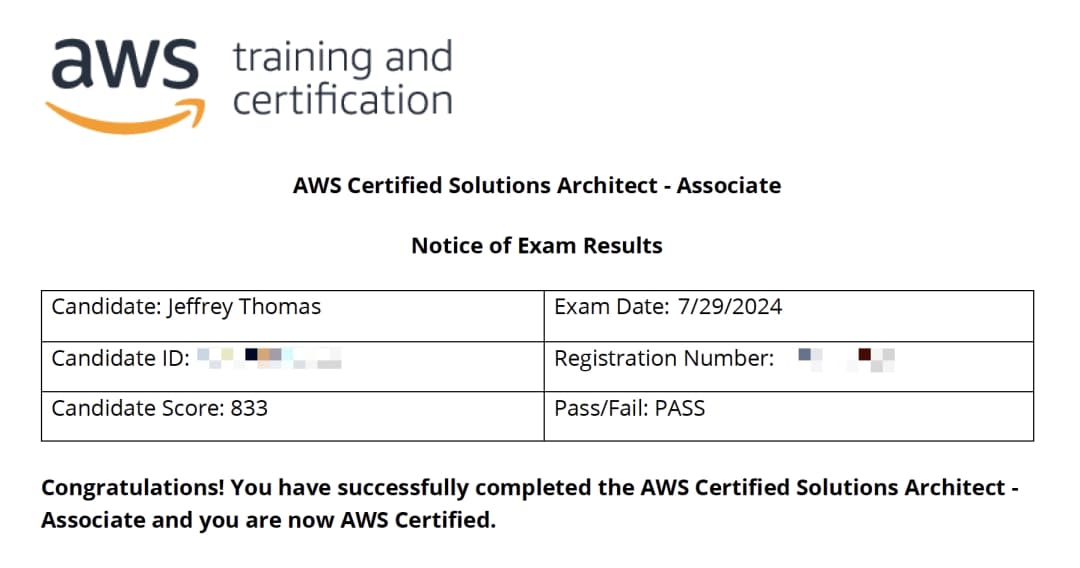
I received my results via email and within the AWS Certification Center about four hours after completing the exam. I passed with a score of 833/1000! The AWS Certified Solutions Architect - Associate (SAA-C03) has a scaled score between 100 and 1,000. The scaled score needed to pass the exam is 720.
Conclusion
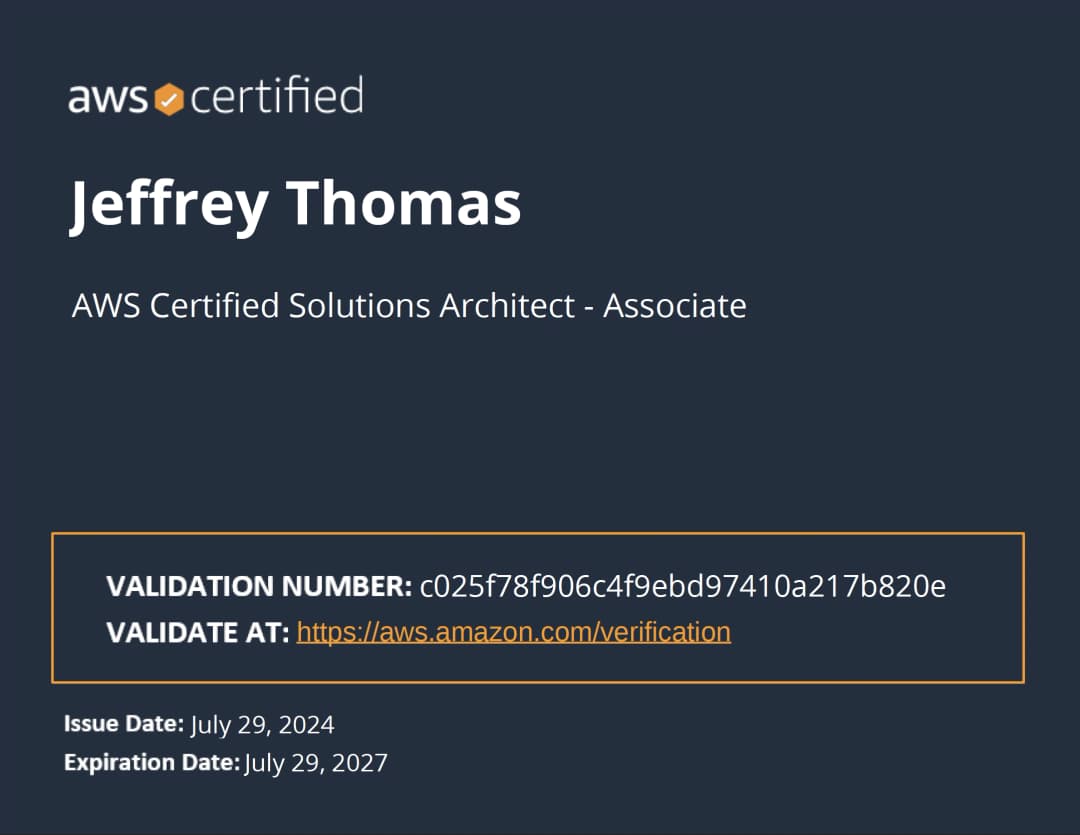
Achieving the AWS Certified Solutions Architect - Associate certification has been a rewarding and challenging journey. Starting with a solid foundation from the AWS Certified Cloud Practitioner course, I built up the momentum needed to dive deep into AWS services and concepts. Despite the ambitious one-month timeline for preparation, I managed to master the course material, practice extensively, and ultimately succeed in passing the exam with a score of 833/1000.
The preparation process was intense, involving 60 hours of video training, hands-on labs, and numerous practice exams. Resources like Adrian Cantrill's comprehensive course and the Tutorials Dojo practice exams were invaluable, as were the motivational stories and tips shared by the community on the r/AWSCertifications subreddit.
Taking the actual exam at West Chester University, my alma mater, was a fitting culmination of this journey. Despite the challenging nature of the exam, particularly the unexpected complexity of the questions, I was able to complete it successfully, reinforcing the importance of thorough preparation and resilience.
Now, as I take a little time off to enjoy the rest of the summer, I'm eagerly planning my next steps. I'm contemplating whether to go straight to the AWS Certified Solutions Architect - Professional certification or explore another Associate certification first. Either way, I'm excited to continue expanding my AWS expertise and advancing my career in cloud computing.
Thank you for following along on this journey. If you're preparing for an AWS certification, remember that persistence, thorough preparation, and leveraging the right resources are key to success. Happy learning!
Verify My Credential
You can verify my AWS Certified Solutions Architect - Associate certification through Credly or directly via AWS Verification using my verification number. To check my credential, visit the Credly verification page or use the AWS Certification Verification tool. This will confirm the authenticity of my certification and provide additional details about my AWS Solutions Architect - Associate status.
See the associated LinkedIn post.
Comments
To leave feedback or questions, simply login using your preferred social network. I will read and answer your comments promptly, but please keep in mind that they will be public.